AI with Michal

Semantic search

Search that ranks by meaning and similarity (often embeddings) rather than exact keyword match, so "React front-end" can surface profiles that only say "UI engineer with hooks".

Michal Juhas · Last reviewed May 2, 2026

What is semantic search?

Semantic search ranks results by meaning and similar wording, not only by exact keywords. Two different job titles can still match when they describe the same kind of work.
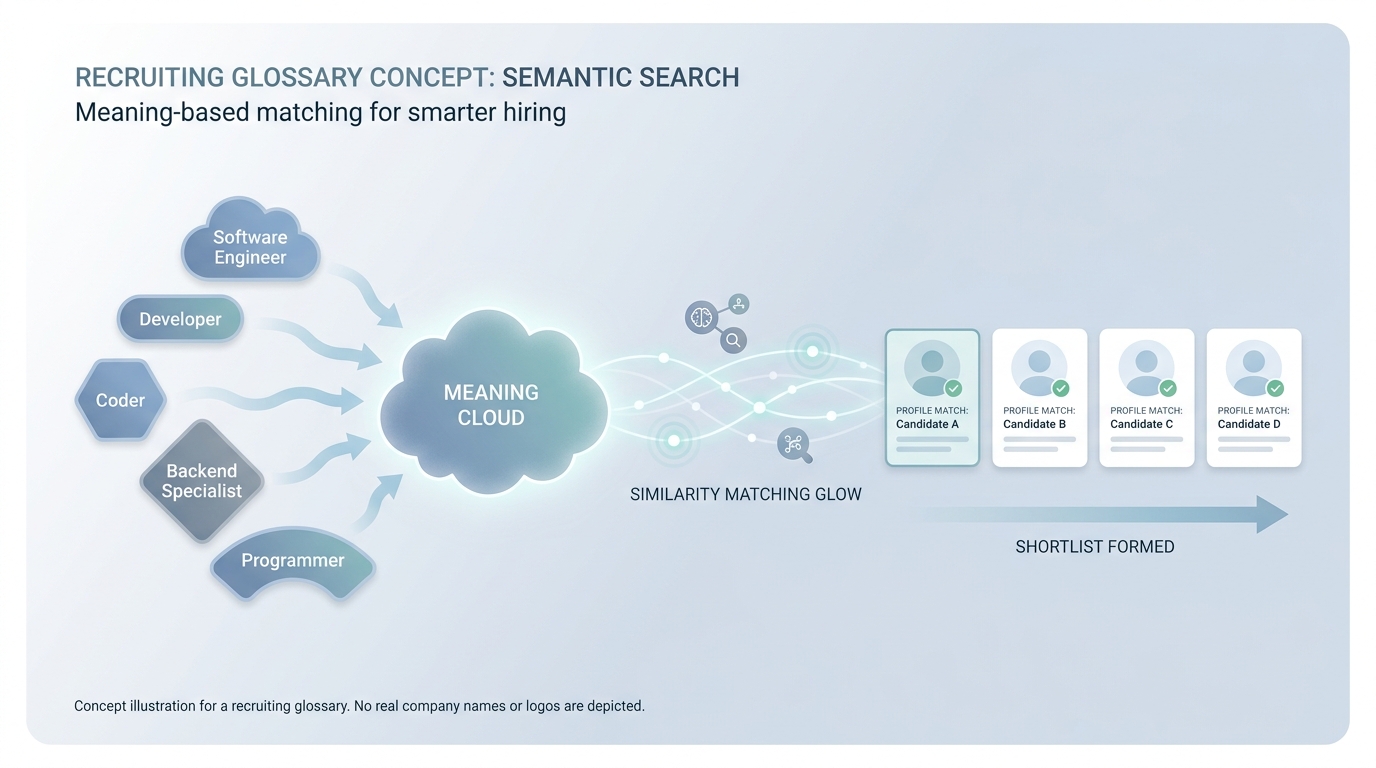
Illustration: Meaning-based clustering of job titles leading to a matched shortlist of profiles

In practice

  • Job boards show "jobs like this one" even when titles do not match word for word; that recommendation leans on meaning, like semantic search. Recruiters notice it when one portal surfaces "customer success" roles for an "account manager" search.
  • Talent products market "AI matching" or "similar profiles" when they rank people by meaning instead of exact strings. You hear that language in vendor demos and in TA tool bake-offs.
  • Sourcers say "this database gets synonyms better than literal LinkedIn search" when they explain why a shortlist surfaced different wording than they typed.

Quick read, then how hiring teams use it

This is for recruiters, sourcers, TA, and HR partners who need the same vocabulary in debriefs, vendor calls, and policy reviews. Skim the first section when you need a fast shared picture. Use the second when you are deciding how it shows up in the ATS, sourcing tools, or candidate communications.

Plain-language summary

  • What it means for you: Semantic search finds "things like this" even when the words differ, like recommendations that know "customer success" is close to "account manager."
  • How you would use it: You type a short job story, you scan suggestions, you still read profiles.
  • How to get started: Run the same req twice: once with literals only, once with "similar" toggled on, compare who surfaces.
  • When it is a good time: When Boolean gives zero or nonsense because titles are creative, not wrong.

When you are running live reqs and tools

  • What it means for you: Semantic search maps text to vectors (or similar representations) for ranking and near-duplicate detection. Thin profiles and buzzwords still poison signals.
  • When it is a good time: When sourcing automation APIs expose embeddings or "match" endpoints worth monitoring.
  • How to use it: Pair with Boolean search slices for explainability, log vendor ranking changes.
  • How to get started: Read Boolean search vs AI sourcing and build one hybrid workflow on paper.
  • What to watch for: Black-box "AI matched" without receipts, and multilingual drift when English-only models rank non-English titles.

Where we talk about this

Sourcing automation conversations compare APIs versus "just prompting" for discovery. Semantic search sits in the API-heavy world: clean inputs, stable identifiers, monitoring when providers change ranking. We walk examples at Workshops.

Around the web (opinions and rabbit holes)

Third-party creators move fast. Treat these as starting points, not endorsements, and double-check anything before you wire candidate data.

YouTube

Reddit

Quora

Literal Boolean versus semantic

NeedPrefer
Exact cert or employer stringBoolean
Synonyms and adjacent skillsSemantic
Explainable shortlist to legalBoolean slice + human read

Related on this site

Frequently asked questions

When should semantic search lead and when should Boolean lead?
Let Boolean search or structured filters handle must-haves (location, authorization, level band, hard exclusions) so you do not rank noise you should have removed. Use semantic ranking inside that slice to float similar wording and adjacent skills sourcing workshops see in the wild. The order matters for explainability: literals answer "why is this person in the set" for legal and hiring managers. Re-evaluate after provider ranking changes, which happens more often than teams expect. Keep a lightweight log that ties each campaign to index version, embedding model, and the Boolean slice used first, so you can reproduce shortlists if compliance asks. When sourcers disagree with the ranker, capture five counterexamples in a shared doc and revisit exclusions quarterly.
How is this different from asking ChatGPT to "find similar profiles"?
Productized semantic search uses embeddings and indexes tuned for scale, reproducible scores, and logging you can defend in audits. Ad hoc chat is great for exploration but weak for repeatability unless you log prompts, sources, and reviewer overrides. Vendor stacks also expose knobs (freshness, diversity constraints) chat lacks. If you cannot reproduce a shortlist next week for compliance, you are not running production search yet. Treat chat exports as untrusted prototypes until you wire the same query through your monitored stack with named owners. In hiring, slips show up as outreach misfires and uneven candidate experience, not only bad CSV rows.
What are the main quality risks?
False positives from generic buzzwords, domain ambiguity ("Python" the language versus the snake in odd corpora), and English-centric embeddings on multilingual markets. Thin profiles amplify noise because vectors extrapolate from a handful of generic lines. Always spot-check the tail of results and log known-bad examples to tune exclusions. Pair semantic rankers with human spot audits until error rates stabilize per role family. Bias can creep in when training data over-represents certain geographies or titles, so pair qualitative hiring manager feedback with precision checks by role family. Vendor solutions engineers can help tune negative lists once you share anonymized misses with clear business impact.
Can semantic search replace reading profiles?
No. It changes reading order, not accountability. Humans still decide fit, outreach tone, and compliance. Pair with hallucination hygiene when models summarize what they retrieved, because summaries can smooth over missing must-haves. Teach sourcers to treat top ranks as "read first," not "trust completely." Log a weekly sample of tail results with hiring managers so you tune exclusions with evidence, and keep vendor release notes when ranking models change so you can explain shifts in shortlists during audits. For leadership reporting, show literal-gate hit rate versus semantic rerank so stakeholders see where duplicate effort drops without hiding human accountability.
How does this relate to RAG?
Both use embeddings, but semantic search ranks candidates or documents for discovery while RAG retrieves chunks to answer questions with citations. Many stacks combine the two: semantic for shortlists, RAG for policy Q&A. Do not conflate the analytics or you will buy the wrong product. Document which index holds people versus policy so GDPR reviews stay clear. When procurement wants one tool to do both, insist on separate data paths, retention rules, and evaluation sets because mixing corpora confuses explainability and trains teams on the wrong failure modes. Your DPO should see a one-page diagram before you expand either path.
What should we read next?
Read Boolean search vs AI sourcing and AI sourcing tools for recruiters, then compare vendors in the tools directory with your actual markets. Bring a req where literals failed so peers can discuss hybrid patterns instead of ideology. Schedule a one-hour working session with sourcers, TA ops, and one hiring manager to replay the same search with and without semantic rerank, capturing screenshots for your enablement wiki. Follow with hallucination and RAG entries if assistants summarize profiles for coordinators. If you want live practice, join a workshop cohort where we stress-test edge cases before you change production SLAs.
Do we need to store embeddings in the EU?
Treat embeddings derived from people as personal data subject to your DPO or counsel guidance on regions, retention, and purpose limitation. Vendor defaults are not legal advice; document decisions when you replicate candidate vectors cross-border. Align deletion workflows when candidates request erasure so indexes do not resurrect ghosts. If you cannot explain where vectors live, pause expansion. Map subprocessors, standard contractual clauses, and whether re-embedding happens on delete, then store that packet beside your DPIA so audits do not depend on one engineer's memory. Regional teams should know how to freeze a campaign if counsel flags a new model trained on data you cannot justify.

← Back to AI glossary in practice