AI for Sourcers
Sourcing on the AI adoption ladder: Boolean plus AI, verification habits, sequence discipline, example climbs from Chatting to Systemizing before Automating outreach.

If this is your job
You turn ambiguous asks into lists people believe in, then turn lists into outreach that earns replies. Speed matters, but sourcers lose credibility faster than anyone when a prospect spots a lazy mail merge, a wrong employer, or a detail that was never true. You also live on the AI adoption ladder: personal synonym hunts (Chatting) versus a desk playbook anyone can run (Systemizing).
This page is for sourcers and sourcing-focused recruiters who need implementation clarity. You feel the ladder in your fingertips: Chatting when you spin up synonyms in a new tab each morning versus Systemizing when your intake doc, Boolean seeds, and sequence shells live in one place your backup can run. The cornerstone section ties those habits to the same rungs TA uses so you do not automate junk outreach.
How to think about AI in sourcing
Verification and precision apply at every rung; the cornerstone section tells you whether you are stuck in Chatting with raw synonyms or Systemizing shells others can ship.
Semantic exploration complements Boolean; it does not replace discipline. Use semantic tools when you map unfamiliar titles or industries. Tighten with filters and strings once you understand the landscape.
Personalization needs evidence. AI drafts faster sentences; you still attach one verified proof point per prospect when you claim relevance.
Verification beats cleverness. Before send, confirm employer, role, and dates on a primary source. Models confidently stitch plausible fiction.
Measure conversations, not touches. Qualified replies and screens sourced per hour of research beat raw InMail counts.
Where the pressure actually shows up
Title and taxonomy drift. The same role carries different labels by company, stack, and region. Leadership still asks for volume KPIs while you care about conversation quality.
Tool churn. Boolean stacks, filters, semantic search experiments, and enrichment vendors each have learning curves. Without a written intake, you bounce between methods and blame the model.
Proof over personalization. Inmail templates multiply; candidates tune them out. Personalization without evidence (a talk, a repo, a real product launch) reads hollow.
Compliance and platform rules. Scraping, enrichment, and automated sequencing walk tight lines. "AI said it was fine" is not a defense.
Research depth versus req load. You are graded on pipelines and time-to-submit, but quality sourcing is thinking time plus verification.
Signal decay. Everyone runs similar AI outreach; differentiation returns to research depth and specificity.
Where you are on the AI adoption ladder (cornerstone)
Start here. Sourcing is where Chatting ("give me fifty synonyms") gets mistaken for strategy. The AI adoption ladder matters because Automating bad outreach scales insults faster than manual mistakes. Your stages: Offline → Chatting → Systemizing → Automating → AI-Native. Most sourcers should fight for Systemizing (shared intake, shells, verification hooks) before they wire sequences to APIs.
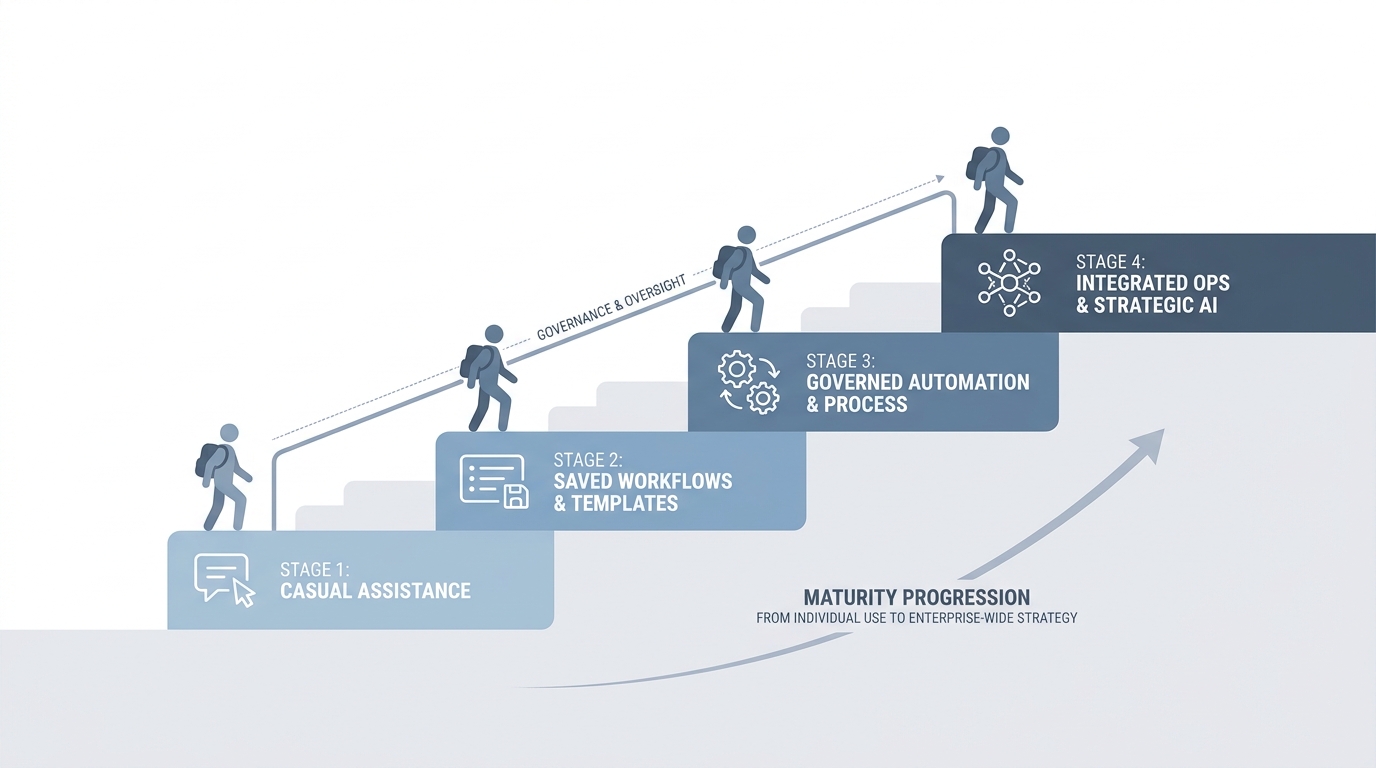
Explore the stages interactively on the AI adoption ladder page. Link hiring discussions to the AI adoption ladder glossary entry when leadership wants bots before intake exists.
Signals sourcers often recognize
- Offline: Pure Boolean muscle; no drafting assist (nothing wrong with that if volume is low).
- Chatting: Fresh prompts daily; great one-offs; zero handoff when you are out.
- Systemizing: Living intake doc with version history; Boolean seed lists tested in sandbox; sequence shells with mandatory proof slots; experiment spreadsheet shared with recruiters.
- Automating: Sequencing or enrichment tools only after shells stabilized; human approve column before third touch; bounce handling reviewed weekly.
- AI-Native sourcing: Market map and search plan are generated from structured intake fields; you spend time on verification and conversation, not reinventing the brief.
Example climbs
- Chatting → Systemizing (this week): Save your three best prompts into one page with placeholders for intake facts; run A/B from that base only.
- Systemizing → Automating: Connect enrichment export to a sheet with a human_ok column; never auto-send the third touch until someone ticks the box.
- Toward AI-Native: Hiring managers cannot widen filters without updating the intake doc version linked from your search notes.
Compare yesterday's workflow to the cues on AI adoption ladder before you blame "the model."
High-leverage use cases (with examples)
Intake clarification. Turn a vague Slack thread into a target profile: must-have signals, nice-to-haves, geographic reality, and compensation band language your recruiter can defend. You still validate with the hiring manager; AI shortens the loop.
Example: "Staff engineer who gets things done." Push back with a structured ask: ownership scope, stack, level anchor against two internal comps, remote posture. Bring that one-pager to a ten-minute sync before you burn LinkedIn credits.
Synonyms and adjacent titles. Models suggest language to test in your stack when you move across industries. You still run strings inside the tool and trim noise.
Market maps and landscape questions. Who hires this profile locally? Which employers compete hardest for this stack? Use AI for orientation, then verify claims against primary sources before you cite them to a candidate or executive.
Example: Ask for a longlist of likely employers in-region, then manually verify headcount signals on careers sites and news. Treat the first map as hypothesis, not fact.
Sequence shells. Build three blocks you reuse: open (why you, why now), proof (one specific artifact), ask (clear CTA). Example open line slots you fill manually: name their conference talk and the date, not "I was impressed by your profile." Example proof: point to a public repo or post and one pattern that matches your team migration. Example ask: "Are you open to a fifteen-minute call Tuesday or Wednesday afternoon CET?" Generate five variants of each block from one intake paragraph; send yourself test emails; kill anything that sounds like marketing.
Notes that transfer. Handoff template your recruiter can paste into ATS notes in under ninety seconds:
- Source: LinkedIn Recruiter search
title:(engineer) AND skills:(kafka); profile URL. - Why now: shipping real-time pipeline cited in their blog post dated June.
- Risk: No evidence of people leadership; flag if we need lead behaviors.
- Screen focus: Ask for war story on on-call rotation and how they handled data loss incident.
Ask the model to compress your messy research scratchpad into those four bullets; you verify URLs before save.
Boolean scaffolding. Ask for synonyms for one title cluster at a time (e.g. "platform engineer" versus "infrastructure engineer"), paste into a sandbox search, count noise before you add OR clauses. Example failure mode you catch early: the model adds "site reliability" and your results flood with irrelevant contractors; delete that synonym after you see the preview.
Conference and alumni recon. Paste public agenda CSV or speaker list; ask for a table "Name | Talk title | Why relevant to our Kubernetes migration req." Click through to confirm each person still works where the agenda says; agendas go stale. Then prioritize five names for deep research before any outreach.
Deep dives: Boolean search vs AI sourcing, AI sourcing tools for recruiters. Tools pages such as LinkedIn Recruiter, LinkedIn Sales Navigator, and Perplexity for quick public fact checks often sit in the same stack.
Glossary anchors: Boolean search, semantic search, outbound talent sourcing, sourcing funnel metrics.
What we often see strong sourcers do
They keep a living intake doc per hard req with version notes when the hiring manager moves the goalposts. Format that works: Google Doc or Notion page with headings Target profile, Out of scope, Version history (date, what changed, who approved). When the HM says "actually staff level," you append version note July ninth and rerun searches instead of silently widening filters.
They tag experiments: subject line A versus B on fifty prospects each, hold audience constant. They track qualified replies, not vanity opens. Spreadsheet columns: subject variant, send date, replied yes or no, entered screen yes or no. Sort by screen rate, not reply rate, when replies are polite brush-offs.
They pair with recruiters on debrief when conversion drops; usually intake drift, not search skill. Fifteen-minute triage questions: "Did the HM change level without telling us?" "Did we start messaging before new comp approval?" "Did we reuse a sequence written for a different region?"
They escalate ethical gray areas early (for example diversity filtering suggestions from tools) instead of improvising. Escalation template: "Tool suggests filtering by X; here is screenshot; here is our policy line on protected attributes; need Legal opinion before we enable."
What tends not to work
Fully automated outreach loops without daily human spot checks on tone and truth.
Trusting enrichment vendors without spot verification. Bad phone numbers and employer mismatches still happen.
Chasing every new "agent" launch without fixing intake. Agents amplify weak briefs faster.
Blanket semantic "lookalike" lists without reviewing why someone matched. You spam adjacent profiles and hurt sender reputation.
A simple rollout shape
Week one: fix intake template for your top two reqs. Use the same five headings as in intake clarification: must-have signals, nice-to-haves, geo, comp band language, dealbreakers.
Week two: ship two outreach shells (cold and referral-intro styles) with mandatory proof slots. Add a line in the template that says to paste a real blog title and URL, and check that line is filled before you send.
Week three: run weekly retro on thirty messages: what earned replies worth a screen? Tag each reply "scheduling," "not interested," "referral." Look for patterns by industry or title cluster.
Week four: tune strings or shells based on evidence, not intuition alone. Example decision: if opens are high but screens are zero, kill subject line humor and try plain descriptive subjects for twenty sends before you touch the body.
Where teams get hurt
Platform terms and regional rules still govern scraping and enrichment. Diversity shortcuts dressed as AI filters can violate policy fast.
Burned domains and reputations come from automated blasting, not from careful pairing of AI drafts with human edits.
When semantic search returns "lookalikes," pressure-test why the model linked them. Otherwise you spam adjacent profiles and damage sender reputation.
Grab the Sourcing Tools Guide PDF from the resources hub when you want a shareable overview for stakeholders.
Courses, live sessions, and consulting on AI with Michal
Courses. First Principles Sourcing is built for this profile: sourcing discipline first, AI second. Pair it with Starting with AI when your team needs aligned foundations across tools. Claude for Recruiters and Better Prompts for Recruiters help when those stacks match yours.
Live sessions. Dates and formats on Sourcing Lab.
Teams. Private sourcing intensives for agencies and in-house pods: AI sessions for teams.
Consulting. For advisory that maps your sourcing stack, sequences, and governance without vaporware, see Recruiting AI Workflow Advisory. Hands-on implementation partnerships live under consulting, including 1-on-1 Individual AI Implementation Mentoring. Custom scopes often start through contact.
Membership. membership keeps you current after training.
FAQ
- What is the first step sourcers should take this week with AI?
Freeze one intake template and one outreach shell with mandatory proof slots. Use AI to tighten synonyms and sequence variants only after the brief is stable. Measure qualified replies per hour of research, not sends.
- Should sourcers rely on AI to build Boolean strings?
Use AI to suggest synonyms and adjacent titles, then test strings inside your tool and trim noise. Precision filters still matter for compliance-heavy searches and when titles are overloaded.
- What tools usually sit in a sourcer stack with AI?
Your search platform (for example LinkedIn Recruiter or Sales Navigator), an approved chat assistant for drafting, and optional enrichment vendors you verify spot-by-spot. No new tool fixes a vague intake.
- What is a better weekly metric than messages sent?
Track qualified conversations and screens sourced per hour of research. Volume without conversion usually means weak intake or generic outreach, not a model problem.
- What should sourcers avoid when scaling outreach?
Avoid third-touch automation before humans review tone and truth. Avoid semantic lookalike lists without checking why each person matched. Avoid enrichment data in prompts until you confirmed employer and role on a primary source.
- How do I recognize lazy AI personalization candidates will mock?
If you cannot point to one specific fact you verified (talk, repo, product launch), it is mail merge with extra steps. Generic praise without proof burns reply rates and reputations.
- When is it worth hiring external sourcing or recruiting AI help?
Engage help when intake keeps drifting, when Legal questions your sequences, or when you need a desk-wide playbook across regions. Email hello@aiwithmichal.com with volume, industries, and stack. See recruiting AI workflow advisory and broader consulting options.
- Where can sourcers go deeper on training?
First Principles Sourcing plus live workshops. Starting with AI helps if the whole desk needs the same baseline.
Skill bundles that pair with this role
Packaged skills and integration paths in the store help you move from one-off prompts to repeatable workflows. Browse bundles below or explore the full skill bundles catalog.
No matching bundles in the catalog from this device. Open the store or skill bundles to see what is available.
For teams
Private workshops and implementation support for rolling out AI responsibly across TA and HR.
AI workshops for teamsTeaching notes based on workshop delivery and recruiting practice. Tools and regulations change; verify current employer policies and vendor terms before production use.