Using personality tests for hiring
The practice of selecting a validated trait instrument, placing it at the right funnel stage, and routing scores through a documented human review step so personality data informs decisions without replacing structured evaluation or obscuring group pass rates.
Michal Juhas · Last reviewed May 15, 2026
What is using personality tests for hiring?
Using personality tests for hiring means selecting a validated instrument, placing it at the right stage in the funnel, and treating scores as one input among several rather than as a ranking mechanism. The most defensible path starts with criterion validity: evidence that the specific trait predicts performance for your role family, not just for a general population. A conscientiousness measure that works for sales roles may add no signal for technical or creative roles, and using it anyway creates adverse impact risk without any offsetting prediction benefit.
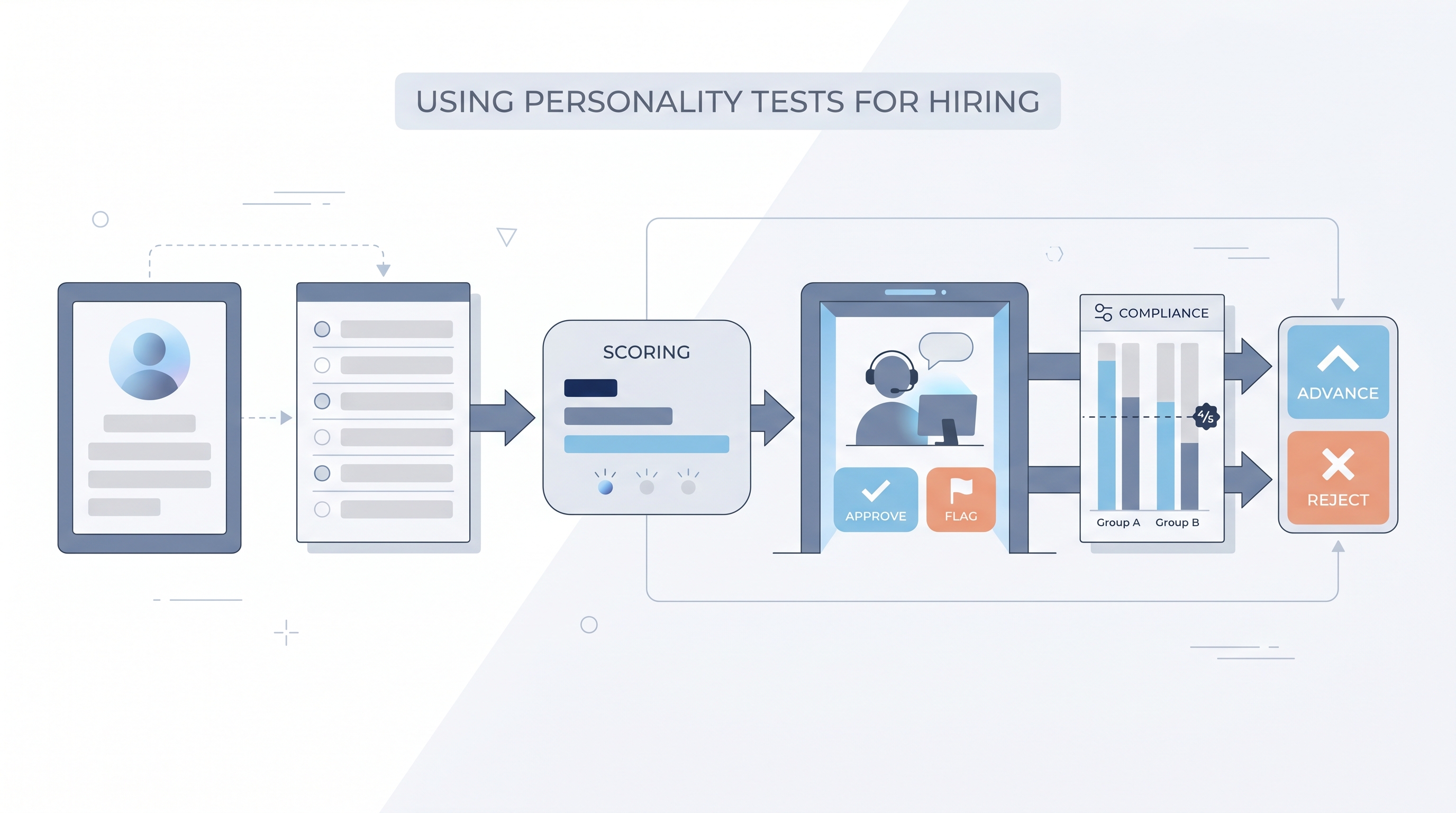
The practical steps are: choose a validated instrument, set a funnel position after at least one human screen, route scores through a documented review gate, log group pass rates from the first hire, and correlate scores to your own performance ratings after 20 or more closed roles. Each step is doable without an IO psychologist on staff, but each step also requires someone to own it.
In practice
- A TA manager preparing to deploy a conscientiousness screen for a high-volume customer service role runs a pilot on 30 past hires first, correlates their scores to manager ratings at six months, and presents the correlation coefficient to legal before going live.
- A recruiter on a debrief call receives the personality report after all panelists have shared structured observations, not before, so scores do not anchor the conversation before direct evidence is on the table.
- An HR director reviewing a quarter-end hiring audit spots that the personality filter pass rate for one demographic group is 62 percent of the pass rate for the majority group, triggering a vendor conversation about the norming sample before the next intake cycle opens.
Quick read, then how hiring teams use it
This is for recruiters, sourcers, TA, and HR partners who need shared language in vendor reviews, debrief rooms, and quarterly audits. Skim the first section for a shared picture. Use the second when you are deciding how a personality layer connects to live reqs, ATS steps, and compliance reporting.
Plain-language summary
- What it means for you: Using a personality test in hiring means choosing a tool that was built and tested for your type of role, placing it after an initial screen, and treating the score as one piece of evidence alongside structured interviews and work samples.
- How you would use it: Pick one trait your scorecard already names as critical for the role, find a validated measure of that trait, and run it as an optional data point before the panel stage.
- How to get started: Ask your current vendor or shortlist whether they have a technical validity report for your role family. If they do not, request one before signing. If they cannot produce one, look at vendors that publish peer-reviewed criterion validity studies.
- When it is a good time: After you have a named trait that matters for the role, after legal or HR has reviewed the lawful basis (GDPR in the EU), and after you have a plan for logging group pass rates from day one.
When you are running live reqs and tools
- What it means for you: In a live workflow, personality scores appear as ATS fields or vendor dashboards. Without explicit rules about when a score can flag or advance a candidate, it becomes a silent automated gate that nobody audits.
- When it is a good time: After the pilot correlation is positive and after the human-in-the-loop gate is documented in writing: who sees the scores, in what order, and what a low score triggers (investigate, override, or reject with documented reason).
- How to use it: Keep assessment version and model version in the candidate record. Run the four-fifths check every quarter. Separate the score field from the advance or reject field in your ATS so an audit can show the two decisions were made independently.
- How to get started: Integrate the tool API into your ATS or export pipeline so scores land in the same record as interview notes. Assign a compliance owner who reviews group pass rates monthly for the first six months of any new assessment deployment.
- What to watch for: Vendors who bundle personality scoring with AI inferred from video or text without a separate validity study for that inference layer. Bundled claims are harder to audit and harder to defend if challenged. See AI bias audit for the questions to ask.
Where we talk about this
On AI with Michal live sessions the legal and ethics modules of the AI in recruiting track cover personality tests as a concrete case study in responsible tooling: how to read a technical manual, how to run a pass-rate audit, and how to brief a sceptical hiring manager on why the score is one input, not a ranking. If you want the peer discussion with real vendor names and real data, join a session at Sourcing Lab.
Around the web (opinions and rabbit holes)
Third-party creators move fast. Treat these as starting points, not endorsements, and verify any vendor-specific claims before deploying a tool.
YouTube
These open search results pages; use Filters - Upload date to find recent content. Mix IO psychology research with employment law explainers.
- Personality tests in hiring validity research (criterion validity, Big Five, what peer-reviewed validation actually means for selection decisions)
- Big Five personality hiring predictions (conscientiousness, emotional stability, and which traits generalise across role types)
- AI personality assessment bias hiring (inferred trait scores from video or text versus validated questionnaires, and the risks involved)
- EEOC adverse impact personality test (US legal framing, Uniform Guidelines, and group pass rate obligations)
- r/IOPsychology is the practitioner and researcher community for discussions on which instruments have defensible criterion validity for specific role types.
- r/recruiting captures real recruiter experience with personality tools: vendor claims, hiring manager pushback, and practical audit stories.
- r/humanresources surfaces HRBP perspectives on policy, lawful basis documentation, and candidate feedback on assessment experience.
Quora
- Quora search: personality tests hiring effectiveness brings together practitioner and academic perspectives on when these tools add value and when they create legal exposure; quality varies, so read critically.
Validated tool checklist
| Criteria | What to ask the vendor | Why it matters |
|---|---|---|
| Criterion validity | What does this trait predict, for which role family? | A general validity claim does not apply to your role |
| Norming sample | How many, what industry, what seniority? | Norms built on one group do not transfer cleanly to another |
| Adverse impact data | Pass rates by race, gender, and age from the norming study | Required under EEOC Uniform Guidelines for any selection tool |
| Inference method | Is the score from self-report or AI inference from behaviour? | Inferred scores have weaker validity and higher bias risk |
| Version tracking | Can I see which version produced a given score? | Needed for audit trails and complaint investigations |
Related on this site
- Glossary: Personality test for employment, Adverse impact, AI bias audit, Human-in-the-loop (HITL), Scorecard, Async screening
- Blog: AI sourcing tools for recruiters
- Live cohort: Sourcing Lab
- Membership: Become a member