AI with Michal

Scorecard

A structured rubric (traits, levels, evidence prompts) that tells recruiters and hiring managers what "good" looks like before interviews, so screening stays consistent and model-assisted drafts have something true to rest on.

Michal Juhas · Last reviewed May 2, 2026

What is a scorecard?

A scorecard is a simple grid that says what "good" looks like for a role before interviews start. Recruiters and hiring managers score against the same traits and examples so feedback stays fair and comparable.
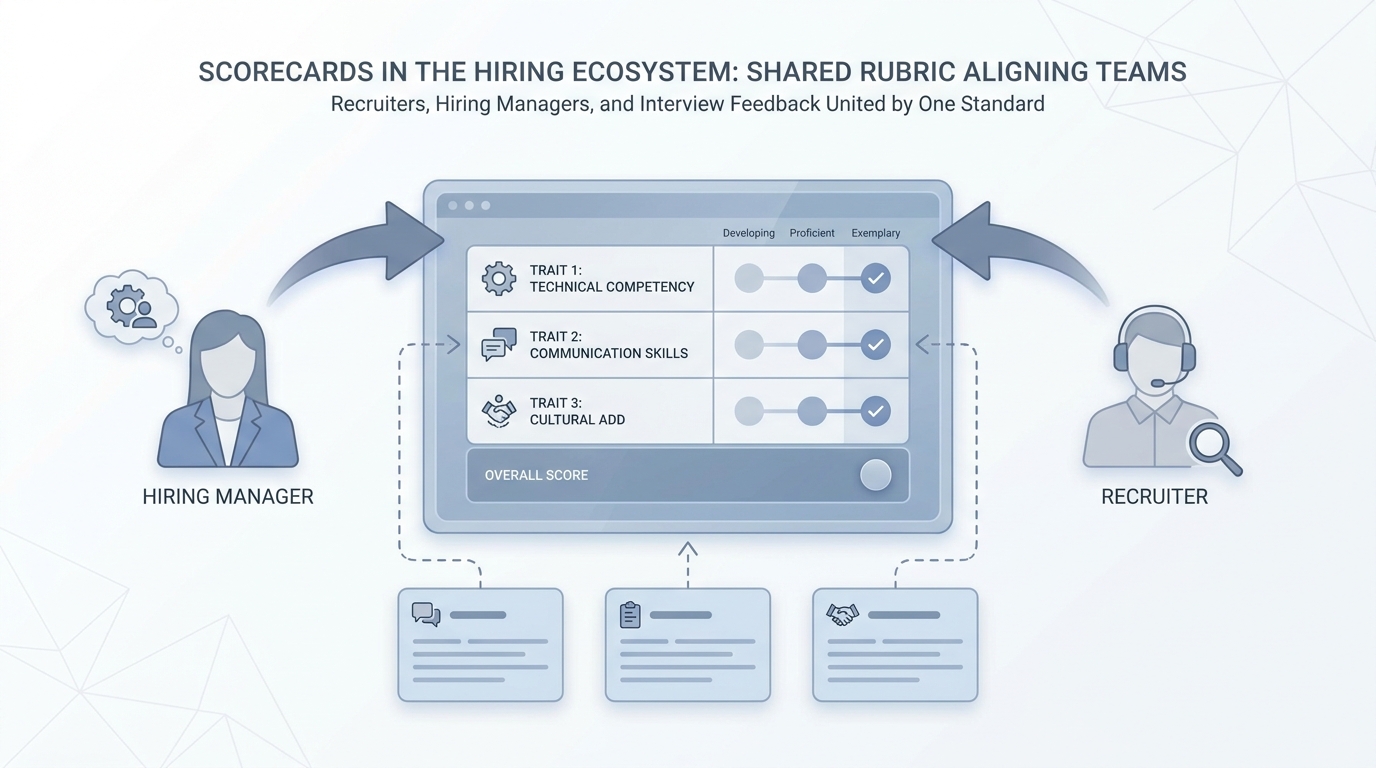
Illustration: A shared scorecard grid aligning hiring managers, recruiters, and interview notes

In practice

  • Hiring managers see a one-page grid labeled "what strong looks like" before interviews on a senior hire. Training courses called it a scorecard or rubric long before AI tools showed up.
  • After debriefs, two recruiters compare notes using the same trait names, which cuts "we felt different things" fights. People say "let's align on the scorecard" in calibration meetings.
  • When someone asks ChatGPT to score a resume, the traits should already live in a doc the team agreed on. Otherwise the numbers look official but mean nothing in the room.

Quick read, then how hiring teams use it

This is for recruiters, sourcers, TA, and HR partners who need the same vocabulary in debriefs, vendor calls, and policy reviews. Skim the first section when you need a fast shared picture. Use the second when you are deciding how it shows up in the ATS, sourcing tools, or candidate communications.

Plain-language summary

  • What it means for you: A scorecard is the same short list of criteria every interviewer marks so debriefs compare apples to apples.
  • How you would use it: You read the job, you pick five behaviors that matter, you stick to them in every loop.
  • How to get started: Steal one scorecard from a hiring manager who already believes, pilot on the next three candidates.
  • When it is a good time: When debriefs are "I liked them" versus "I did not vibe" and leadership wants fairness language.

When you are running live reqs and tools

  • What it means for you: Scorecards are structured evidence: competencies, rating anchors, and behavioral examples. They pair with structured output when models draft pre-reads, not decisions.
  • When it is a good time: When you connect AI-native practices to legally defensible processes.
  • How to use it: Train interviewers on anchors, audit variance across panels, and forbid free-text-only notes for final decisions.
  • How to get started: Read Greenhouse or internal enablement templates, then localize to your bar.
  • What to watch for: Score inflation, duplicate criteria that correlate 1:1, and AI "scores" shipped without human calibration.

Where we talk about this

AI in recruiting workshops use scorecards as the bridge between model drafts and hiring-manager trust. If your rubric is messy, bring redacted examples to Workshops.

Around the web (opinions and rabbit holes)

Third-party creators move fast. Treat these as starting points, not endorsements, and double-check anything before you wire candidate data.

YouTube

Reddit

Quora

Scorecard versus unstructured notes

ArtifactHiring signal qualityModel usability
Freeform notesVariableLow
ScorecardCalibratableHigh
Scorecard + examplesHighest teaching valueBest for few-shot

Related on this site

Frequently asked questions

What belongs on a hiring scorecard?
Must-have capabilities, nice-to-haves, anti-patterns, and level definitions tied to observable behaviors hiring managers can probe in interview. Avoid vague buckets like "culture fit" unless you translate them into behaviors and evidence prompts diverse panels can use consistently. Add guidance on how notes flow to the ATS so debriefs stay comparable across weeks. Review scorecards when the role family or tech stack shifts materially, and archive old versions so RAG and humans do not mix rubrics accidentally. Name an owner who updates the rubric when marketing rewrites the JD, and map each trait to a sourcing signal so scorecards reward evidence, not keyword stuffing. Flag sensitivity (executive, regulated) early so privacy and DEI partners review language before models see it.
How do scorecards help AI-assisted screening?
They give models structured labels and short rationale fields aligned to traits humans already agreed matter, which pairs with structured output to reduce free-form invention. Quality still depends on verification: numeric scores are prompts to investigate, not decisions. Log model version and reviewer overrides so you can audit drift. When scorecards are fuzzy, AI only scales ambiguity faster. Run monthly calibration sessions where recruiters compare model suggestions to human notes on the same five anonymized profiles, then adjust anchors instead of blaming the model silently. Publish which traits are pilot-safe for automation versus which always require panel review so coordinators do not improvise thresholds under pressure.
Who should write the first draft?
Hiring manager plus recruiter together, then TA enablement for calibration across teams. HM-only drafts may encode bias without peer review; TA-only drafts drift from real work on the floor. Run a pilot debrief with anonymized notes to see if interviewers actually use the same anchors. Publish a lightweight approval workflow so updates do not live in one person's inbox. For executive or regulated roles, add legal and DEI sign-off checkpoints tied to documented business justification, not ad hoc Slack threads. Store the approved PDF or Markdown in your agent knowledge base so assistants and humans cite the same version after midnight hotfixes.
How often should scorecards change?
When the role family, stack, level, or market materially changes, and always tie updates to req refreshes so downstream prompts and agent knowledge base files stay aligned. Archive old versions with dates in filenames or Git tags so retrieval and trainers do not cite stale rubrics. Quarterly review is a sensible default for fast-moving orgs; slower businesses may go semi-annual. Communicate changes to sourcers the same week they ship. Trigger an out-of-cycle review after a failed hire, a spike in panel disagreement, or a vendor model upgrade that changes how summaries map to traits. Keep a short changelog your enablement team can narrate in standups without burying people in version numbers.
What is the ethical line for automated scoring?
Models may suggest, humans decide, and you log overrides with reasons accessible to compliance review. Automated rejection without oversight is high risk for fairness and for hallucination-driven mistakes on short signals. Publish how candidates can appeal or request human review when automation plays a role. If you cannot explain a score to a candidate in plain language, do not automate it. Track disparate impact indicators where counsel allows, and pause automation when appeals cluster around the same trait or model version. Train interviewers to document why they disagreed with a suggestion so product and legal can learn from real edge cases, not only aggregate dashboards.
Can we use a simple numeric fit score from a model in a spreadsheet?
Yes as a draft aid when the score maps to observable scorecard traits, uses structured output, and triggers human review before outreach. Add filters in workflow automation so low-confidence rows never auto-send. Treat numbers as prompts to investigate, not as hiring decisions, and calibrate weekly with hiring managers on false positives. Log which prompt version produced each score. Freeze the sheet schema when finance audits begin, and keep a parallel tab that records who overrode a score so downstream reporting does not pretend every cell was untouched automation. Teach coordinators that conditional formatting is not a substitute for governance.
Where can we learn more about AI plus screening?
Read AI candidate screening with your policy partners, walk hiring managers through Guides, and join a workshop for live calibration on tricky roles. Bring redacted scorecards that caused debate so the group practices evidence-based language, not arguments about taste alone. After class, assign one recruiter plus one HM to pilot the rubric on the next three reqs, capturing before-and-after debrief notes your TA ops lead can share internally. Pair reading with async screening and hallucination entries so automation owners understand how scores surface to candidates. If you need deeper prompt hygiene, skim few-shot prompting before you wire models to live traffic.
Do scorecards replace structured interviews?
No. They guide them. Scorecards tell you which signals to probe with behavior-based questions; interviews still need skilled follow-up and diverse panels where possible. AI can summarize answers against rubric rows, but humans judge nuance, context switching, and integrity signals machines miss. Update interview guides when scorecards change so panels are not asking obsolete probes. Keep a short bridge doc that maps rubric rows to interview prompts so new panelists ramp quickly and model drafts do not invent questions you never aligned on with legal.

← Back to AI glossary in practice