Data room and due diligence when selling a recruitment agency
A structured collection of financial, operational, and legal documents that agency owners prepare so a prospective buyer can verify the business before committing to an offer price.
Michal Juhas · Last reviewed May 5, 2026
What is a data room and due diligence when selling a recruitment agency?
When a recruitment agency owner decides to sell, the transaction process has two related but distinct phases. The first is preparing a data room: a secure, indexed collection of documents that gives a prospective buyer everything they need to understand the business before making an offer. The second is due diligence: the buyer's structured investigation of those documents to verify the claims made in the sales process.
For agency owners, these two phases often arrive at the same time and feel like one overwhelming exercise. In practice, the sellers who navigate it best start the data room preparation 12 to 18 months before they expect to close. Documents built under deal pressure tend to have gaps, and every gap gives a buyer a reason to reduce the price.
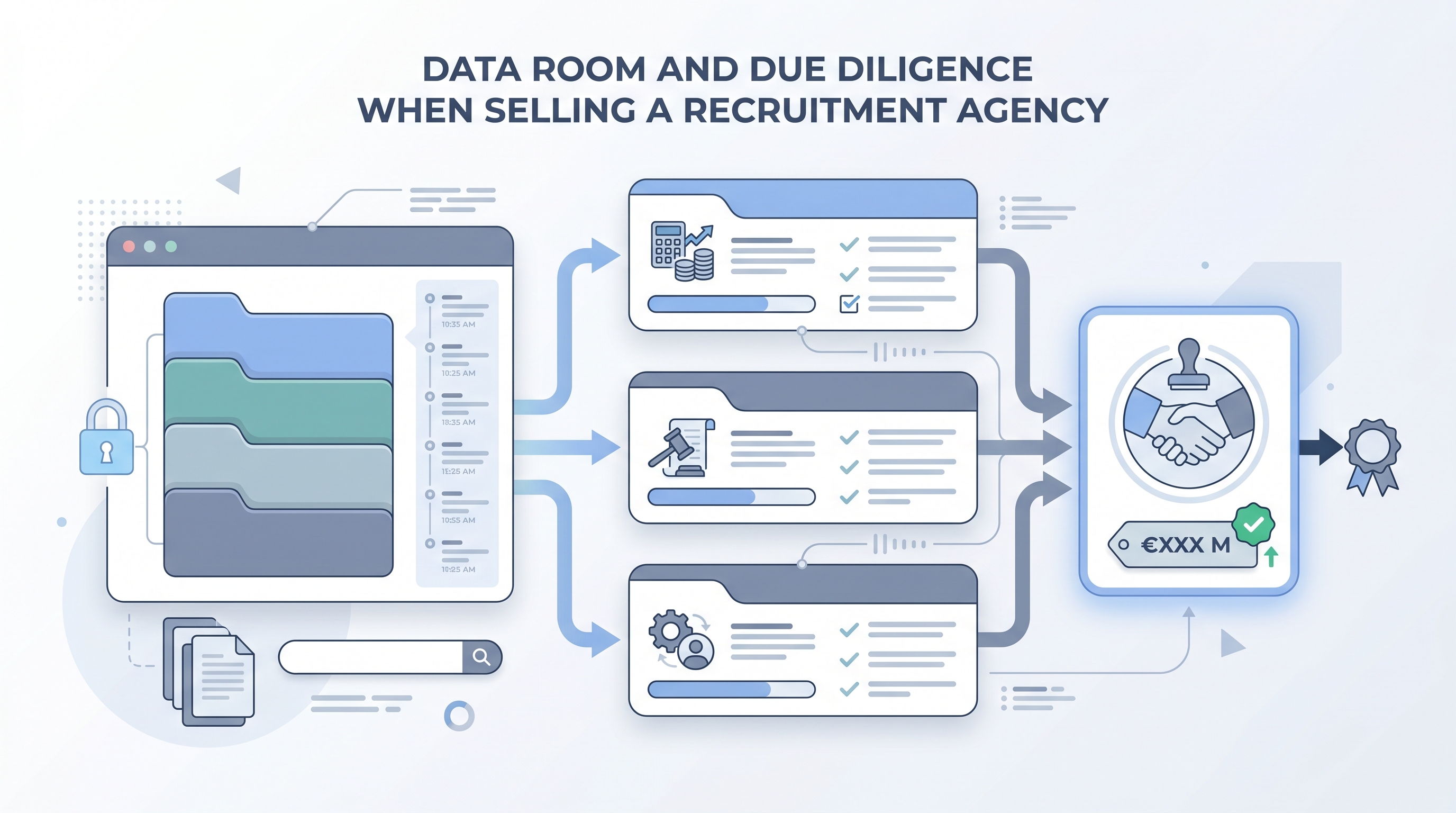
A well-prepared data room covers five areas: financials, client relationships, team and employment, operating processes, and legal standing. The depth of each section will vary by buyer type, but the index structure should be consistent and complete from the first day of access.
In practice
- An agency founder preparing for a management buyout builds a data room in a shared document tool six months before the first buyer call. When the buyer's financial adviser requests three years of management accounts, she sends the link immediately, which signals operational maturity and keeps the deal timeline on track.
- A buyer reviewing a mid-size perm and contract desk discovers that two of the top three clients have verbal-only retainer arrangements with no signed terms. The absence of written contracts is flagged as concentration risk and the buyer adjusts the offer price downward by 15%.
- A recruiter turned agency owner uses an AI assistant to compare his current data room index against a standard M&A document checklist. The model flags that his team employment agreements lack post-termination non-solicitation clauses, which he addresses with his employment solicitor before going to market.
Quick read, then how hiring teams use it
This page is for agency owners preparing to sell, for TA leaders who work inside or alongside agencies and want to understand the transaction vocabulary, and for acquirers running a structured search for a recruitment business. Skim the first section for the definitions. Use the second when you are setting up a data room or entering active diligence.
Plain-language summary
- What it means for you: A data room is the organised folder of documents a buyer needs to verify your agency before committing to a price. Due diligence is the process they use to check everything in it.
- How you would use it: Build the index before you start the sale process. Buyers who wait for documents lose confidence and use the delay to renegotiate.
- How to get started: List every revenue source, client contract, employment agreement, and open legal matter on one page. That list becomes your data room index. Assign one person to own completeness.
- When it is a good time: 12 to 18 months before you expect to close. Documents prepared under deal pressure are riddled with gaps that buyers use to chip the price.
When you are preparing to sell and running the business simultaneously
- What it means for you: Most agency owners enter a sale process while still running full client and candidate operations. Data room preparation competes with live req delivery, which is why pre-preparation matters. The more complete your data room on day one of buyer access, the shorter the diligence period and the less disruption to your team.
- When it is a good time: Start with financials and employment contracts, which take longest to assemble and verify. Client contracts and CRM exports can follow once the core financial picture is clean.
- How to use it: Grant buyer access to sections in sequence rather than all at once. Financial and commercial sections first, legal and HR second. This controls the pace of questions and prevents a buyer from jumping to a sensitive area before you have context ready.
- How to get started: Use workflow automation to set calendar reminders for document reviews and version updates. A living data room is easier to maintain than one you rebuild from scratch when a buyer appears.
- What to watch for: Change-of-control clauses in client contracts, employment agreements without restrictive covenants, candidate data stored in personal email threads rather than a GDPR-compliant recruitment agency software system, and normalised EBITDA that has not been independently verified.
Where we talk about this
On AI with Michal live sessions, agency economics and exit readiness come up in the AI in recruiting track when participants who own or work closely with agencies ask how to use AI to systematise operations before a transaction or review. The Sourcing Lab cohort covers agency business model design alongside sourcing automation, so consultants and owners can align on vocabulary and operational readiness well before a sale process begins.
Around the web (opinions and rabbit holes)
Third-party creators cover recruitment agency M&A, data room preparation, and due diligence from legal, financial, and operational angles. These are starting points, not endorsements. Verify any template or clause language with a qualified accountant and solicitor before using it in a live transaction.
YouTube
- How to sell your recruitment agency surfaces practitioner walkthroughs of what buyers look for and how sellers prepare for a sale process in the staffing and executive search sector.
- Recruitment agency valuation and EBITDA covers how financial advisers calculate and normalise EBITDA multiples for staffing businesses across different market segments.
- M&A data room best practices includes deal advisers and corporate lawyers explaining how to structure and manage a virtual data room for a mid-market business sale.
- Selling a recruitment agency experiences in r/RecruitmentAgencies covers real experiences from agency owners who have been through sale processes, including what buyers scrutinised most.
- EBITDA normalisation in staffing deals in r/recruiting surfaces discussions on what multiples are realistic and what financial adjustments buyers typically make.
- Due diligence checklist for small business sale in r/smallbusiness is a recurring reference thread with practitioner-contributed document lists adaptable to a recruitment business context.
Quora
- How do recruitment agencies get valued for acquisition? collects practitioner opinions on valuation multiples, EBITDA normalisation, and what buyers prioritise across agency types.
Data room versus confidential information memorandum
| Document | Purpose | Who prepares it | When it is shared |
|---|---|---|---|
| Confidential information memorandum (CIM) | High-level overview of the business for initial buyer interest | Seller or M&A adviser | Before NDA and LOI |
| Data room | Full evidence base for buyer verification | Seller with adviser support | After NDA, usually after LOI |
| Management accounts | Detailed financial records for diligence | Seller with accountant verification | Inside the data room |
| Employment contracts | Legal agreements covering consultant terms and restrictions | Seller | Inside the data room |
Related on this site
- Glossary: Business development for recruiting agencies, Rebate and clawback clauses on placement fees, Recruitment agency software
- Glossary: Workflow automation, Human-in-the-loop, Talent acquisition metrics
- Guides: Sourcers
- Workshops: Sourcing Lab
- Course: Starting with AI: the foundations in recruiting
- Membership: Become a member