Business development (BD) for recruiting agencies
The process an agency recruiter or dedicated BD consultant runs to identify, approach, and convert companies into fee-paying clients, covering prospecting, outreach, pitch calls, and account expansion.
Michal Juhas · Last reviewed May 5, 2026
What is business development (BD) for recruiting agencies?
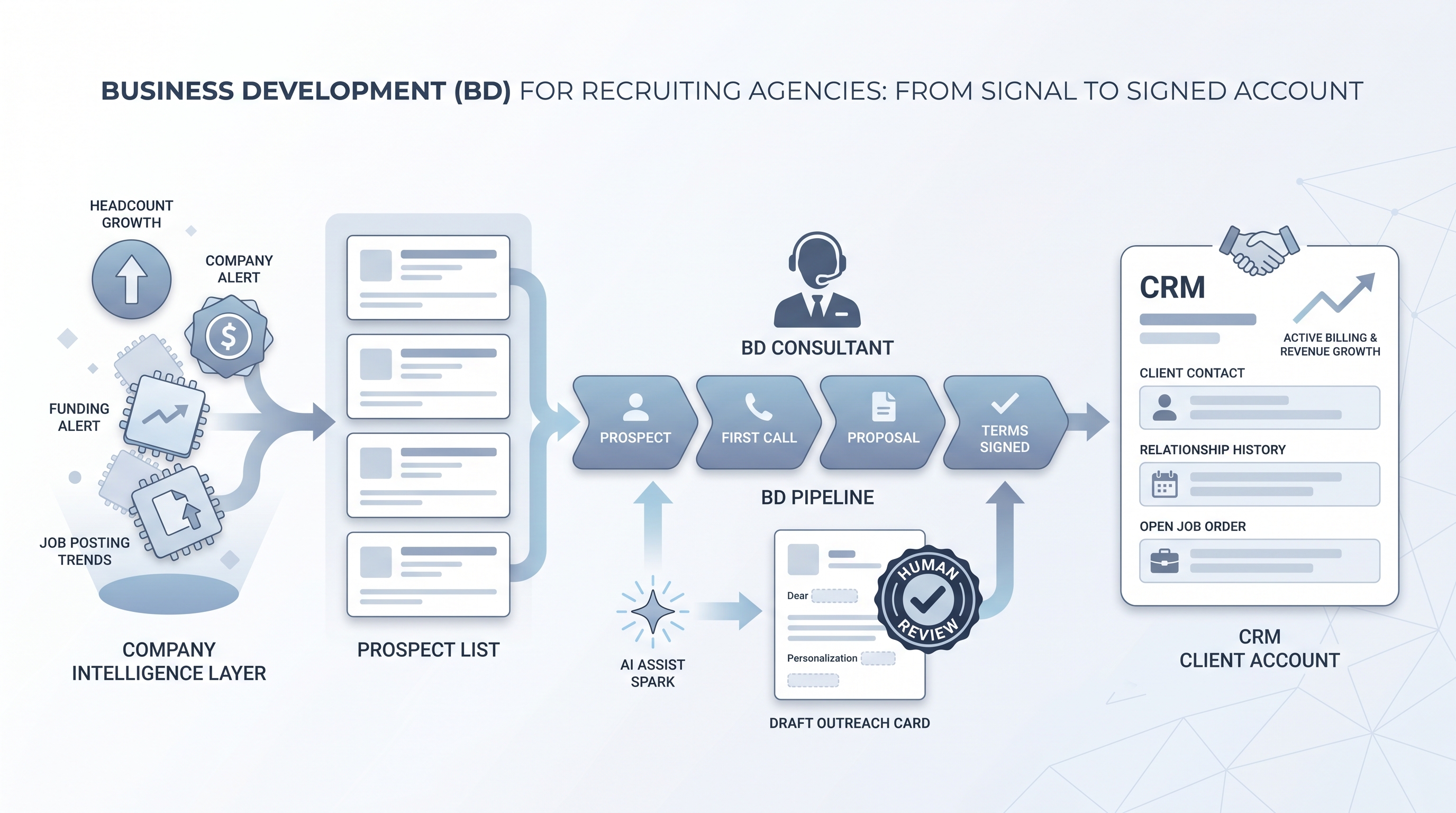
Business development in a recruiting agency is the work of building and expanding the client side of the business: identifying companies that need to hire, reaching the right decision-makers, and converting those conversations into signed fee agreements. It sits alongside delivery (sourcing, screening, placing) as one of the two core functions that keep an agency running.
A BD consultant typically manages a prospect list, tracks where each target sits in a pipeline from first contact to terms signed, and works to stay relevant between active reqs so the call comes to them before it goes to a competitor. The role requires relationship skills that AI cannot replace, but AI can compress the research and admin work that used to fill the first hour of every BD session.
In practice
- A senior consultant at a boutique tech agency spends the first thirty minutes of each morning scanning job postings and company news for accounts that recently crossed fifty employees or announced a funding round. They call that list their "warm signals." AI tools can surface the same list automatically from a company intelligence feed.
- A BD director describes "working the desk" as simultaneously running active placements and nurturing ten to fifteen prospect accounts, knowing that two or three will convert to job orders in any given month. Keeping that ratio healthy is a calendar and CRM discipline, not a luck problem.
- A recruitment manager says a consultant "lost the account" when a competitor responded faster to a live job posting, even though the agency had been courting that company for months. Speed to a live role often wins the first instruction.
Quick read, then how hiring teams use it
This is for agency recruiters, BD managers, and operations leads who want a shared vocabulary for the client side of an agency business and for where AI fits into it. Skim the first section for the definition. Use the second when you are evaluating tools or setting BD workflow policy.
Plain-language summary
- What it means for you: BD is how an agency gets new clients. It is the prospecting, calling, and pitching work that fills the job order pipeline that delivery teams then work to place.
- How you would use it: Research a target company, reach the hiring decision-maker, present the agency's track record in the relevant niche, and negotiate a fee agreement before the next role goes live on a job board.
- How to get started: Pull your last ten placements and identify what the client companies had in common in the year before they became clients. That pattern is your best prospecting filter. Run it against a company database or a job posting feed.
- When it is a good time: Any time delivery is running well and the job order pipeline looks thin for the next quarter. BD works best when it is proactive, not triggered by a quiet month.
When you are running live reqs and tools
- What it means for you: BD that uses AI signal feeds (company growth alerts, job posting monitors, funding announcements) can surface warm accounts before competitors do. The signal is only as useful as the CRM discipline behind it.
- When it is a good time: After your CRM has clean account records, a defined owner per account, and a suppression list that prevents duplicate outreach. Adding automation to a messy CRM produces a faster mess.
- How to use it: Use AI to generate a research brief on a target account before a first call, to draft an opener based on a specific growth signal, and to summarize call notes into CRM fields. Keep relationship-critical messages human-written and reviewed. See workflow automation for the pattern of where to place AI drafting steps versus automation triggers.
- How to get started: Run a prompt against one target company this week: feed the company's recent job postings and public news into the model and ask for three facts a BD consultant would find useful before a first call. Verify the output before using it on a real call.
- What to watch for: AI-drafted messages that reference stale or incorrect company data, outreach sent to suppressed accounts because the suppression list was not wired to the outreach tool, and CRM note fields left empty because the consultant relied on memory rather than logging the call that day.
Where we talk about this
On AI with Michal live sessions, agency BD questions surface across the AI in recruiting and sourcing automation tracks: how to use AI for company research, how to build a prospect signal feed without expensive proprietary tools, and where the outreach review gate should sit before messages reach senior-level contacts. If you want the full room conversation with peers running agency desks, start at Sourcing Lab and bring a real BD sequence or a specific account you are trying to crack.
Around the web (opinions and rabbit holes)
Third-party creators cover BD in staffing and executive search from a range of angles. These are starting points, not endorsements. Verify any tool or tactic before wiring it to your CRM or outreach sequences.
YouTube
- Business development in recruitment agency surfaces practitioner walkthroughs of cold calling, LinkedIn outreach, and fee negotiation from agency recruiters in the chair.
- Recruiting agency new client tips covers phone-first BD habits that still work in a message-saturated market.
- How top recruitment agencies win new clients shows strategic account targeting and relationship-building approaches from agency leaders.
- Business development tips for a boutique agency in r/RecruitmentAgencies covers practical prospecting and cold outreach questions from working agency recruiters.
- How do you handle BD while also doing delivery? in r/recruiting is a recurring discussion about the tension between running placements and building new client relationships simultaneously.
- AI tools for recruiting agency BD surfaces the current tool landscape from practitioners using AI for prospect research and outreach drafting.
Quora
- How do recruitment agencies get new clients? collects practitioner opinions on prospecting, referrals, and inbound lead generation across agency types and sizes.
BD pipeline versus in-house TA pipeline
| Aspect | Agency BD pipeline | In-house TA pipeline |
|---|---|---|
| Goal | Convert a company into a fee-paying client | Fill an approved internal requisition |
| Owner | BD consultant or business development manager | Recruiter or TA partner |
| CRM use | Client relationships, job orders, fee agreements | Candidate stages, hiring manager notes |
| AI fit | Prospect research, outreach drafting, signal feeds | Screening summaries, scheduling, sourcing |
| Revenue tie | Direct: placement fee or retainer | Indirect: cost per hire reduction |
Related on this site
- Glossary: Recruitment agency software, Outbound talent sourcing, Workflow automation, Human-in-the-loop, Recruiting email automation, Proprietary talent pool
- Glossary: Hiring funnel conversion rates, Talent acquisition metrics, Recruiting prompt library
- Blog: AI sourcing tools for recruiters
- Guides: Sourcers
- Workshops: Sourcing Lab
- Course: Starting with AI: the foundations in recruiting
- Membership: Become a member