Retainers and escrow for search engagements
A retainer is an upfront non-refundable payment a client makes to a recruiting agency to secure exclusive, dedicated time for an executive or specialist search. Escrow arrangements hold milestone payments in a neutral account until agreed delivery criteria are met.
Michal Juhas · Last reviewed May 5, 2026
What are retainers and escrow for search engagements?
A retainer in recruiting means the client pays a portion of the total fee upfront, before any candidate names are surfaced. The payment reserves the agency's exclusive attention for the search and compensates them for the research, sourcing, and qualification work that begins on day one. Unlike contingency arrangements, where the agency earns nothing until placement, a retainer creates shared financial commitment from both sides.
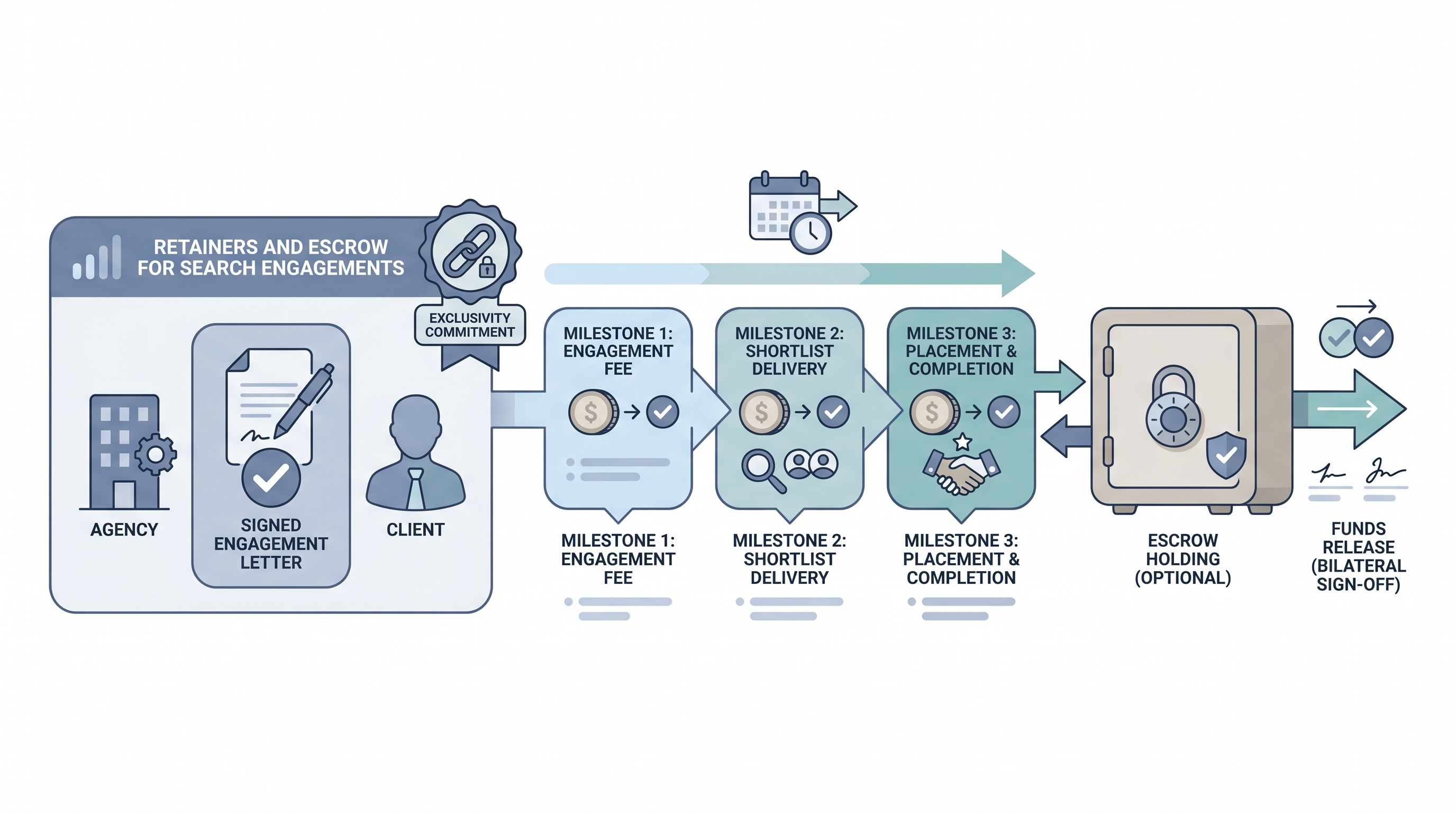
The standard structure splits the total fee into thirds: one third on signing the engagement letter, one third on presenting a qualified shortlist, and the final third on the successful candidate accepting an offer or starting in the role. These milestones and what counts as satisfying each one need to be defined in writing before the search begins.
Escrow enters the picture on high-value or cross-border searches where a client wants additional protection. Rather than paying milestone installments directly to the agency, the funds sit in a neutral third-party account and are released only when both parties confirm delivery. Escrow arrangements are not standard in most mid-market retained searches, but they are a reasonable ask when the fee is significant and the relationship is new.
In practice
- A technology company retaining a search firm to hire a Chief Revenue Officer pays the first installment on signing. When the agency presents four shortlisted candidates six weeks later, the second payment is triggered. One candidate accepts an offer twelve weeks after engagement, and the final third is invoiced the same day.
- An agency principal working on a cross-border CFO search for a private equity firm agrees to an escrow arrangement. All three milestone payments are held in an independent account. Each release requires a written sign-off from both the client and the agency partner, preventing disputes about whether a shortlist met the agreed criteria.
- A TA leader reviewing a retained search engagement letter before signing notices that the milestone trigger for the second payment says "shortlist presented" with no minimum candidate count or quality criteria. She requests the agency add a clause specifying at least three qualified candidates, each with a two-page assessment summary, before the second installment is released.
Quick read, then how hiring teams use it
This page is for agency principals and consultants building their retained search practice, for TA leaders and HR directors commissioning an executive or specialist search, and for in-house lawyers or procurement teams reviewing agency engagement letters. Skim the first section for the vocabulary. Use the second when you are negotiating terms or tracking an active retained search.
Plain-language summary
- What it means for you: A retainer is the upfront fee that commits an agency exclusively to your search. You pay part of it whether the search succeeds or not, in exchange for dedicated resource and a structured delivery process.
- How you would use it: Agree payment milestones and delivery criteria in writing before signing. The first third on engagement, second on shortlist, final on acceptance is the standard, but the exact trigger definitions matter more than the percentage split.
- How to get started: Ask the agency for their engagement letter template before negotiating the fee rate. The milestone delivery criteria and cancellation terms have more financial impact than a one-point difference in fee percentage.
- When it is a good time: When the role is senior, confidential, or genuinely hard to fill using a contingency agency that will deprioritise the search whenever a faster placement appears elsewhere.
When you are running an active retained search
- What it means for you: Retained income changes your firm's cash flow profile and creates a higher-stakes client relationship than contingency work. Milestone documentation, exclusivity tracking, and clear escrow conditions (if applicable) need to be managed as separate operational tracks from the day of signing.
- When it is a good time: Move to retained structures when you have sector expertise that justifies the exclusivity ask and the research investment. Agencies pitching retained arrangements without a distinct methodology rarely hold the position against client pushback.
- How to use it: Document what is delivered at each milestone stage, keep written confirmation of shortlist sign-off from the client, and store all engagement correspondence in your recruitment agency software. If the client requests escrow, agree the release conditions with a commercial solicitor before accepting.
- How to get started: Audit your current engagement letters against a standard retained search template. Most disputes trace back to vague milestone definitions in the original contract, not bad intentions on either side. See data room and due diligence when selling a recruitment agency for how document discipline matters across agency transactions.
- What to watch for: Clients who sign retained terms but continue direct sourcing in parallel, milestone payments delayed past agreed dates without renegotiation, and escrow release conditions written so loosely that the trigger is disputed by both parties.
Where we talk about this
On AI with Michal live sessions, agency business models and fee structures come up in the AI in recruiting track when participants who own or run agencies ask how to systematise their commercial operations and protect revenue through structured engagements. The Sourcing Lab cohort covers the full agency lifecycle from business development through delivery and commercial terms, so consultants and owners can align on vocabulary before they negotiate their next retained engagement letter.
Around the web (opinions and rabbit holes)
Third-party creators cover retained search fee structures, escrow arrangements, and engagement letter best practices from legal, financial, and practitioner angles. These are starting points, not endorsements. Verify any template or clause language with a qualified lawyer before using it in a live transaction.
YouTube
- Retained vs contingency recruiting fees surfaces practitioner walkthroughs of how agencies and clients structure upfront retainer arrangements and what each side gets in exchange.
- Executive search retainer payment milestones covers how the three-installment structure works in practice and where searches break down between milestone stages.
- How escrow works in professional services explains the mechanics of third-party escrow for B2B service transactions and how release conditions are typically drafted.
- Retained versus contingency search experiences in r/recruiting covers real agency and in-house experiences with retainer structures, including what clients push back on and how fee disputes play out.
- Executive search fee negotiation in r/RecruitmentAgencies surfaces discussions from agency principals on how to price, defend, and deliver retained engagements.
- Escrow and milestone payments for service contracts in r/smallbusiness is a recurring thread with practitioner-contributed approaches adaptable to a search engagement context.
Quora
- How do retainer fees work in executive recruiting? collects practitioner opinions on retainer structures, what percentage splits are standard, and how agencies justify the non-refundable terms to clients.
Retained search versus contingency at a glance
| Factor | Retained search | Contingency search |
|---|---|---|
| When the agency earns | At each milestone (engagement, shortlist, placement) | On successful placement only |
| Exclusivity | Required as a condition of the retainer | Rarely guaranteed |
| Upfront cost to client | One third of total fee on signing | Nothing until placement |
| Agency incentive | Deliver the best candidate within the agreed timeline | Fill the role as fast as possible |
| Best suited to | Senior, confidential, or hard-to-fill roles | High-volume, well-defined, or time-sensitive roles |
Related on this site
- Glossary: Rebate and clawback clauses on placement fees, Business development for recruiting agencies, Data room and due diligence when selling a recruitment agency
- Glossary: Recruitment agency software, Talent acquisition metrics, Human-in-the-loop
- Guides: Sourcers
- Workshops: Sourcing Lab
- Course: Starting with AI: the foundations in recruiting
- Membership: Become a member