Executive sourcing
The practice of proactively identifying and engaging senior or C-suite talent for leadership roles, using confidential outreach, org-chart intelligence, and bespoke research rather than job postings.
Michal Juhas · Last reviewed May 4, 2026
What is executive sourcing?
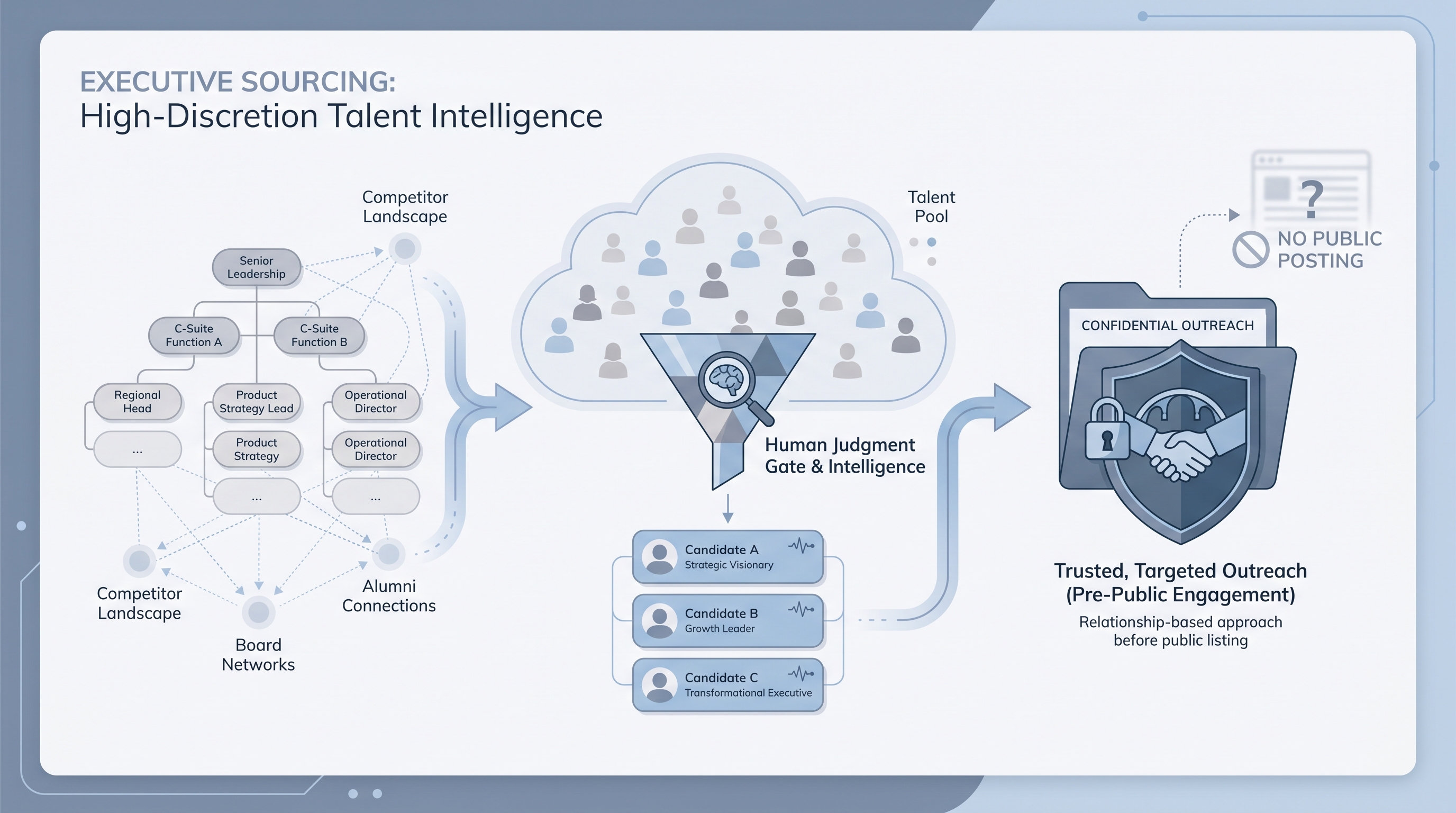
Executive sourcing is the work of building a shortlist of senior candidates for leadership roles before any public job posting goes live. It relies on org-chart intelligence, professional network mapping, and bespoke outreach rather than the volume tactics that drive high-volume recruiting.
In practice
- When a search firm builds a long-list of 30 potential CFO candidates from competitor companies before calling a single person, that research phase is executive sourcing.
- A TA leader mapping VPs of Engineering at series B and C companies for a future C-suite hire is doing executive sourcing months before a req is formally opened.
- Recruiters say "mapping the market" when they mean documenting who holds which role at which company, so they know who to approach first and in what order when the role goes live.
Quick read, then how hiring teams use it
This is for recruiters, sourcers, TA, and HR partners who need the same vocabulary in debriefs, vendor calls, and policy reviews. Skim the first section when you need a fast shared picture. Use the second when you are deciding how it shows up in your sourcing stack or retained-search process.
Plain-language summary
- What it means for you: Executive sourcing is finding and warming up senior candidates before anyone posts a job, so the shortlist is ready when leadership says "we need a new CFO by Q3."
- How you would use it: You map which companies have the right pedigree, identify three to five target names at each, and build a relationship months before the search is official.
- How to get started: Pick one upcoming senior role, list five competitor companies, and spend two hours profiling the person who holds that function at each. That is a basic market map.
- When it is a good time: When speed matters for a critical role, when a public posting would signal a leadership change too early, or when the talent pool is small enough that every name counts.
When you are running live reqs and tools
- What it means for you: Executive sourcing in a live search means confidential research tracked separately from your main ATS, with access limited to the search team and sponsoring executives.
- When it is a good time: When the role is VP level or above, when the incumbent is still in seat, or when the client has asked for a confidential retained search with no public footprint.
- How to use it: Build the long-list in a restricted CRM or secure spreadsheet, run candidate data enrichment to verify contact details, draft personalised outreach, and log every touchpoint so the search owner can see relationship status at a glance.
- How to get started: Set up a dedicated project folder with strict access controls before you add any names. Paste nothing into AI tools that log inputs or train on sessions; use local or enterprise-grade versions for drafting research notes.
- What to watch for: Confidentiality leaks from shared screens or ATS systems with broad user access, GDPR lawful basis for storing executives' data without their consent, and off-limits constraints your client forgot to mention at intake.
Where we talk about this
On AI with Michal live sessions, sourcing automation blocks cover how to use AI for market mapping without exposing candidate names to public-facing models, and how to build long-list research workflows that respect confidentiality. If you want the full room conversation, start at Sourcing Lab and bring your real stack questions.
Around the web (opinions and rabbit holes)
Third-party creators move fast. Treat these as starting points, not endorsements, and double-check anything before you wire candidate data.
YouTube
- Executive search process recruiting for walkthroughs of the retained-search lifecycle from intake to close; Greg Savage on YouTube is a reliable starting point for search-firm perspective.
- AI market mapping + talent sourcing for newer tools that accelerate the long-list research phase, from public signal aggregation to org-chart analysis.
- LinkedIn Recruiter + senior talent sourcing for advanced filter techniques sourcers use to narrow a senior candidate list before first contact.
- Executive search sourcing tactics in r/recruiting surfaces practical long-list and outreach threads from both in-house and agency sourcers.
- How do you handle confidential searches? in r/recruiting is where recruiters share real approaches to discretion and access control.
- Executive vs standard recruiting in r/RecruitmentAgencies has candid threads comparing retained-search and in-house TA models.
Quora
- How do executive search firms find candidates? collects a range of practitioner answers from both firm and in-house perspectives (read critically, quality varies).
Executive sourcing versus high-volume sourcing
| Dimension | Executive sourcing | High-volume sourcing |
|---|---|---|
| List size | 5 to 20 names | Hundreds to thousands |
| Speed priority | Relationship timeline | Conversion rate |
| Confidentiality | Almost always required | Rare |
| Tools emphasis | Network, research, CRM | Boolean search, AI matching, automation |
| AI role | Market mapping, profiling | Candidate matching, outreach drafting |
Related on this site
- Glossary: Candidate data enrichment, Proprietary talent pool, Boolean search, Workflow automation
- Blog: AI sourcing tools for recruiters
- Guides: Sourcers
- Live cohort: Sourcing Lab
- Membership: Become a member