Interview to offer ratio
Interview to offer ratio measures how many candidates who reach the interview stage receive a job offer, expressed as a percentage. It isolates whether your calibration problem sits inside the interview process itself or upstream in sourcing and screening.
Michal Juhas · Last reviewed May 5, 2026
What is interview to offer ratio?
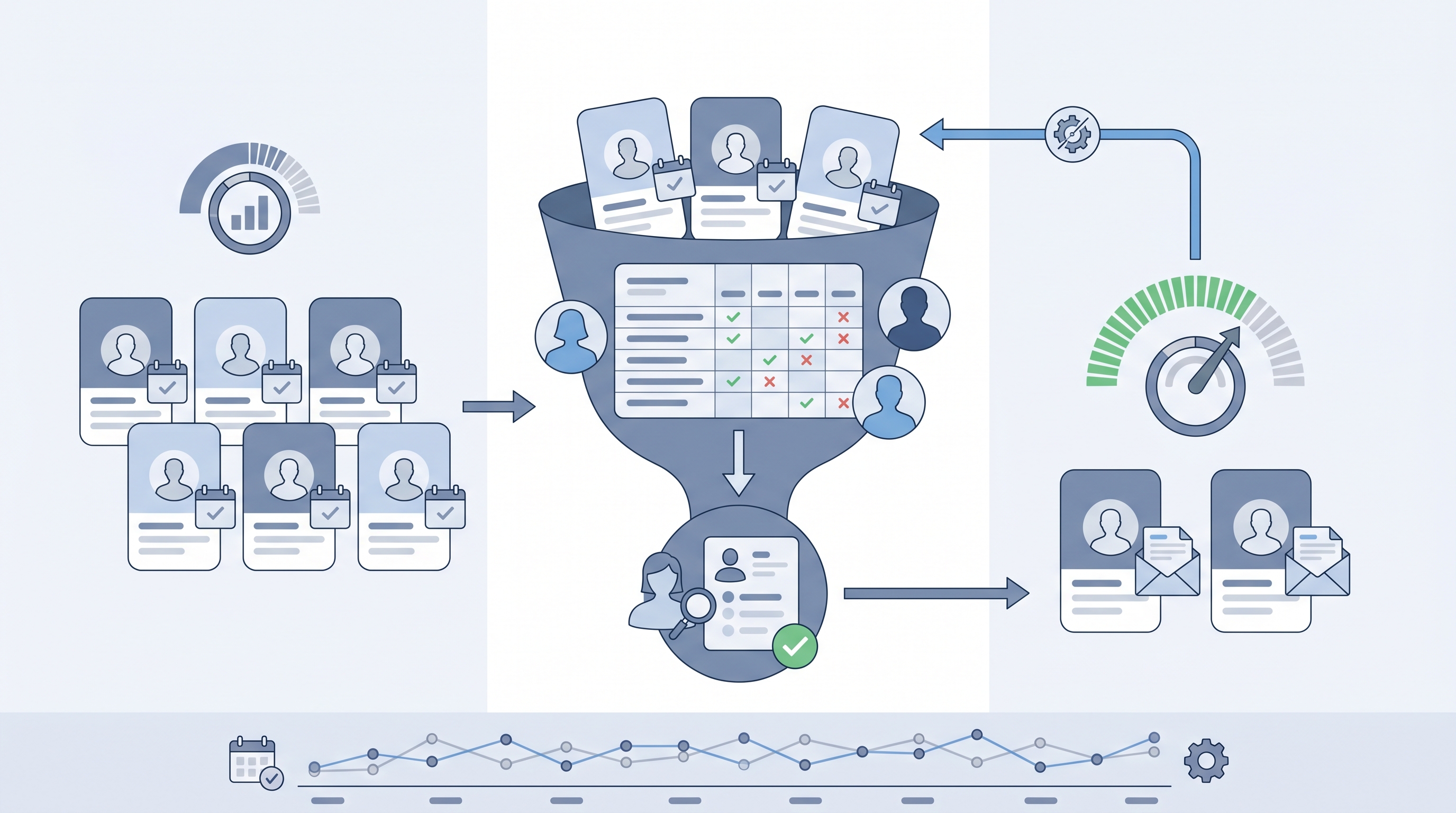
Interview to offer ratio measures the percentage of candidates who complete interviews and receive a job offer. You calculate it by dividing offers extended by total candidates interviewed, then multiplying by 100. A ratio of 25% means one offer for every four people who reached the interview stage.
The number tells you something specific: what happens inside your process after sourcing delivers candidates. Unlike the overall hiring funnel conversion rate, which covers every stage from application to hire, interview to offer isolates the decision quality happening in your interview rooms. If the ratio is low, the problem is usually calibration, not candidate supply.
In practice
- A TA team running quarterly pipeline reviews notices their interview-to-offer ratio on a senior engineer search dropped from 22% to 9% across three consecutive quarters. A structured debrief with the hiring manager reveals the role scope expanded after sourcing started, but nobody updated the scorecard. Two interviewers spent months applying criteria the brief never stated.
- An HR analytics lead pulls per-interviewer ratio data from the ATS and finds one panel member rejects 90% of candidates who cleared every other interview. The data alone does not explain the gap, but it triggers a calibration conversation that surfaces an undocumented must-have the rest of the team had never heard.
- A talent ops team building a recruiting dashboard includes interview-to-offer ratio alongside time to fill and sourcing channel quality. When ratio falls while volume stays flat, the dashboard flags it so the TA lead can investigate before it compounds into a missed hiring target.
Quick read, then how hiring teams use it
This is for recruiters, sourcers, TA, and HR partners who need the same vocabulary in pipeline reviews, vendor conversations, and calibration sessions. Skim the first section when you need a fast shared picture. Use the second when you are actively debugging a hiring process or building an analytics layer.
Plain-language summary
- What it means for you: For every ten candidates you interview, interview-to-offer ratio tells you how many receive an offer. A low number is a signal to look at what is happening inside the room, not just at the top of the funnel.
- How you would use it: Pull ratio data by role family, seniority, and interviewer panel at least quarterly. Compare current numbers to prior periods and look for drops rather than relying on a single industry benchmark.
- How to get started: If your ATS tracks stage transitions, you can calculate ratio manually in a spreadsheet today. Divide offers by total candidates who reached the first interview stage, then multiply by 100. Do it for the last six months and segment by role type.
- When it is a good time: Before adding sourcing headcount or spend, check your interview-to-offer ratio first. Volume problems and calibration problems look similar on the surface but require entirely different fixes.
When you are running live reqs and tools
- What it means for you: A ratio below 10% on a professional role in a tight market is a process flag, not a pipeline flag. Throwing more candidates at a broken calibration loop wastes sourcing capacity and damages employer brand with each unnecessary rejection.
- How to use it: Pair ratio tracking with your scorecard review cadence. If ratio drops, check whether the scorecard still matches what the hiring manager actually says in debrief. Drift between the two is the most common root cause.
- How to get started: Add a ratio column to your pipeline reporting template. Flag any role where the rolling three-month ratio has dropped more than five points. Bring those flagged reqs to your next hiring manager sync with the raw interviewer breakdown ready.
- When it is a good time: After any hiring manager change on a long-running req, and before you renegotiate a recruiting agency contract based on candidate quality complaints. Ratio data is the objective record.
- What to watch for: Ratio gaming: interviewers who know they are being measured can push borderline candidates to offer stage to protect their numbers. Triangulate ratio with offer acceptance rate and 90-day retention to catch this pattern.
Where we talk about this
On AI with Michal live sessions, interview to offer ratio comes up in the AI in recruiting track when teams build pipeline dashboards and calibration workflows. Sourcing automation sessions connect it to what data you need to automate the right things versus what still needs a human to own. If you want the full room conversation with real pipeline data practice, start at Sourcing Lab and bring your current hiring metrics for group review.
Around the web (opinions and rabbit holes)
Third-party creators move fast. Treat these as starting points, not endorsements, and double-check anything before you wire candidate data.
YouTube
Search "interview to offer ratio recruiting metrics" for TA practitioners walking through how they calculate and present this number to leadership. Look for channel operators who show actual ATS exports rather than theory slides.
r/recruiting and r/humanresources both have threads on what panels do to game metrics when leadership starts tracking ratios. The pattern shows up in comments rather than top-level posts, so search within the subreddits.
Quora
"How do you improve interview to offer ratio?" surfaces practical answers from TA leaders at scale companies. The best responses focus on intake calibration and scorecard design rather than sourcing volume.
Typical interview to offer ratio by role type
| Role category | Typical ratio range | Common driver of low ratio |
|---|---|---|
| High-volume operations | 30%-50% | Rarely low; flag if drops below 20% |
| Professional / business functions | 15%-30% | Scorecard drift, comp misalignment |
| Technical / engineering | 8%-18% | Unclear technical bar, poorly scoped assessment |
| Executive / leadership | 5%-12% | Role spec changes mid-search, stakeholder disagreement |
Related on this site
- Hiring funnel conversion rates - the full pipeline picture this ratio sits inside
- Talent acquisition metrics - connecting ratio to cost-per-hire and quality-of-hire
- Time to fill - how calibration problems cascade into delivery timelines
- Scorecard - the calibration tool that most directly moves this metric
- Human in the loop - governance for AI-assisted interview evaluation
- AI in recruiting - tooling overview including pipeline analytics
- Sourcing Lab - live sessions where teams practice pipeline reviews with real data
- Become a member - office hours if you are redesigning your interview process