Careers site SEO
The practice of optimising your company careers page and individual job posting pages so they appear in organic search results and attract relevant candidates without paid job advertising.
Michal Juhas · Last reviewed May 23, 2026
What is careers site SEO?
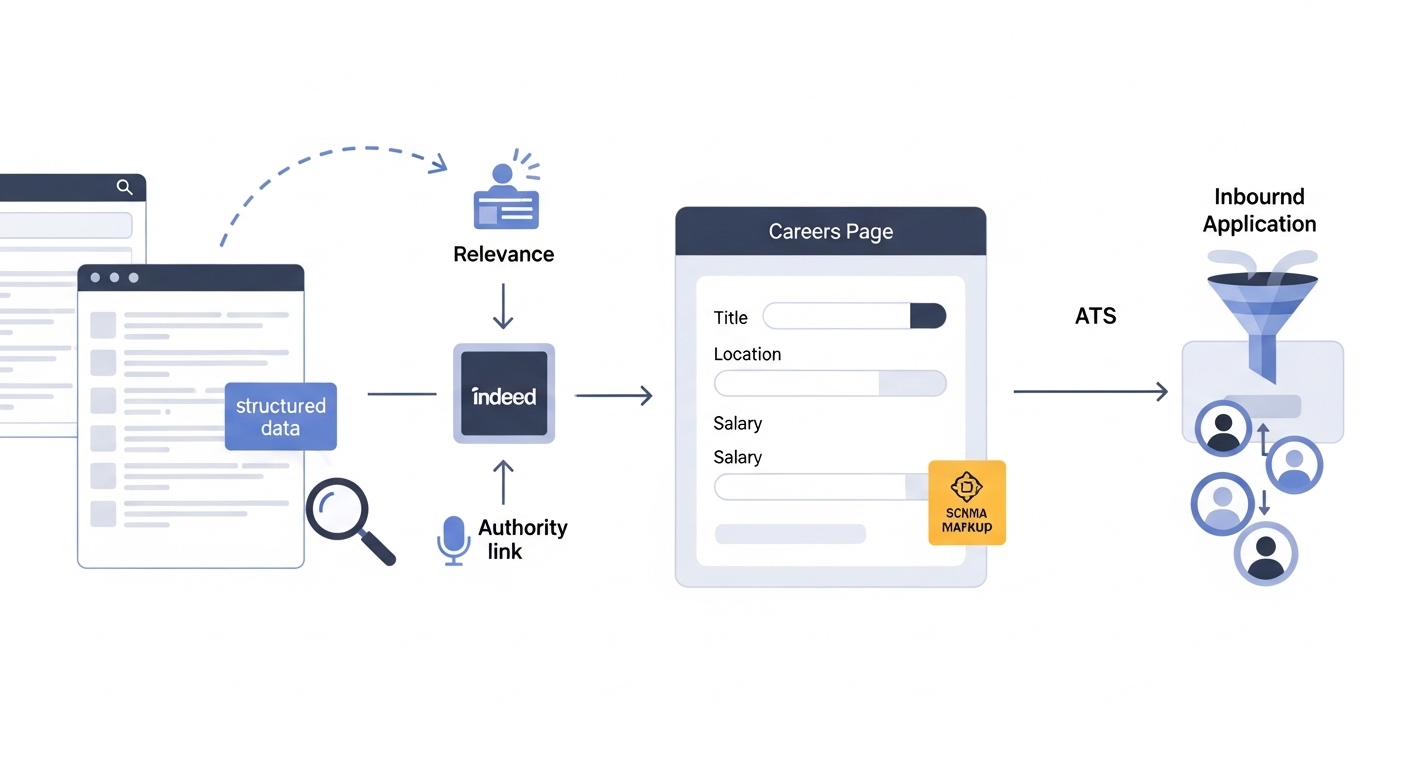
Careers site SEO is the work of making your job pages discoverable through search engines so relevant candidates find you before they find a job board ad. It combines technical hygiene (crawlable pages, fast load times, structured data), on-page content (titles and descriptions that match real search queries), and authority signals (links and brand mentions that tell Google your domain is trustworthy). Done well, it builds a steady inbound applicant flow that does not depend entirely on sponsored placements.
In practice
- A TA ops lead adds JobPosting schema to the company careers site for the first time and sees organic impressions for job-related queries triple within 60 days in Google Search Console.
- A recruiter notices that postings titled "Technologist II" get no organic traffic while a rewrite to "Data Engineer (Python, remote)" starts appearing in Google for Jobs within two weeks.
- A talent brand manager describes their careers blog as "SEO for trust": the company's engineering blog posts rank for queries like "what it's like to work at [company name]" and drive 20 percent of non-sourced applications.
Quick read, then how hiring teams use it
This is for recruiters, sourcers, TA, and HR partners who need the same vocabulary in debriefs, vendor calls, and policy reviews. Skim the first section when you need a fast shared picture. Use the second when you are deciding how it shows up in the ATS, sourcing tools, or candidate communications.
Plain-language summary
- What it means for you: Writing and publishing job pages so that the right candidates find them through Google, without paying for every click.
- How you would use it: Use real search terms in job titles, add location and salary where possible, make sure your pages load fast and are crawlable by Google.
- How to get started: Install Google Search Console on your careers domain, check for crawl errors, and run one job page through Google's Rich Results Test to see if your schema is valid.
- When it is a good time: Any time you are posting jobs publicly and want applications from people who were not already in your database.
When you are running live reqs and tools
- What it means for you: A properly structured careers site feeds the top of your hiring funnel with organic traffic, reducing cost-per-applicant on high-volume or evergreen roles.
- When it is a good time: When your ATS or careers site publishes job pages on public URLs, when you have at least one person who can interpret Search Console data, and when the volume of open roles justifies the setup investment.
- How to use it: Ensure JobPosting schema is present and valid on every listing. Write job titles using the phrasing candidates search. Publish employer brand content (team profiles, engineering blog, DEI pages) to support broader topical authority on your domain.
- How to get started: Audit your five highest-volume roles. Check their titles against Google Keyword Planner or Search Console search queries. Rewrite the two weakest and compare application volume over 30 days.
- What to watch for: ATS platforms that render job pages via JavaScript only (crawlers may miss them), expired postings with no noindex tag (they dilute crawl budget), and duplicate job URLs caused by location or department filters appending query strings.
Where we talk about this
On AI with Michal live sessions, careers site SEO comes up in inbound talent strategy discussions: how to build a hiring pipeline that does not start from zero every time a req opens. The sourcing automation track in AI Sourcing Lab covers how public content and careers pages work alongside outbound sequences to create consistent candidate flow.
Around the web (opinions and rabbit holes)
Third-party creators move fast. Treat these as starting points, not endorsements, and double-check anything before wiring candidate data or changing technical site settings.
YouTube
- Search "careers site SEO job schema" on YouTube for step-by-step walkthroughs of JobPosting markup and Google for Jobs setup.
- Search "Google Search Console for recruiting" for practitioner videos showing how to read impression and click data for job pages.
- r/recruiting has occasional threads on whether SEO for careers sites is worth the effort versus just using LinkedIn and Indeed.
- r/SEO covers the technical mechanics (schema, canonicals, crawlability) that apply directly to careers pages.
Quora
- How do you do SEO for a careers page? covers the basics from practitioners who have done this across different ATS setups.
Related on this site
- Glossary: AI-assisted job description generation, talent acquisition metrics, applicant tracking system
- Glossary: candidate experience, recruitment marketing, evergreen requisitions
- Live cohort: AI Recruiting Accelerator
- Membership: Become a member