Candidate experience
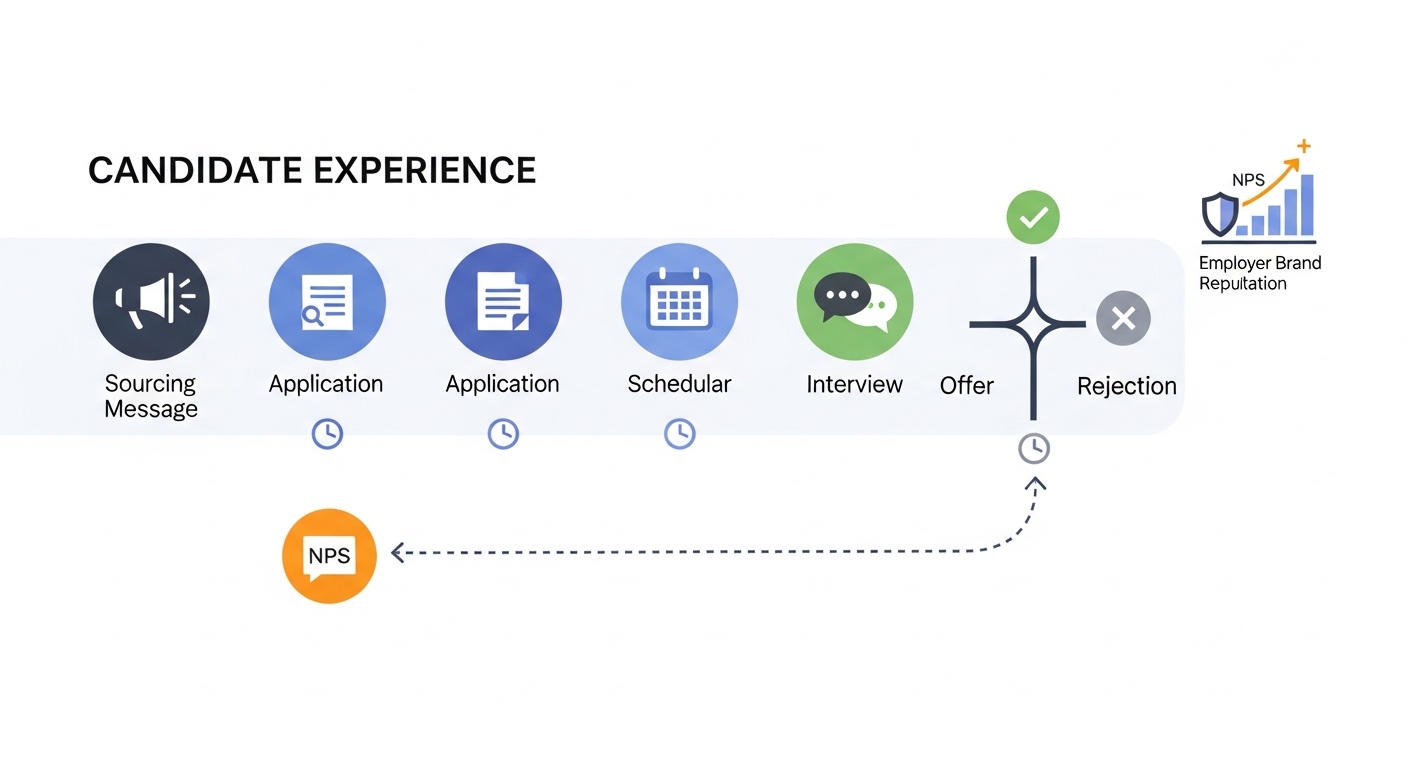
The sum of every interaction a candidate has with your organisation during the hiring process, from the first job ad or sourcing message through offer, rejection, or ghosting -- and the impression that stays with them afterward.
Michal Juhas · Last reviewed May 23, 2026
What is candidate experience?
Candidate experience is the sum of every interaction a person has with your organisation while being considered for a role: the job ad they found, the application form they filled in, the recruiter message they received (or did not), the interviews they sat through, the feedback they got (or did not), and the offer or rejection that ended the process. It also includes the impression that lingers after the process closes -- whether they would recommend the company to a peer, apply again, or post about it publicly.
The term sounds like a soft HR metric until you see the cost of a poor one: top candidates withdraw before offer, referrals dry up, and Glassdoor interview ratings quietly suppress future applications.
In practice
- A sourcer sends 200 personalised outreach messages via the AI Sourcing Lab, but the follow-up sequence fires every three days regardless of reply -- candidates who replied once get a second automated nudge and disengage permanently.
- A hiring manager asks "what did the candidate think of us?" after a final-round loop; the recruiter has no NPS data and only remembers that scheduling took two weeks, which the candidate mentioned twice.
- A startup's ATS sends a rejection email six weeks after application with no subject-line personalisation; a screenshot circulates on LinkedIn's recruiting community and the talent team spends a month doing damage control.
Quick read, then how hiring teams use it
This is for recruiters, sourcers, TA, and HR partners who need to diagnose drop-off, improve employer brand signals, and make better decisions about where AI automates versus where humans write the message. Skim the first section for shared vocabulary. Use the second when you are designing or auditing a live process.
Plain-language summary
- What it means for you: Every message, silence, and scheduling delay is part of the experience. Candidates judge your company by how the process felt, not just whether they got the offer.
- How you would use it: Map every touchpoint from first contact to close, note the owner and average response time for each, and identify the three slowest or coldest steps.
- How to get started: Send a two-question NPS survey to your next 20 rejected candidates. The open answers will tell you more than a month of internal discussion.
- When it is a good time: Before launching a new sourcing campaign, when you see application drop-off increase, or after any interview process that ran longer than four weeks.
When you are running live reqs and tools
- What it means for you: Every automation you add -- scheduling bots, AI-drafted outreach, ATS status updates -- either improves speed and clarity for the candidate, or signals that they are a low-priority inbox item. The difference is in the design.
- When it is a good time: During workflow design for a new req type, when onboarding a new sourcing or scheduling tool, and quarterly when you review ATS drop-off rates by stage.
- How to use it: Log touchpoint timestamps in your ATS and measure time-to-response at each stage. Set SLA alerts: if a candidate sits in "screening" for more than five business days without a status update, trigger a human review. Cross-link with human-in-the-loop gates so automated sequences pause before rejection messages go out without review.
- How to get started: Pull your last quarter of ATS data. Find the stage with the highest drop-off rate before candidate withdrawal. That is your first fix.
- What to watch for: AI personalisation that misfires -- wrong name, wrong role title, or a "personalised" detail that is obviously scraped. One broken personalisation token destroys more goodwill than a plain generic message. Audit outreach samples before scaling volume.
Where we talk about this
On AI with Michal, candidate experience comes up inside the sourcing automation track because the first sourcing message is the first CX moment for passive candidates. Sessions cover message personalisation, follow-up cadence design, and opt-out handling -- the mechanics that determine whether outreach feels considered or spammy. The AI Sourcing Lab is the hands-on environment where members workshop their own sequences and get peer feedback on tone and structure. If you want to build a sourcing workflow that candidates appreciate rather than block, the Lab is the right starting point.
Around the web (opinions and rabbit holes)
Third-party creators move fast. Treat these as starting points, not endorsements. Do not copy stranger scripts that touch candidate data.
YouTube
- Candidate experience best practices recruiting for practitioner walkthroughs from TA leaders and HR consultants covering NPS setup, ATS audit steps, and rejection message reviews.
- Employer brand candidate experience for sessions linking Glassdoor interview scores to top-of-funnel application volume -- useful for building the business case.
- AI recruiting candidate experience for panel discussions on where automation helps versus where it creates the uncanny-valley problem in hiring communication.
- r/recruiting threads on "candidate ghosting" and "rejection email templates" reveal what recruiters are actually sending and the candidate reaction in comments -- useful for benchmarking your own process.
- r/cscareerquestions and r/jobs are candidate-side communities where real applicants describe experiences that went wrong; reading these trains recruiter empathy faster than any workshop.
Quora
- Quora: candidate experience hiring process surfaces a mix of HR practitioners and job-seekers describing the gap between what companies think they deliver and what candidates actually feel.
Candidate experience versus employer brand
| Candidate experience | Employer brand | |
|---|---|---|
| Scope | Individual journey through one hiring process | Collective perception of what it is like to work here |
| Primary owner | Recruiter, TA team, hiring manager | HR, marketing, leadership |
| Measurement | NPS at offer/rejection, ATS drop-off, interview ratings | Glassdoor score, offer acceptance rate, pipeline source quality |
| AI leverage point | Faster scheduling, personalised outreach, status updates | Career site copy, employee story content, social proof |
| Feedback loop speed | Immediate (one process cycle) | Slow (months to years) |
Related on this site
- Glossary: Human-in-the-loop (HITL), Workflow automation, Structured output, Talent acquisition, Scorecard
- Lab: AI Sourcing Lab
- Live cohort: Sourcing Lab
- Membership: Become a member