ChatGPT Boolean strings
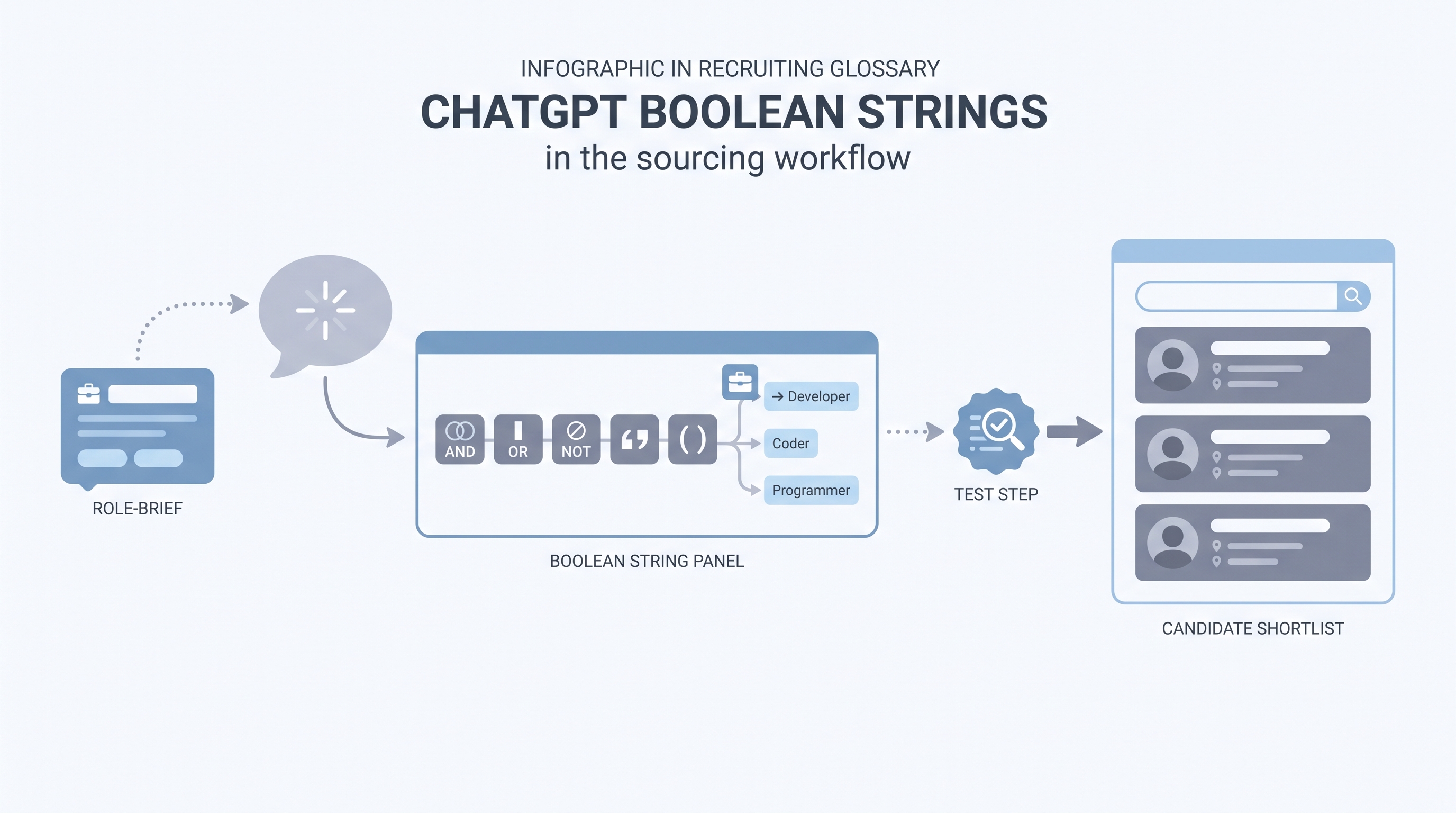
ChatGPT Boolean strings are candidate search queries built with Boolean operators (AND, OR, NOT, quotation marks, and parentheses) that a recruiter generates by prompting ChatGPT or another large language model, rather than writing by hand, to speed up sourcing across job boards, search engines, and professional networks.
Michal Juhas · Last reviewed June 29, 2026
What are ChatGPT Boolean strings?
ChatGPT Boolean strings are candidate search queries written with the operators of Boolean search, AND, OR, NOT, quotation marks, and parentheses, that you generate by prompting a large language model rather than typing by hand. You tell ChatGPT the role, the must-have skills, the seniority, and the location, and it returns a structured query with synonyms and title variants built in.
The value is speed and coverage. Turning Senior Backend Engineer into a query that also captures Backend Developer, Server-Side Engineer, and the right framework keywords used to take a few minutes of recall and typing. A model does it in seconds and tends to remember variants you forget under time pressure. For high-volume or unfamiliar roles, that head start is real.
The limit is that the model does not actually run your search, and it does not reliably know each platform's current syntax. It will produce confident strings with operators a site ignores, titles that do not exist in your market, or so many OR terms that the results turn to noise. The string is a fast first draft. The recruiter still owns testing, trimming, and validating it before it goes near a real search.
In practice
- A sourcer pastes a job description into ChatGPT with the instruction to write a Google X-ray string for a professional network, including title synonyms and excluding agency recruiters. They test the draft on a small result set, remove two synonyms pulling in irrelevant profiles, and keep the tightened version.
- A recruiter uses ChatGPT to translate a Boolean string that works on a search engine into the reduced syntax a professional network actually supports, because the original parentheses and minus signs were being silently ignored.
- A team builds a saved prompt that takes any role title and returns three strings: a broad version for volume, a tight version for precision, and an X-ray version for search engines. A human reviews and tests each before use, and the team logs which strings produced replies.
Quick read, then how hiring teams use it
This is for sourcers and recruiters who want to write better Boolean searches faster, without trusting the model blindly. Skim the first section for the idea. Use the second when you are building ChatGPT into a real sourcing workflow.
Plain-language summary
- What it means for you: Instead of hand-writing Boolean strings, you describe the role to ChatGPT and it drafts the query with synonyms and title variants you might miss. It is a speed and coverage boost, not a replacement for your judgment.
- How you would use it: Tell the model the platform, the title, the must-have skills, the location, and which operators are allowed. Ask it to explain each block, then test the result before scaling.
- How to get started: Take one role you are filling now, prompt ChatGPT for a Boolean string for your specific platform, and compare it against a string you would have written by hand.
- When it is a good time: When you are sourcing for unfamiliar titles, working at volume, or repeatedly forgetting useful synonyms under deadline pressure.
When you are running live reqs and tools
- What it means for you: The model drafts, you validate. Most of the value comes from synonym expansion and structure, and most of the risk comes from wrong syntax and over-broadening, so the test-and-trim step is not optional.
- When it is a good time: When you can give the model the exact platform and a known-good example string. Generic prompts produce generic, often wrong, output.
- How to use it: Provide the platform and an example with few-shot prompting, ask for an explanation of each block, then test on a small set and tighten. Verify operators against the platform's current help docs, since support changes.
- How to get started: Save a reusable prompt for your most common roles and keep notes on which generated strings produced replies and hires, so the prompt library improves over time.
- What to watch for: Hallucinated operators and made-up titles, platforms that silently ignore unsupported syntax, and OR-heavy strings that bury good candidates in noise.
Where we talk about this
On AI with Michal live sessions, ChatGPT Boolean strings come up in sourcing automation blocks when participants build prompts that draft, translate, and debug search strings, then stress-test them against real platforms. The membership community includes sourcers who share prompt patterns and compare which generated strings actually convert.
ChatGPT Boolean vs hand-written vs sourcing tools
| Approach | Strength | Watch for |
|---|---|---|
| ChatGPT Boolean string | Fast synonym expansion, transparent, portable across platforms | Wrong syntax, made-up titles, needs testing |
| Hand-written Boolean | Full control, platform-accurate | Slower, easy to forget synonyms |
| AI sourcing tool | Ranked matches at scale, no string needed | Costs more, can be a black box |
Around the web (opinions and rabbit holes)
Third-party creators move fast. Treat these as starting points, not endorsements.
YouTube
- Searches for "ChatGPT Boolean search recruiting" and "AI Boolean string sourcing" surface walkthroughs of prompts and the common syntax pitfalls.
- r/recruiting has threads on using ChatGPT for sourcing, including where the generated strings break and how people fix them.
- r/sourcing goes deeper on Boolean technique and how AI-drafted strings compare to hand-built ones.
Quora
- Searches for "ChatGPT Boolean string for LinkedIn" and "AI generated Boolean search" collect practitioner answers on prompts, accuracy, and platform syntax limits.
Related on this site
- Glossary: Boolean search, X-ray search (sourcing), AI sourcing tools, AI candidate sourcing, Few-shot prompting, Hallucination, Deep web talent sourcing
- Program: AI Recruiting Accelerator
- Membership: Become a member