Pre-employment personality test
A validated questionnaire administered to candidates before a hiring decision to measure stable behavioural traits such as conscientiousness or emotional stability, used as one scored input alongside interviews and work samples to predict job fit while managing adverse impact and legal risk.
Michal Juhas · Last reviewed May 9, 2026
What is a pre-employment personality test?
A pre-employment personality test is a validated questionnaire that measures stable behavioural traits in candidates before a hiring decision. Unlike a work sample or skills test, which captures what someone can do in a specific task, a personality instrument measures how someone typically behaves across situations: whether they tend toward conscientiousness, openness to change, or emotional stability under pressure.
The "pre-employment" timing is the key legal and operational fact. Administered before an offer, the test becomes a selection instrument under EEOC guidelines and GDPR. That means the data collected must have a documented lawful basis, the scoring logic must be defensible, and the results must not create adverse impact on protected groups. A personality test added informally, without a validity study tied to your role family, is not a neutral culture check. It is an undocumented selection screen.
The most research-supported instrument type is the Big Five, covering Openness, Conscientiousness, Extraversion, Agreeableness, and Emotional Stability. Branded alternatives like MBTI or DISC were not designed as hiring screens and carry poor predictive validity when used as selection tools in a pre-employment context.
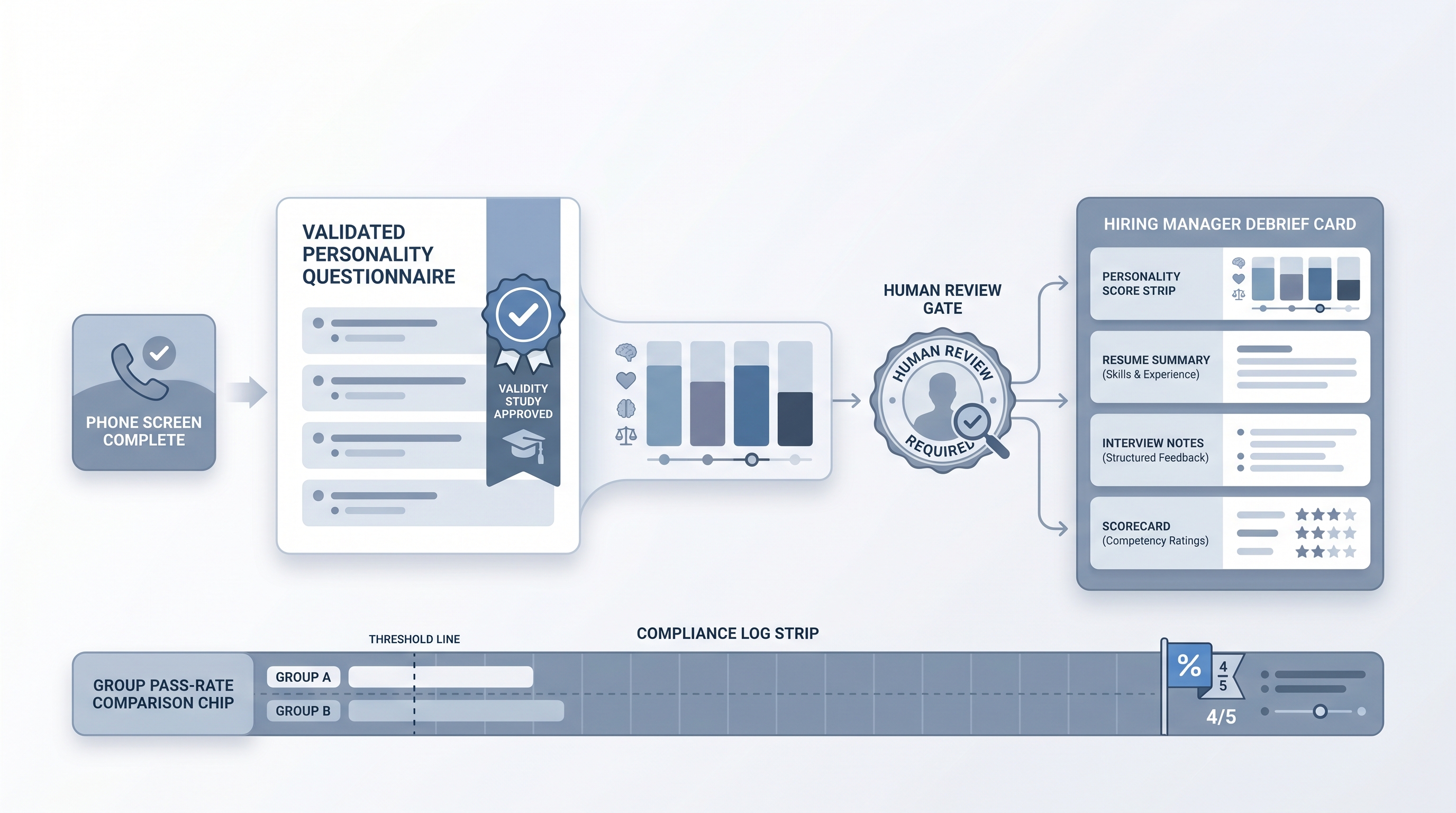
In practice
- A recruiter asked by a hiring manager to "add a personality filter" asks them to name the specific trait on the scorecard that predicts success in the role before selecting any vendor.
- A TA leader evaluating two assessment platforms asks each for a validity report tied to their exact role family and a technical manual listing group pass rates by gender and age before signing a contract.
- An HRBP reviewing a completed hiring cohort checks whether pass rates through the personality screen were similar across demographic groups before closing the req and making sourcing adjustments.
Quick read, then how hiring teams use it
This is for recruiters, sourcers, TA, and HR partners who need shared vocabulary in vendor briefings, debrief rooms, and policy conversations. Skim the first section when you need a fast picture. Use the second when you are deciding whether a personality layer belongs in a live req or how to evaluate a scoring vendor.
Plain-language summary
- What it means for you: A pre-employment personality test is a scored questionnaire that measures one or two traits relevant to the job. Results are useful when the test was designed for your role type, and risky when applied outside its validated scope.
- How you would use it: Place it after the phone screen, share results with the hiring manager as one input alongside interview notes, and never use a raw score as an automatic pass-or-fail gate.
- How to get started: Ask the vendor for a validity report naming the job family, the norming sample size, and group pass rate differences at a typical cut score. If they cannot produce one for your role type, do not deploy.
- When it is a good time: After the scorecard names the two or three traits that predict performance, and after legal or compliance has confirmed your lawful basis for collecting psychometric data in this jurisdiction.
When you are running live reqs and tools
- What it means for you: A personality layer in an ATS or hiring platform scores candidates on traits in the background. If no one is monitoring group pass rates through that step, you are running a selection screen with no audit trail and no way to defend a future complaint.
- When it is a good time: After role-specific validation and after the human-in-the-loop gate is documented: which human reviews a flagged score and what the process is before a candidate is declined on the basis of that output.
- How to use it: Set a minimum group sample size before interpreting results (40 per group is a practical floor). Log assessment version and model version so you can trace any future complaint to the exact instrument and cohort that ran.
- How to get started: Run a pilot on a closed req with past hires and check whether test scores correlate with your own performance ratings before using results in live hiring decisions.
- What to watch for: AI vendors who mention personality fit or culture add scores without naming the validated instrument underneath. That phrasing pattern should trigger a vendor questionnaire and an AI bias audit before you sign anything.
Where we talk about this
On AI with Michal live sessions we cover pre-employment personality testing in the legal and ethics modules of the AI in recruiting track. Participants walk through reading vendor technical manuals, practice identifying which validity coefficients matter for their role types, and discuss when a personality layer adds signal versus when it adds paperwork and legal exposure with no predictive gain. Join a session at Sourcing Lab for the peer discussion with real vendor names and live pipeline examples, and continue in membership office hours when compliance questions surface in your specific hiring context.
Around the web (opinions and rabbit holes)
Third-party creators move fast. Treat these as starting points, not endorsements, and verify before you wire any assessment into a candidate-facing step.
YouTube
Use Filters - Upload date to find recent talks from IO psychologists and employment law practitioners alongside vendor demos.
- Pre-employment personality test validity Big Five hiring (criterion validity, norming samples, and what "validated for pre-employment" actually means)
- Personality test hiring funnel placement EEOC (where in the funnel to add the test and how pass-rate differences interact with group demographics)
- MBTI DISC pre-employment validity IO psychology (why branded frameworks were not designed as selection tools and what the research shows)
- AI personality inference hiring bias video interview (AI-inferred traits versus validated questionnaires and what independent research actually shows)
- Big Five conscientiousness job performance prediction (which traits predict performance across role types and under what conditions)
- r/IOPsychology has active threads on which pre-employment personality instruments have criterion validity and which are oversold by vendors.
- r/recruiting captures real recruiter discussions on legal risk, hiring manager pressure to add personality filters, and vendor claims around culture fit scores.
- r/humanresources surfaces HRBP perspectives on where personality tests belong in a pre-employment process and how to handle candidate requests for score transparency.
Quora
- Quora search: pre-employment personality test validity surfaces practitioner and researcher answers on which tests hold up under legal and psychometric scrutiny; quality varies, so verify citations before acting on specific recommendations.
Pre-employment personality tests: signal, risk, and common misuse
| Instrument type | Predictive validity | Pre-employment risk |
|---|---|---|
| Validated Big Five questionnaire (role-normed) | Moderate, highest for conscientiousness | Adverse impact if no role norming |
| MBTI or DISC used as hiring screen | Very low | EEOC exposure, poor criterion validity |
| AI-inferred traits from video or text | Low to unknown | Bias, no independent validation |
| Situational Judgment Test (SJT) | Moderate | Needs role-specific norming to hold up |
Related on this site
- Glossary: Adverse impact, AI bias audit, Human-in-the-loop (HITL), Scorecard, Candidate assessment tools, Personality test for hiring
- Glossary: Pre-employment assessment test, Hiring assessment test, Employment assessment test
- Blog: AI sourcing tools for recruiters
- Live cohort: Sourcing Lab
- Membership: Become a member
- Course: Starting with AI: the foundations in recruiting