Retained search vs contingency recruiting
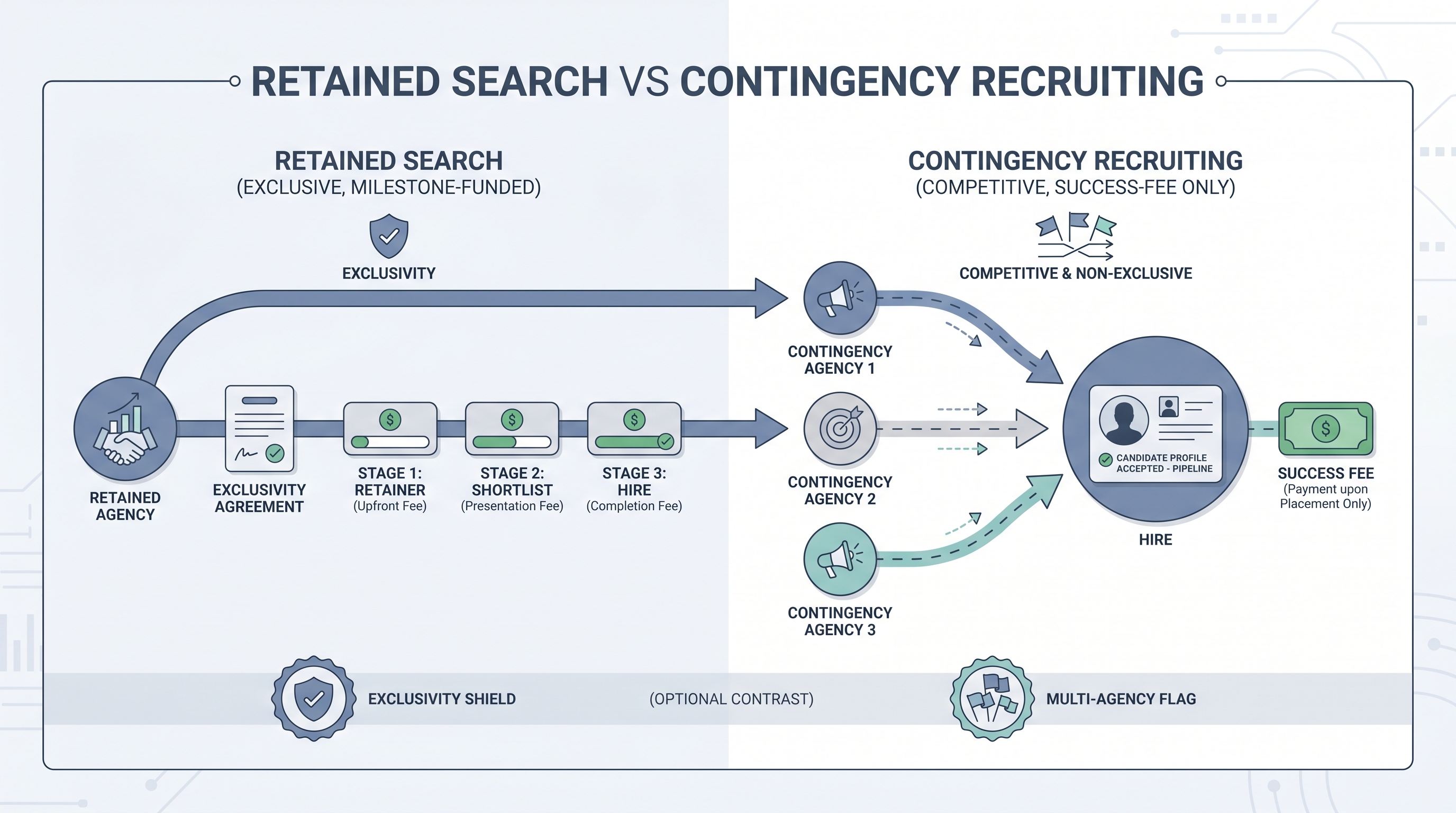
Retained search means a client pays a recruiting agency upfront in milestones for an exclusive, dedicated search effort. Contingency recruiting means the agency works the role at its own cost and earns a fee only when a candidate they sourced is hired.
Michal Juhas · Last reviewed May 8, 2026
What is retained search vs contingency recruiting?
Retained search and contingency recruiting are the two main commercial models for engaging external recruiting agencies. In retained search, the client pays upfront in milestones in exchange for a dedicated, exclusive search effort. In contingency search, the agency works the role at its own cost and earns a fee only when a candidate they sourced is hired.
The distinction shapes everything downstream: how deeply the agency researches the market, whether multiple agencies work the same role simultaneously, how candidates experience the process, and who absorbs the financial risk if the search takes longer than expected.
For recruiters and TA leaders, understanding the difference is not just contract vocabulary. It determines whether you end up with three agencies sending you the same active-market candidates or one agency conducting a structured confidential search into passive talent nobody else has contacted.
In practice
- A hiring director at a 200-person fintech retains a search firm to hire a Head of Compliance. Six weeks later the agency presents four passive candidates from competitor firms, people who were not on job boards and had not responded to any internal outreach. The exclusive brief gave the agency both the incentive and the time to reach them.
- A TA team filling fifteen entry-level software roles works three contingency agencies in parallel, paying a fee only when an offer is accepted. The competitive dynamic keeps submission velocity high and lets the team pick the strongest candidates from a wide funnel without any upfront agency cost.
- A recruiter at a staffing agency is asked by a client to work a VP of Engineering role on contingency alongside two other firms. After two candidates are rejected without structured feedback, the recruiter recognises the shared multi-agency model has created a race on availability rather than quality and proposes a short retained engagement instead.
Quick read, then how hiring teams use it
This is for TA leaders deciding which agency model fits a req, for agency owners structuring their commercial offer, and for HR business partners sitting in on budget conversations about external sourcing spend. Skim the first section for the vocabulary. Use the second when you are negotiating terms or reviewing a live agency engagement.
Plain-language summary
- What it means for you: Retained means you pay before placement and get an exclusive agency committed to your search. Contingency means you pay nothing until someone they sourced is hired, but you share the agency with competitors and have no exclusivity guarantee.
- How you would use it: Use retained when the role is senior, confidential, or has failed contingency twice. Use contingency when the role is well-defined, timelines are flexible, and the talent pool is large enough for parallel agency work without crowding the market.
- How to get started: Before signing any agency agreement, decide whether the role needs exclusive research depth or open-market speed. For retained searches, read the milestone delivery definitions and the cancellation clause as carefully as the fee percentage.
- When it is a good time: Retained when the cost of a bad hire or an empty seat exceeds the upfront milestone risk. Contingency when the role has clear criteria, multiple qualified candidates are available, and internal sourcing capacity is already stretched.
When you are running live reqs and tools
- What it means for you: For TA ops, retained searches sit in your ATS as committed pipeline with milestone dates and one named agency contact. Contingency searches often generate duplicate candidate submissions from competing agencies, which requires deduplication logic and a clear candidate right to represent policy in your vendor agreements.
- When it is a good time: Switch to retained when the same role has failed contingency twice, when you are hiring at VP level or above, or when the role requires confidentiality that a multi-agency contingency dynamic cannot protect.
- How to use it: Track agency source alongside candidate pipeline stage. For retained searches, define what a "qualified shortlist candidate" means in writing before the agency presents names. For contingency, document which agency submitted each candidate first and enforce your right-to-represent policy on every submission.
- How to get started: Audit your current open roles against the retained versus contingency criteria: seniority, search depth required, time pressure, and whether internal sourcing can absorb a second cycle if the first agency fails. Set a vendor cadence for retained searches and a submission SLA for contingency agencies.
- What to watch for: Contingency agencies submitting candidates already in your ATS, retained agencies treating a signed engagement as a license to slow down, and candidates declining to engage because they were contacted by multiple firms on the same role without any coordination.
Where we talk about this
On AI with Michal live sessions, agency business models and fee structures come up in the AI in recruiting track when participants who own or commission agencies work through live commercial scenarios together. The cohort covers sourcing model decisions, vendor agreements, and how to decide when internal outbound talent sourcing with AI tools is the better call over paying a retained agency for work the team can now do in-house. If you want the full room conversation, start at Sourcing Lab and bring your real agency agreements and open req list.
Around the web (opinions and rabbit holes)
Third-party creators cover retained versus contingency search from practitioner, agency owner, and in-house TA perspectives. These are starting points, not endorsements. Verify any fee structure or contract language with a qualified lawyer before applying it to a live engagement.
YouTube
- Retained vs contingency recruiting surfaces agency owner walkthroughs of how each model works and what clients should expect from each structure.
- Executive search fee structure explained covers how retained milestone payments work in practice and where searches break down between stages.
- How to choose a recruiting agency model includes TA leader perspectives on when contingency works and when it fails for senior roles.
- Retained versus contingency experiences in r/recruiting covers real in-house and agency experiences with both models, including what clients push back on and how disputes play out.
- Executive search model decisions in r/RecruitmentAgencies surfaces agency owner perspectives on how to price, pitch, and defend each model.
- Agency fee negotiation for hard-to-fill roles in r/humanresources includes HR leader takes on when each model is worth the cost.
Quora
- When should you use a retained search firm? collects practitioner opinions on the retained versus contingency decision, including what failure modes change the calculus.
Retained search vs contingency at a glance
| Factor | Retained search | Contingency search |
|---|---|---|
| When agency earns | Three milestones: engagement, shortlist, placement | Only on successful placement |
| Exclusivity | Required as a condition of the retainer | Rarely guaranteed |
| Upfront cost to client | One third of total fee on signing | None until placement |
| Agency incentive | Best candidate, committed timeline | Fastest placed candidate |
| Risk if search fails | Client absorbs upfront milestone costs | Agency absorbs the cost of failed work |
| Best suited to | Senior, confidential, specialist, or hard-to-fill roles | High-volume, well-defined, or speed-critical roles |
| AI impact | Speeds research phase, does not eliminate relationship value | Raises competitive bar, may reduce fee justification for simple roles |
Related on this site
- Glossary: Retainers and escrow for search engagements, Candidate right to represent, Rebate and clawback clauses on placement fees
- Glossary: Preferred supplier list (PSL), Recruitment factoring and agency cash flow, Outbound talent sourcing
- Glossary: AI sourcing tools, Executive sourcing, Talent acquisition metrics
- Blog: AI sourcing tools for recruiters
- Workshops: Sourcing Lab
- Course: Starting with AI: the foundations in recruiting
- Membership: Become a member