Preferred supplier list (PSL) and vendor tiers
A preferred supplier list (PSL) is a pre-approved panel of recruitment or staffing agencies that a company commits to engage for specified vacancy types, with negotiated rates and compliance requirements set in advance. Vendor tiers rank agencies within the panel, typically granting Tier 1 suppliers first or exclusive access to roles before overflow passes to Tier 2 or Tier 3 agencies.
Michal Juhas · Last reviewed May 7, 2026
What is a preferred supplier list (PSL) in recruitment?
A preferred supplier list is a pre-approved panel of recruitment or staffing agencies that a company commits to use for a defined scope of hiring. Agencies on the PSL sign a master services agreement in advance that sets fee rates, guarantee periods, compliance requirements, and SLA expectations. In return they receive preferential access to roles, often as a defined Tier 1 before any vacancy is opened to agencies outside the panel.
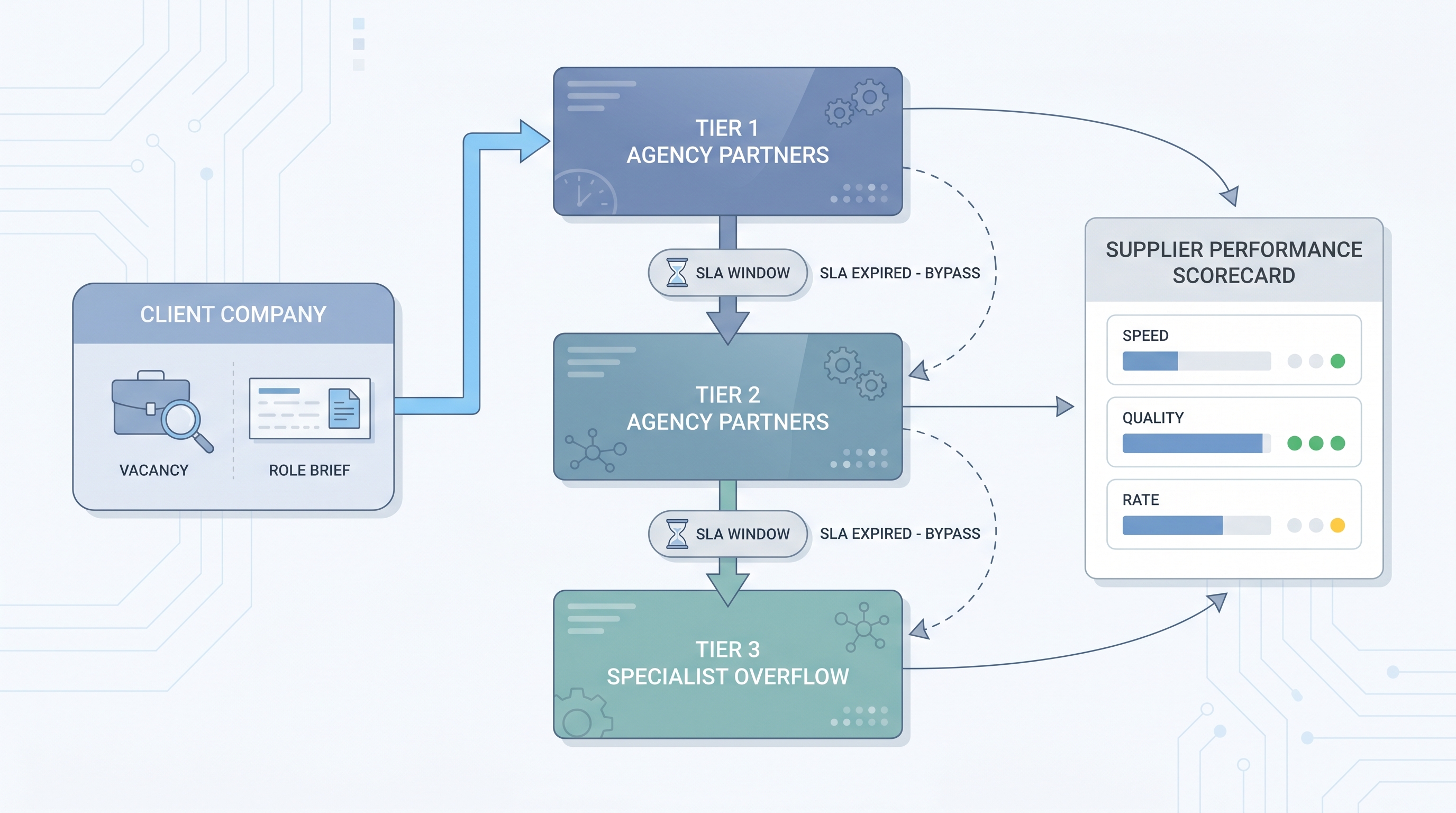
Vendor tiers rank agencies within the PSL by performance level and category expertise. Tier 1 agencies get first or exclusive access to roles for a defined SLA window. If they do not fill within that window, the vacancy cascades to Tier 2, then Tier 3 for specialist overflow. The structure gives companies cost efficiency and quality standards through a managed supplier panel, while giving agencies predictable volume in exchange for agreed terms.
For in-house TA and procurement leaders, a PSL reduces the cost and time of onboarding agencies vacancy by vacancy and creates a foundation for supplier performance tracking. For agencies, panel membership is a commercial asset that requires active account management and consistent delivery to protect tier status.
In practice
- An enterprise technology company runs a quarterly PSL review and uses ATS data to rank its twelve panel agencies on time-to-submission, offer acceptance, and twelve-month retention. The two Tier 1 agencies in the software engineering category receive all engineering roles first, with a five-day exclusive window before vacancies open to Tier 2. During review, one Tier 1 agency has a 40 percent offer acceptance rate against a panel average of 68 percent, and the client downgrades it to Tier 2 with a formal performance improvement notice.
- A recruitment agency preparing for a PSL tender at a target client compiles a capability document mapping each of its consultants to the client's active hiring categories, includes reference account contacts at comparable companies, and shows its GDPR-compliant data processing workflow. It also runs a rate benchmarking exercise to understand what discount it can sustain at the expected volume before the commercial section of the tender is scored.
- An in-house TA leader discovers that three agencies are sending speculative CVs outside the PSL process, bypassing the agreed tier structure. She reviews the MSA to confirm that non-PSL submissions are not permitted and directs all hiring managers to acknowledge only submissions routed through the ATS supplier portal, where PSL status is verified automatically.
Quick read, then how hiring teams use it
This page is for in-house TA and procurement leaders who set up or manage a PSL, agency principals and business development leads who are competing for or operating within a panel, and HR business partners who need to understand why some vacancies go to specific suppliers first. Skim the first section for the definition and structural logic. Use the second when you are preparing a PSL tender, negotiating tier terms, or managing a supplier performance review.
Plain-language summary
- What it means for you: A PSL is the list of approved agencies your company uses. If you are in-house, it is how you control cost, quality, and compliance for agency hiring without re-negotiating contracts every time. If you are an agency, being on it gives you a pipeline of roles in exchange for agreed rates and SLA commitments.
- How you would use it: Route all agency-sourced vacancies through the PSL structure, release roles to Tier 1 first, cascade to lower tiers only when the SLA window lapses, and track performance per supplier using ATS data so reviews are data-led rather than relationship-led.
- How to get started: Audit your current agency relationships and map each supplier to a category and performance tier. Check whether you have a signed MSA with each agency that documents fee rates, guarantee terms, SLA windows, and GDPR obligations.
- When it is a good time: Before a significant hiring ramp, when the current agency mix is unmanaged and fees vary by deal, or when procurement needs a defensible supplier governance structure for audit purposes.
When you are running live reqs and tools
- What it means for you: Every role you release to the panel has a tier sequence. If the sequence is not enforced in the ATS or procurement portal, agencies outside the structure will submit candidates directly to hiring managers, creating fee disputes and compliance gaps.
- When it is a good time: When releasing a vacancy, confirm the assigned tier in the ATS before the brief goes out. When reviewing submissions, check supplier portal timestamps to verify the tier cascade was followed before any CV is formally acknowledged.
- How to use it: Load PSL status, tier assignment, and SLA windows into your ATS supplier portal. Use workflow automation to notify the next tier automatically when the SLA window expires, so the cascade is documented without manual intervention.
- How to get started: Pull the last six months of agency placements from your ATS. Check which agencies placed outside a PSL structure and quantify the fee rate variance. Use that data to build the business case for formalising or tightening the panel.
- What to watch for: Tier 1 agencies sitting on roles past the SLA window without escalating, agencies submitting candidates for categories not covered by their panel scope, fee disputes when two agencies submit the same candidate, and PSL agreements that have not been reviewed in more than two years and no longer reflect current fee market rates.
Where we talk about this
On AI with Michal live sessions, preferred supplier lists and vendor governance come up in the AI in recruiting track when agency principals and in-house TA leaders discuss how supplier relationships, performance data, and automation intersect. If you want to hear how teams are using ATS data and process automation to run PSL reviews without a quarterly spreadsheet exercise, start at Sourcing Lab and bring your current supplier mix questions.
Around the web (opinions and rabbit holes)
PSL management, vendor tiering, and agency governance are discussed across staffing industry associations, HR procurement communities, and legal blogs covering MSA structures. These are starting points, not endorsements. Verify any legal or contractual position with counsel before applying it to a live agreement or procurement process.
YouTube
- How to set up a preferred supplier list for recruitment covers the practical steps for designing a PSL, including how to structure the tier criteria and SLA windows before running a supplier selection process.
- Agency PSL management and vendor performance reviews explains how in-house teams track KPIs across a supplier panel and use the data to inform tier changes at annual review.
- Negotiating agency rates and PSL terms as a recruitment business gives the agency-side perspective on how to assess PSL commercial terms before signing and what clauses to push back on.
- Managing recruitment agencies and preferred supplier lists in r/humanresources includes in-house TA perspectives on how PSLs work in practice, common governance gaps, and what makes a PSL review useful versus a box-ticking exercise.
- Agency PSL membership and tier negotiation in r/RecruitmentAgencies covers agency owner experiences with PSL tenders, rate pressure, and how tier placement affects desk economics.
- Vendor management and supplier governance in r/procurement offers broader procurement perspectives on how PSL structures compare across professional services categories beyond recruitment.
Quora
- What is a preferred supplier list in recruitment and how does it work? collects practitioner answers on how PSLs are structured, the benefits and trade-offs for both clients and agencies, and how tier placement affects access to roles.
PSL tier structure and trade-offs
| Tier | Access order | Typical SLA window | Agency benefit | Agency risk |
|---|---|---|---|---|
| Tier 1 | First or exclusive | 3 to 7 business days before cascade | Highest role volume, category ownership | Rate discount, SLA pressure, performance visibility |
| Tier 2 | After Tier 1 SLA expires | 3 to 5 additional business days | Steady overflow volume | Lower volume, harder-to-fill roles, competition with other Tier 2 agencies |
| Tier 3 | Specialist overflow only | Activated by client on request | Niche expertise valued, less rate pressure | Unpredictable volume, no guaranteed flow |
| Off-panel | Not permitted in most PSLs | No access without a waiver | None by default | Fee dispute risk, no MSA protection |
Related on this site
- Glossary: Master services agreement for agency services, Agency markup and contract staffing
- Glossary: Most favored nation (MFN) pricing in agency contracts, Agency invoice and payment terms
- Glossary: Off-limits and non-solicit clauses for agencies, Client exclusivity in agency agreements
- Glossary: Talent acquisition metrics, Time to fill
- Glossary: Workflow automation, Proprietary talent pool
- Workshops: Sourcing Lab
- Course: Starting with AI: the foundations in recruiting
- Membership: Become a member