Right to represent and candidate ownership (agency)
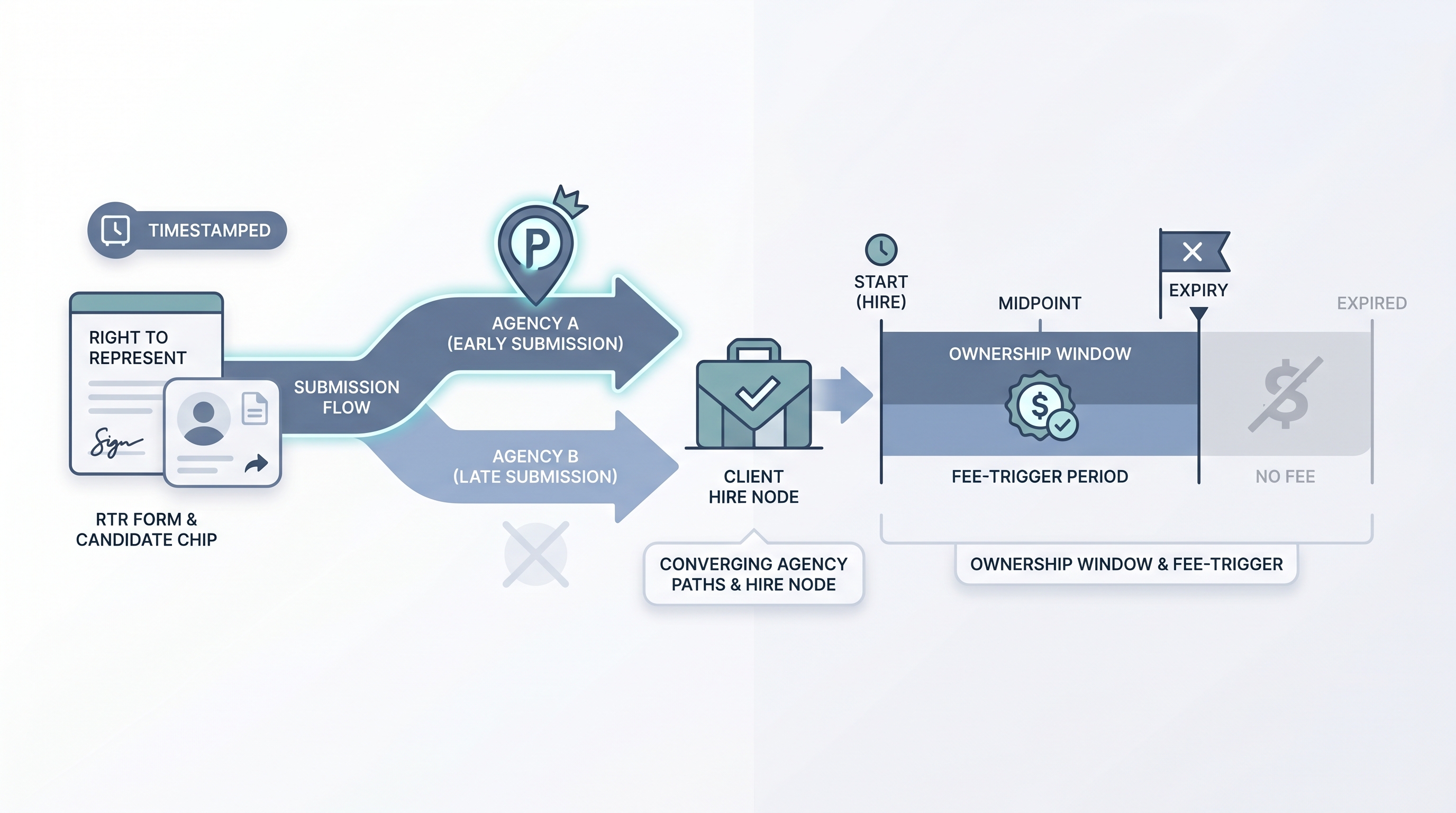
Right to represent (RTR) is a recruitment agency's formal claim that it has the candidate's consent and a timestamped submission record to present that candidate to a specific client. Candidate ownership defines which agency or internal TA team holds priority rights to that candidate for a specified period, determining who earns the placement fee if a hire is made.
Michal Juhas · Last reviewed May 5, 2026
What is right to represent and candidate ownership?
Right to represent (RTR) is the formal claim a recruitment agency makes before submitting a candidate to a client: the candidate has consented to this specific submission, and the agency has a timestamped record proving it was first to introduce that candidate to that client.
Candidate ownership is the related but distinct question of who holds priority rights to a candidate for a defined period after that introduction. Both concepts matter because they determine who earns the placement fee if the candidate is hired, and who has a defensible position when a dispute arises.
In practice, RTR and candidate ownership are the difference between a confident invoice and a fee arbitration conversation. Agencies that treat them as administrative formalities tend to discover their importance only after a hire goes through and two parties are claiming the same placement.
In practice
- A retained executive search agency sends a candidate profile to a client and simultaneously emails the candidate an RTR confirmation, logging the timestamp in its CRM. Three weeks later, a second agency submits the same candidate. When the client hires the person and only one fee is payable, the first agency produces its timestamped submission log and the dispute is resolved without escalation.
- An internal recruiter sources a DevOps engineer on LinkedIn and marks the candidate as "identified" in the ATS but has not yet sent an introductory message. An agency submits the same engineer two days later. The client's MSA defines "introduction" as first outreach, not first identification. The agency fee is owed.
- A candidate signs RTR with two competing agencies, telling neither. Both submit to the same client. The client hires the candidate and receives two invoices. Both agencies present timestamped submission emails. The MSA defines the earlier timestamp as the winning submission. The agency that submitted 90 minutes later loses the fee.
Quick read, then how hiring teams use it
This page is for agency recruiters, founders, and operations leads who need to understand RTR and candidate ownership as operational and commercial disciplines, not just legal boilerplate. Skim the first section for the core definition. Use the second when you are building submission workflows or reviewing MSA terms with a client.
Plain-language summary
- What it means for you: RTR is your paper trail that proves you introduced a candidate to a client first and with the candidate's consent. Without it, any placement fee you think you have earned can be challenged.
- How you would use it: Before any candidate CV leaves your agency, confirm RTR in writing, log the timestamp in your CRM, and set an expiry date. Make this a non-negotiable step in your submission process, not an optional extra.
- How to get started: Create a one-paragraph RTR email template that names the candidate, the client, the role, and the expiry date. Require every recruiter to send it and save the response before logging a submission. Review your MSAs to understand how your largest clients define "introduction" and "ownership window."
- When it is a good time: Before every single submission, and when renewing or renegotiating MSA terms with a volume client.
When you are running live reqs and tools
- What it means for you: Candidate ownership defines how long your introduction protects your fee claim. Most MSAs give you 30 to 90 days. Some extend to 12 months. Knowing the window for each client is a revenue protection issue, not a compliance footnote.
- When it is a good time: At submission, when a hire is confirmed, and when a tail-period conversation is needed because a client re-engaged a candidate you introduced six months ago.
- How to use it: Configure your ATS to flag when a candidate has already been submitted to a client, so two recruiters in the same agency do not generate conflicting RTR claims. Use workflow automation to trigger RTR confirmation emails and log expiry dates automatically. Pull a monthly report of RTR expiries to decide which candidates to re-confirm or close out.
- How to get started: Map your five highest-volume clients against their MSA ownership terms. For any client where you do not have a signed MSA defining these terms, get one. An email thread is not a fee agreement.
- What to watch for: Candidates granting RTR to multiple agencies without disclosing it, internal TA claiming independent introduction for candidates they sourced after your submission, and ownership window expiry dates that pass unnoticed. Track expiry dates in your CRM alongside open req status so you know when to refresh or close a representation. See recruitment agency software for what ATS and CRM platforms handle submission tracking best.
Where we talk about this
On AI with Michal live sessions, RTR and candidate ownership come up in the AI in recruiting track when agency founders and senior recruiters ask how to systematize the commercial and compliance side of placements alongside sourcing and screening work. The Sourcing Lab cohort covers agency economics, MSA negotiation, and placement fee structures so TA leaders and agency principals can build shared vocabulary before they enter commercial conversations with clients or competing agencies.
Around the web (opinions and rabbit holes)
Third-party creators cover RTR and candidate ownership from agency operations, legal, and staffing industry perspectives. These are starting points, not endorsements. Verify any legal interpretations or contract terms with employment counsel before applying them to your agreements.
YouTube
- Right to represent in recruiting agencies covers how experienced agency recruiters handle RTR conversations and submission tracking to protect placement fees.
- How to avoid recruitment fee disputes walks through the most common scenarios where ownership disputes arise and how agencies defend their position.
- Recruitment agency MSA terms explained covers key contract clauses including tail periods, ownership windows, and introduction definitions.
- RTR disputes and fee losses in r/RecruitmentAgencies surfaces real situations where recruiters lost fees over missing RTR documentation and what they changed afterward.
- Candidate ownership and PSL terms in r/recruiting covers how agency recruiters handle preferred supplier list terms and ownership claims.
- MSA negotiation for staffing agencies in r/staffing discusses how agencies negotiate ownership window lengths and fee trigger language with enterprise clients.
Quora
- How do recruitment agencies handle right to represent disputes? collects practitioner accounts of how agencies document submissions and defend fee claims when multiple parties present the same candidate.
RTR and ownership scenarios
| Scenario | Outcome | Protection needed |
|---|---|---|
| Agency submits first with signed RTR | Fee claim is defensible | Timestamped submission log |
| Two agencies submit same candidate, no MSA | Both may invoice; dispute likely | Clear MSA defining winner criteria |
| Internal TA sources before agency submission | Client may claim no fee owed | Submission timestamp before any internal ATS record |
| Candidate granted RTR to two agencies | One fee at most; earlier timestamp wins | Per-submission RTR with expiry date |
| Ownership window expires before hire | No fee owed unless MSA has a tail period | Track expiry dates in CRM |
Related on this site
- Glossary: Backfill periods and replacement guarantees, Agency invoice payment terms, Agency business development
- Glossary: Agency vs in-house recruiting, Agency recruiter utilization, Recruitment agency software
- Glossary: GDPR and first-touch outreach, Workflow automation, Human-in-the-loop
- Glossary: Bench cost and recruiter pipeline management, Agency markup and contract staffing
- Workshops: Sourcing Lab
- Course: Starting with AI: the foundations in recruiting
- Membership: Become a member