Sourcing channel attribution
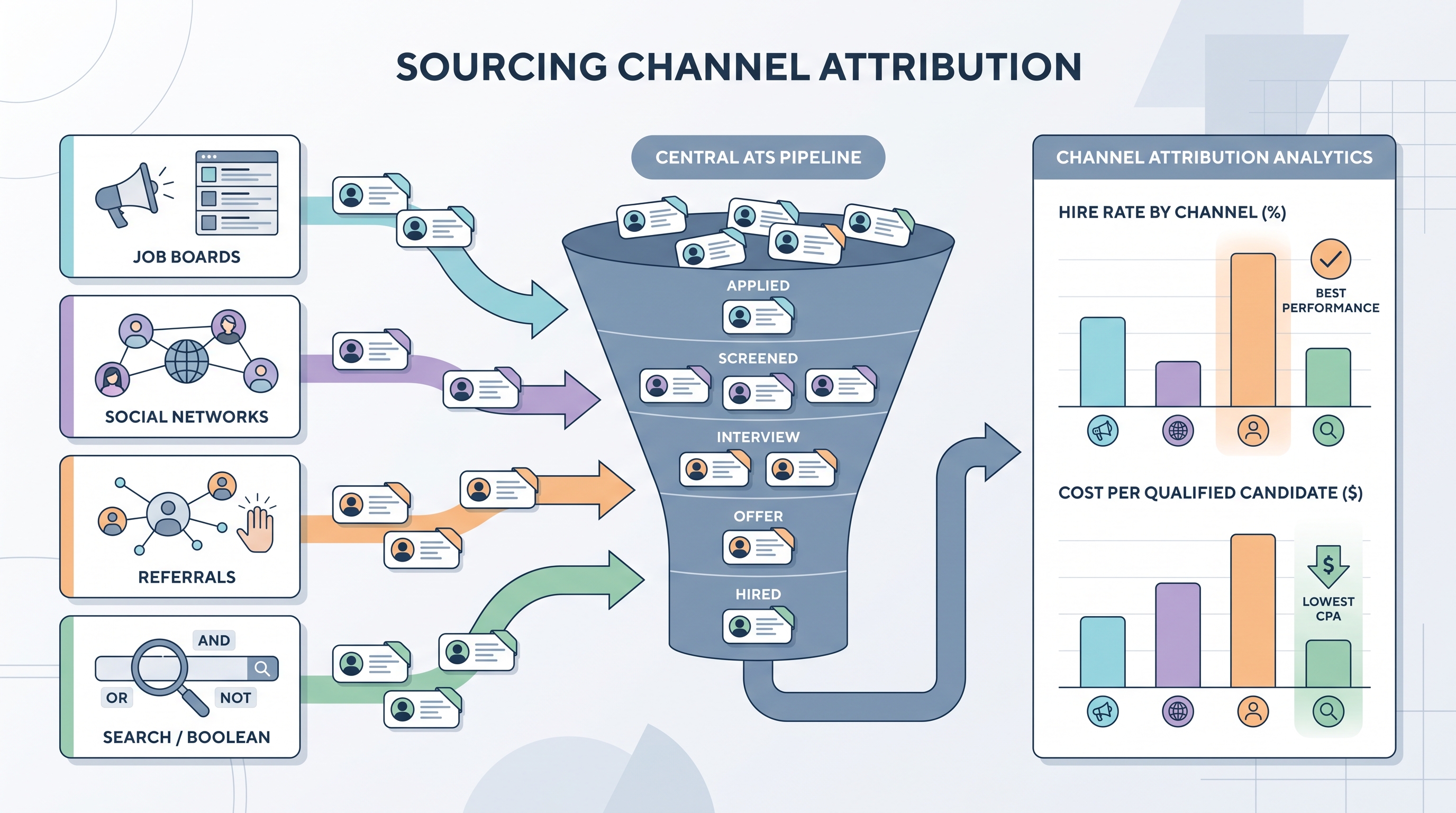
Tracking which channel (job board, LinkedIn, referral, Boolean search, AI tool) produced each hire, so teams can invest in what works and cut what does not.
Michal Juhas · Last reviewed June 16, 2026
What is sourcing channel attribution?
Sourcing channel attribution is the discipline of tracking which source (job board, LinkedIn InMail, employee referral, Boolean search, AI-assisted outreach, or careers page) produced each candidate who eventually became a hire. It answers the question that matters at budget time: where should we put our money and recruiter hours next quarter?
The challenge is that candidate journeys rarely start and end in one channel. A person might see a sponsored post, ignore it, receive a direct message three weeks later, and finally apply through a Google search. The ATS records the last touch, not the one that actually prompted the decision. Fixing attribution requires a combination of logging discipline, agreed definitions, and tooling.
In practice
- A TA ops manager pulls a quarterly source-of-hire report and discovers 42 percent of the source field is blank or tagged "unknown," making any budget defence in the QBR impossible.
- A sourcer manually tags each candidate with the specific channel that produced the first positive reply, which reveals that GitHub sourcing converts at three times the rate of a costly job board subscription.
- At a team retrospective, the recruiting lead realises that two successful hires this quarter were first contacted at a community event, but neither is tagged as "event sourcing" in the ATS, so that channel stays invisible in the data.
Quick read, then how hiring teams use it
This is for recruiters, sourcers, TA ops, and HR partners who need shared vocabulary when defending budgets, evaluating tool contracts, or building a sourcing strategy. Skim the first section for the shared definition. Use the second when you are configuring ATS source fields or preparing a channel performance review.
Plain-language summary
- What it means for you: Attribution is how you prove which channels are worth paying for and which you can cut without impact.
- How you would use it: Tag every candidate with the channel that produced the first positive contact. Review the data monthly.
- How to get started: Audit your current ATS source field. Count how many records are blank or "unknown." Set that number as your baseline and target cutting it in half within two quarters.
- When it is a good time: Before any tool renewal conversation and before presenting a sourcing strategy to leadership.
When you are running live reqs and tools
- What it means for you: Attribution data tells you which sourcing investments are producing pipeline and which are producing noise. Without it, you renew expensive tools on gut feel.
- When it is a good time: Every month for an active TA function; at a minimum before each quarterly planning cycle and any tool contract renewal.
- How to use it: Define a channel taxonomy with six to eight categories (job boards, LinkedIn direct, referrals, AI-assisted, events, Boolean search, inbound careers page, other). Enforce field completion in the ATS workflow. Add a check-in at each offer acceptance to confirm and correct the source if needed.
- How to get started: Start with a retroactive audit of the last 20 hires. Reconstruct the source from recruiter notes and Slack history. Use the findings to define which channels need better tracking going forward.
- What to watch for: Last-touch bias (the ATS records the application channel, not the contact that prompted it), duplicate source labels for the same channel, and AI tools that generate outreach without logging a sourcing action in the ATS.
Where we talk about this
On AI with Michal live sessions, sourcing channel attribution comes up in sourcing automation blocks when participants are deciding which tools to wire into their ATS and how to track ROI. The sourcing lab is the right place to bring your attribution questions alongside real ATS setups.
Around the web (opinions and rabbit holes)
Third-party creators move fast. Treat these as starting points, not endorsements, and double-check anything before you wire candidate data.
YouTube
- Searches for "source of hire tracking" and "recruiting analytics ATS" surface practitioner walkthroughs on setting up source fields correctly and pulling actionable reports.
- r/recruiting threads on "source of hire" contain frank discussion about how hard it is to get clean data in practice, and which ATS platforms handle it best.
- r/TA includes debates on multi-touch attribution in recruiting and whether first-touch or last-touch is more useful for budget decisions.
Quora
- Searches for "how to track source of hire" on Quora surface a range of practitioner answers covering common ATS configurations and reporting approaches.
Related on this site
- Glossary: Sourcing funnel metrics, ATS API integration, Workflow automation, AI sourcing tools, Hiring manager funnel review, Talent acquisition metrics
- Blog: AI sourcing tools for recruiters
- Guides: Sourcers
- Live cohort: Sourcing Lab
- Membership: Become a member