Hiring manager funnel review
A structured, recurring meeting between a recruiter and hiring manager to review pipeline health stage by stage, align on which candidates advance, and unblock stalls before they cost qualified applicants.
Michal Juhas · Last reviewed May 9, 2026
What is a hiring manager funnel review?
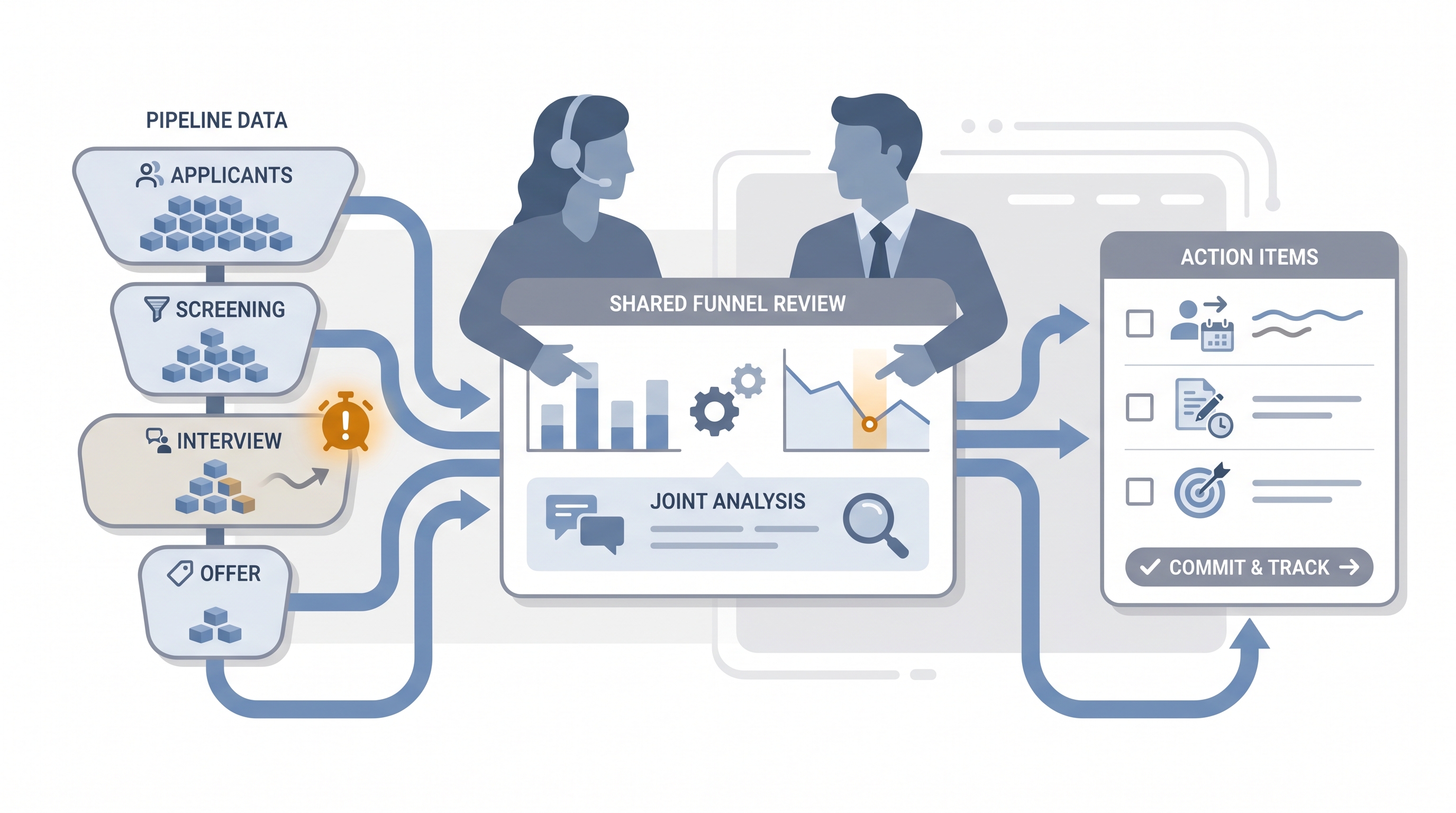
A hiring manager funnel review is a structured, recurring sync between the recruiter and hiring manager to look at the active pipeline together. It covers which candidates are in each stage, how long they have been sitting there, what feedback is missing, and what both parties need to do before the next meeting.
Most TA teams hold one when a req is new or stalled. The teams that hire fastest treat it as a weekly habit on every active role, not a reaction to problems.
The distinction from a candidate debrief matters: a debrief is about one person after an interview. A funnel review is about the whole pipeline and the process behind it.
In practice
- A recruiter pastes a short pipeline summary into a shared Notion page before the Monday call: three candidates in phone screen, two in final round sitting seven days without feedback, one offer out. The hiring manager shows up with context and the call takes 12 minutes instead of 40.
- After a AI Sourcing Lab session, a team builds a weekly ATS digest that emails itself to the hiring manager every Friday afternoon. The hiring manager flags two candidates who should have advanced two weeks ago. They trace the delay to a panel member who was never looped in on the feedback SLA.
- A TA lead notices that a hiring manager has been quietly applying different criteria in final rounds than in the intake brief. The weekly funnel review surfaces the pattern when the pass-rate from final round drops to 10 percent while earlier stages hold steady.
Quick read, then how hiring teams use it
This is for recruiters, TA leads, and HR partners who need shared vocabulary in pipeline reviews, hiring manager training, and process design. Skim the first section for fast shared context. Use the second when configuring review cadences or building dashboards.
Plain-language summary
- What it means for you: A short weekly call or async update where the recruiter and hiring manager look at the pipeline together, not just the shortlist. It catches stalls before they cost a candidate.
- How you would use it: Bring the ATS stage counts and the time-in-stage numbers. Flag anything sitting longer than your agreed SLA. Ask one decision question per review so both sides leave with a clear next action.
- How to get started: Put a recurring 15-minute slot on the calendar for every active req. Use the first three calls to build the habit before trying to automate the data prep.
- When it is a good time: When a req has been open more than 30 days, when the hiring manager seems disengaged, or when candidates are dropping off at a specific stage with no clear cause.
When you are running live reqs and tools
- What it means for you: The funnel review is where your ATS data, time in stage reporting, and pipeline coverage reporting earn their value. Without a regular review, the data sits unseen and problems compound.
- When it is a good time: Weekly for active reqs with five or more candidates in motion. Bi-weekly for slower-moving executive or niche roles. Immediately when a stage conversion drops by more than half compared to the prior week.
- How to use it: Pull stage counts and median days per stage from your ATS the morning of the review. Pair with outstanding feedback reports from your interview panel. Structure the agenda around the four items: volume, velocity, outstanding feedback, and actions.
- How to get started: Build a short pipeline report template using your ATS export or a prompt that generates the summary from structured data. Share it in the calendar invite so the hiring manager arrives informed, not waiting for context.
- What to watch for: Hiring managers who treat the review as a briefing rather than a joint decision session. If the hiring manager is not committing to actions, the format needs to shift from report to dialogue. The weekly hiring funnel report format can help by making the ask explicit in the document itself.
Where we talk about this
On AI with Michal live sessions the hiring manager funnel review comes up across both the AI in recruiting and sourcing automation tracks as the operational heartbeat beneath pipeline metrics. The most common question is how to make the prep automatic without making the conversation feel like a dashboard walkthrough. Full room conversation at Sourcing Lab.
Around the web (opinions and rabbit holes)
Third-party creators move fast. Treat these as starting points, not endorsements, and double-check anything before wiring candidate data.
YouTube
- How to Run Effective Hiring Manager Meetings (AIHR) covers the structure of recruiter and hiring manager sync calls and how to make them productive rather than ceremonial.
- Recruiting Metrics and KPIs You Need to Track (AIHR) explains the stage-level data that makes funnel reviews specific and actionable rather than anecdotal.
- How to Analyze Your Hiring Funnel (Greenhouse) walks through ATS pipeline reports and how to identify which stage contributes most to delays.
- How do you handle a hiring manager who never gives feedback? in r/recruiting is a candid thread on the accountability problem at the center of most failed funnel reviews.
- What recruiting metrics do you report to leadership? in r/recruiting has practitioner takes on which funnel numbers resonate with hiring managers versus which stay in dashboards.
- How do you keep hiring managers engaged? in r/TalentAcquisition covers tactics for maintaining hiring manager accountability mid-process.
Quora
- How do recruiters manage communication with hiring managers? collects practitioner views on cadence, format, and the data that makes reviews useful rather than performative (read critically).
Funnel review versus related touchpoints
| Touchpoint | Focus | Frequency | Output |
|---|---|---|---|
| Funnel review | Pipeline health for one or more reqs | Weekly | Shared action items |
| Candidate debrief | Evaluation of one specific candidate | After each interview stage | Advance or pass decision |
| Intake meeting | Criteria alignment before sourcing | Once per req | Scorecard and brief |
| Weekly funnel report | Data digest across all open reqs | Weekly | Alert-flagged summary |
Related on this site
- Glossary: Funnel velocity in recruiting, Time in stage reporting, Pipeline coverage reporting, Weekly hiring funnel report, Hiring funnel conversion rates, Scorecard, Funnel drop-off analysis, Sourcing funnel metrics
- Tools: AI-assisted interview feedback in the ATS
- Course: Starting with AI: the foundations in recruiting
- Live cohort: Sourcing Lab
- Membership: Become a member