Validation study (selection)
A structured research process that tests whether a hiring assessment, test, or scoring tool actually predicts the job outcome it claims to predict, such as performance or retention, in the specific role and organisation where it will be used.
Michal Juhas · Last reviewed June 26, 2026
What is a validation study in selection?
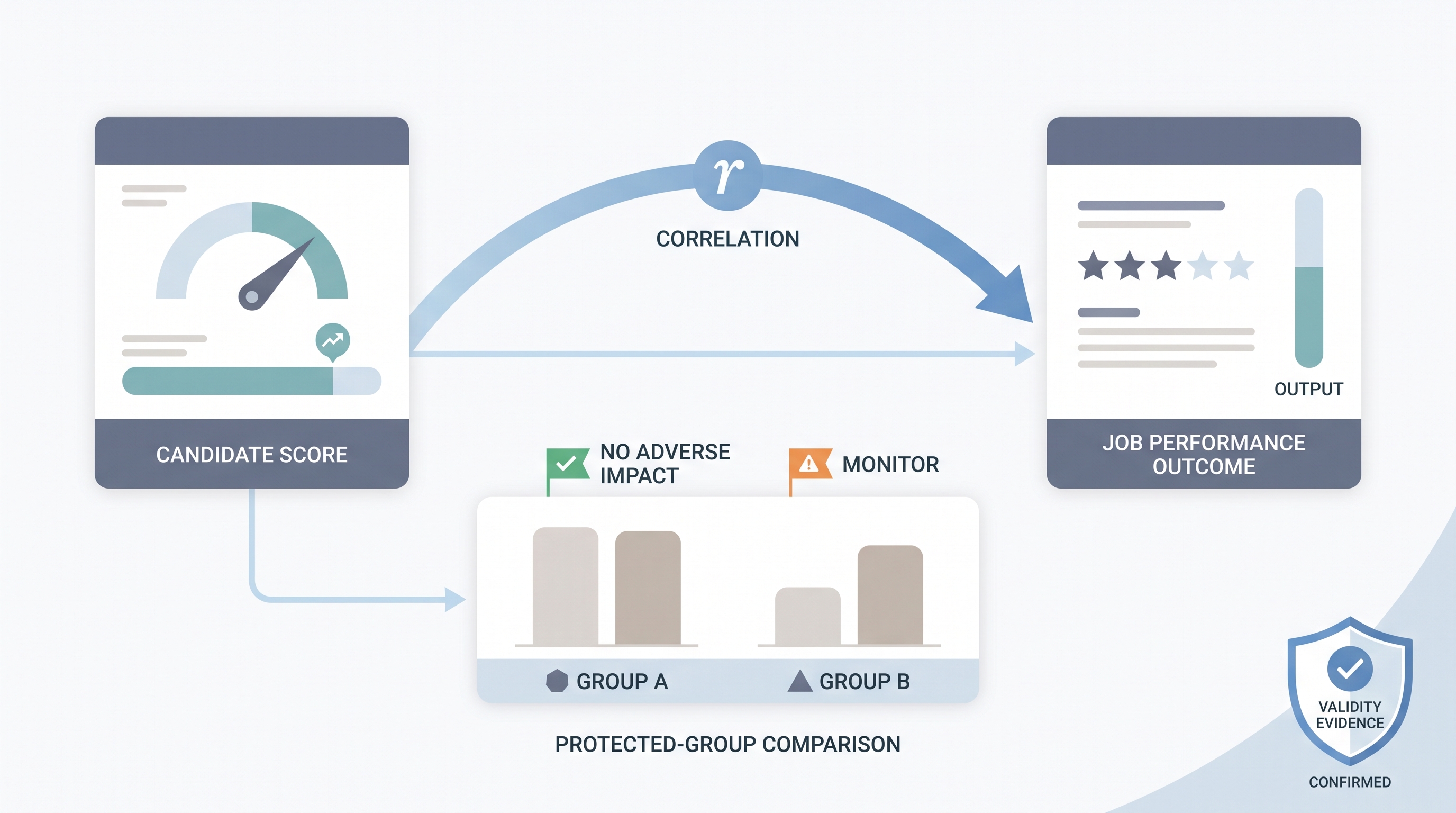
A validation study is the research that proves whether a hiring assessment actually does what it claims. Rather than taking a vendor at their word that a test predicts performance, a validation study collects data from your actual hiring pipeline or workforce and tests the statistical link between assessment scores and real job outcomes.
For recruiters and TA leaders, this matters in two practical ways. First, it is the legal defence when a regulator or plaintiff asks whether your selection process is job-related. Second, it is the quality signal that tells you whether the assessment is worth the time it adds to your hiring process. An assessment that does not predict performance is friction with no return.
The concept applies equally to traditional psychometric tests and to AI-based tools that rank resumes or score candidate responses. A high-performing model in a vendor demo is not evidence of validity in your specific context.
In practice
- A large retail employer uses a personality questionnaire for store manager hiring without a local validation study. Three years later, an adverse impact claim surfaces and legal asks for the validation file. The vendor provides a general study covering retail broadly, which is not strong enough to defend the specific use case.
- A TA ops lead at a mid-size tech company commissions a content validity study before deploying a work sample test for software engineers. The process takes six weeks and a small external consultant fee, but the team can point to job task alignment when a candidate challenges the process.
- An AI resume screener is evaluated during vendor renewal. The people analytics team runs a retrospective analysis against performance data for the past 18 months and finds the tool predicts top-performer placement slightly better than the prior manual process, but shows a small disparity for one demographic group that triggers a calibration review before renewal.
Quick read, then how hiring teams use it
This is for recruiters, TA leaders, and HR business partners who need to understand validation before procuring assessments or defending selection processes. Skim the first section for the core concept. Use the second when you are in a vendor evaluation, a compliance review, or building the case for or against an assessment tool.
Plain-language summary
- What it means for you: A validation study is the evidence that a test or AI scorer actually predicts job performance in your specific context, not just in the vendor's general research.
- How you would use it: Ask for validation evidence during procurement and check whether the study covers roles, seniority levels, and demographic groups comparable to your hiring population.
- How to get started: Pull one high-volume role, pull performance data for people hired via your current process, and check whether scores from the assessment you are evaluating correlate with the outcome you care about.
- When it is a good time: Before deploying any assessment at scale, and during any annual review of tools that contribute to employment decisions.
When you are running live reqs and tools
- What it means for you: Every assessment tool in your pipeline that influences hiring decisions carries a validation obligation. AI-based tools are explicitly included under EEOC guidance and increasingly under state and local law.
- When it is a good time: Before procurement approval and before any tool reaches more than a pilot cohort. Revisit annually.
- How to use it: Request the technical manual and validity evidence from the vendor. Check whether it covers your role family and seniority. If it does not, ask for a transport validity rationale or commission a small local study.
- How to get started: Start with your most-used assessment. Map who owns validity oversight. Establish a cadence for monitoring adverse impact metrics on any tool that produces a score used in hiring decisions.
- What to watch for: Vendors citing test reliability instead of validity evidence, generic industry studies presented as role-specific validation, and AI tools with no published adverse impact data.
Where we talk about this
On AI with Michal live sessions, assessment validity comes up in AI in recruiting blocks when participants are evaluating AI screening and scoring tools and need to separate vendor claims from evidence. The membership community includes HR leaders who have navigated regulatory audits involving AI-based selection tools.
Around the web (opinions and rabbit holes)
Third-party creators move fast. Treat these as starting points, not endorsements.
YouTube
- Searches for "selection validation study HR" and "EEOC uniform guidelines hiring" on YouTube surface I-O psychology explainers and employment law discussions aimed at HR practitioners.
- r/IOPsychology has detailed discussions on validity types, sample size requirements, and how practitioners run studies in applied settings.
- r/humanresources has candid threads on assessment procurement and what happens when legal gets involved after a challenge.
Quora
- Searches for "hiring assessment validity" and "how to validate a pre-employment test" collect a range of practitioner and academic answers worth filtering by applied context.
Related on this site
- Glossary: Adverse impact, AI bias audit, Structured interview, Async screening, Scorecard
- Lab: AI Sourcing Lab
- Membership: Become a member