Structured interview
An interview format where every candidate is asked the same predetermined questions in the same order and scored against a shared rubric, reducing bias and improving the predictive validity of hiring decisions.
Michal Juhas · Last reviewed June 21, 2026
What is a structured interview?
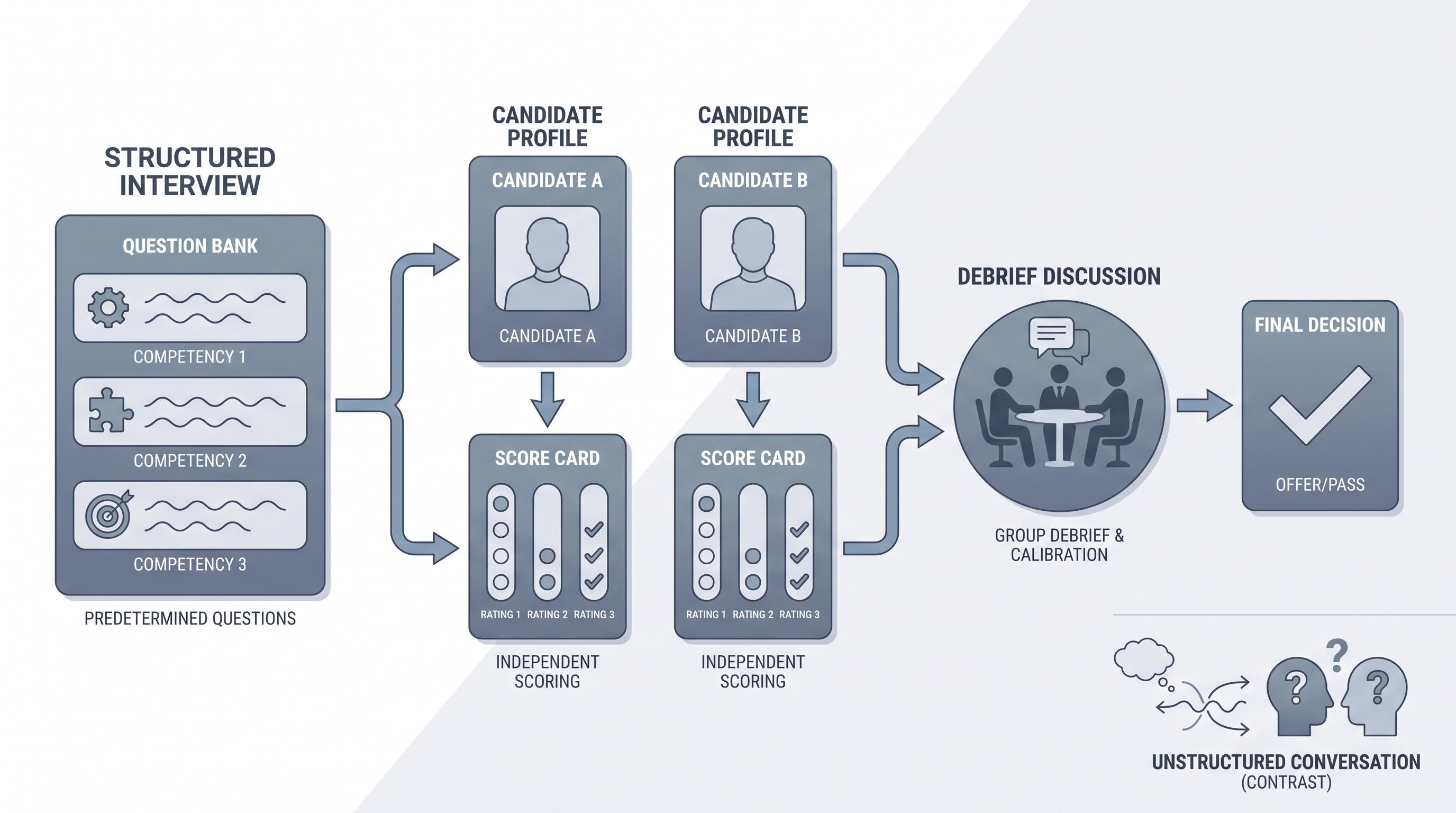
A structured interview is an evaluation format where every candidate for the same role is asked exactly the same predetermined questions, in the same order, and scored against a shared rubric before any group discussion happens.
The format is grounded in decades of industrial-organisational psychology research showing that unstructured conversations, however skilled the interviewer, predict job performance poorly. The reason: unstructured interviews allow too much variation in what is asked and how answers are interpreted, which lets irrelevant factors influence decisions.
In practice
- A recruiting manager at a 300-person SaaS company implements structured interviewing for engineering roles after noticing that two senior engineers on the same panel gave wildly different scores to the same candidate with no shared rubric. She builds a four-question bank tied to the competency framework and runs a 30-minute calibration session before the next hire. Score agreement improves immediately.
- A TA leader prepares for an employment tribunal by pulling interview records for a rejected candidate who alleged bias. Because the team ran structured interviews, she can show a complete, consistent question log with per-interviewer scores submitted before the debrief. The file closes quickly.
- A sourcer building a pipeline for a high-volume customer service role notices that unstructured phone screens vary from 8 to 35 minutes per candidate depending on the recruiter. She proposes a 10-question structured phone screen with a score threshold that unlocks the video stage, reducing screening time and improving consistency.
Quick read, then how hiring teams use it
This is for recruiters, hiring managers, and TA leaders who design and run interview processes. Skim the first section for the vocabulary. Use the second section when you are building or auditing a structured interview programme.
Plain-language summary
- What it means for you: Structured interviews reduce the influence of gut feel and irrelevant conversation on hiring decisions, and they produce a defensible paper trail.
- How you would use it: Define three to five competencies per role. Write two to three behavioural questions per competency from a job analysis. Build a scoring rubric with behavioural anchors. Train interviewers to score before the debrief.
- How to get started: Pick the highest-volume role family in your company. Write a question bank with a hiring manager and an experienced TA professional. Run a calibration session with every interviewer before the first panel. Review score data after 10 hires.
- When it is a good time: When you are scaling hiring in a role family, when a discrimination complaint lands, when hiring manager feedback quality is inconsistent, and when two interviewers keep disagreeing on the same candidates.
When you are running live reqs and tools
- What it means for you: At scale, structured interviewing only holds if the process is enforced in your ATS and scheduling system. Interviewers who skip questions or skip scoring break the validity of the method for the entire cohort.
- When it is a good time: During ATS setup for a new interview stage, when onboarding new interviewers, and after any change to the role requirements that may need a question bank update.
- How to use it: Store your question banks in the ATS interview kit so interviewers receive them automatically. Require score submission before the candidate can advance. Pull a weekly report on score completion rates by interviewer and flag anyone below 90 percent.
- How to get started: Export your last 20 closed reqs and check how many have complete, timestamped scoring records. The gaps tell you where process compliance is breaking down.
- What to watch for: AI interview scoring tools that summarise answers before the interviewer submits their own score introduce anchoring from the AI rather than from a peer. Require individual human scoring first. See AI interview intelligence for how to integrate AI tools without undermining structured scoring.
Where we talk about this
On AI with Michal sessions, structured interviewing comes up when teams are designing human-in-the-loop processes for AI-augmented hiring. If you want to build a question bank and rubric for a specific role family and practice calibration, bring your competency framework to an AI Recruiting Accelerator.
Around the web (opinions and rabbit holes)
Third-party creators move fast. Treat these as starting points, not endorsements, and do not copy stranger scripts that move candidate data.
YouTube
- Search "structured interview training" on YouTube for content from SHRM, Criteria Corp, and talent management consultancies explaining the behavioural anchor rubric and calibration process.
- "Predictive hiring" talks from Industrial-Organisational psychology researchers on YouTube cover the validity evidence comparing structured and unstructured interview formats.
- r/recruiting threads on "structured interviews" include practitioner experiences rolling them out at companies where hiring managers resist losing conversational flexibility.
- r/humanresources discussions on "bias in hiring" frequently reference structured interviews as one of the few evidence-based mitigation strategies.
Quora
- What is the difference between structured and unstructured interviews? collects practitioner and researcher answers explaining the trade-offs in detail.
Structured vs unstructured interview comparison
| Dimension | Structured | Unstructured |
|---|---|---|
| Questions | Same for every candidate | Varies by candidate or interviewer |
| Scoring | Against a shared rubric before debrief | Holistic, often after group discussion |
| Predictive validity | Higher (0.50 to 0.57) | Lower (0.38) |
| Legal defensibility | Stronger documentation | Weak to moderate |
| Interviewer training required | More | Less |
| Candidate experience | Can feel rigid | Can feel more natural |
Related on this site
- Glossary: Panel debrief alignment, AI-generated interview questions, Calibration session in hiring, AI bias audit, Adverse impact, EU AI Act and hiring, Interview transcription
- Blog: AI sourcing tools for recruiters
- Live cohort: AI Sourcing Lab
- Course: Starting with AI: the foundations in recruiting
- Membership: Become a member