Work sample assessment
A hiring exercise that asks candidates to complete a task directly representative of the actual job, such as writing a sourcing strategy, reviewing a job description, or responding to a candidate scenario, to evaluate real performance rather than predicting it from abstract trait scores.
Michal Juhas · Last reviewed June 26, 2026
What is a work sample assessment?
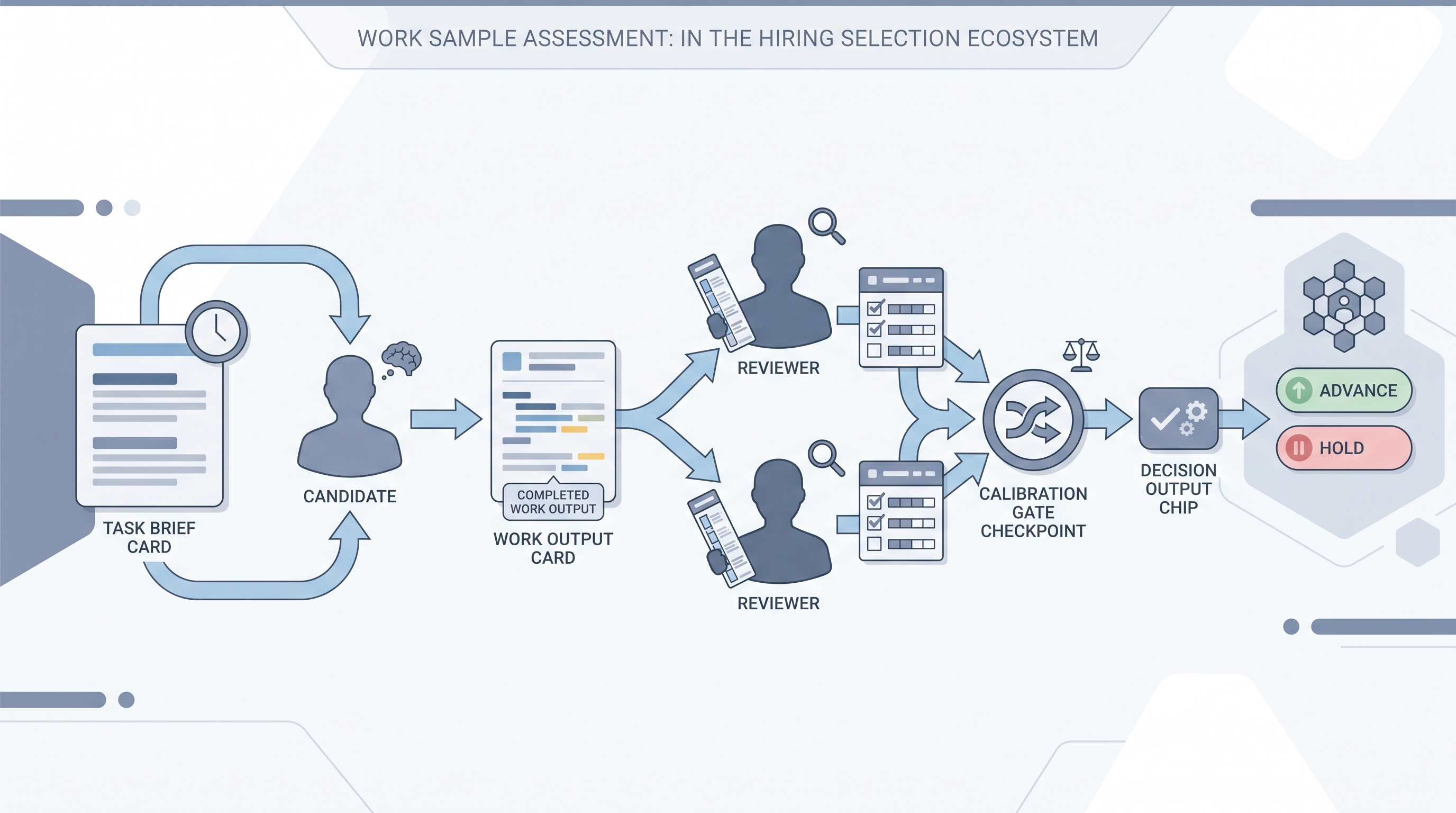
A work sample assessment asks candidates to complete a realistic version of the actual job before being hired. Rather than asking how they would approach a problem or measuring an abstract trait believed to predict performance, it gives them the task and evaluates what they produce.
For recruiting teams, common examples include writing a sourcing message for a specific target persona and req, building a brief talent mapping strategy for a hard-to-fill role, reviewing a job description for bias and clarity, or running a structured intake call simulation. The exercise does not need to be exhaustive, it needs to be representative.
Work samples consistently rank among the most predictive selection methods in research literature. The reason is straightforward: the closer the assessment task is to the actual work, the less prediction required and the more direct measurement becomes possible.
They also create a useful shared artefact for debrief: panelists can discuss a concrete piece of work rather than reconciling abstract impressions of culture fit.
In practice
- A talent acquisition team adds a two-hour sourcing exercise to the interview process for senior sourcing roles. Candidates receive a fictional job brief and a partial list of target companies and are asked to produce a sourcing strategy and an outreach message. The rubric reduces disagreement between panelists by 40 percent compared to the previous unstructured technical interview.
- An AI-assisted first-pass review of work sample outputs uses a prompt aligned to the scoring rubric to flag submissions missing a GDPR consideration or a clear subject line. The team uses this as a consistency check, not a decision, and validates that the AI flags align with human scores on the first 30 submissions before trusting it for volume.
- A recruiter notices that work sample drop-off is higher among women with primary care responsibilities. The team reduces the task window from four hours to 90 minutes and makes it optional, with an in-interview alternative. Drop-off decreases without measurable reduction in predictive value.
Quick read, then how hiring teams use it
This is for recruiters, TA leaders, and hiring managers who want to build better assessments for roles where abstract trait tests are not convincing anyone. Skim the first section for the core idea. Use the second when you are designing or evaluating a work sample task, or when debrief calibration is inconsistent.
Plain-language summary
- What it means for you: A work sample shows what a candidate does when given a realistic version of the job, not just what they say they would do. For recruiting and sourcing roles, it is often the clearest signal in the whole process.
- How you would use it: Define the two most important tasks in the role. Build a brief exercise around one of them. Write the rubric before you look at any submissions.
- How to get started: Pick a recent real task from the role (anonymised) and adapt it into a take-home exercise. Have two people on the team complete it independently to test whether the rubric is clear before you use it on candidates.
- When it is a good time: When debrief conversations keep producing disagreements about quality that the interview alone cannot resolve, or when you need to differentiate between candidates who are all strong at presenting.
When you are running live reqs and tools
- What it means for you: Work samples have high validity but high overhead. The design, rubric, and drop-off management require more up-front investment than adding a cognitive test, but the debrief quality and hiring manager buy-in are usually worth it for high-impact roles.
- When it is a good time: For specialist and senior roles where the cost of a mis-hire is high. Less suited to high-volume, time-constrained pipelines unless the task is very short and well-calibrated.
- How to use it: Standardise the brief across every candidate. Define the rubric with the hiring manager before the first submission arrives. Calibrate with at least two evaluators on the first batch. Monitor adverse impact quarterly once the assessment is at scale.
- How to get started: Audit your current interview process for the step where panelist disagreement is highest. That is usually where a work sample can reduce noise most efficiently.
- What to watch for: Intellectual property concerns (do not use the candidate's work in production), disproportionate time burden on candidates with care responsibilities, and AI evaluation tools that reward style over substance.
Where we talk about this
On AI with Michal live sessions, work sample design comes up in AI in recruiting blocks when participants are building rubrics and exploring how AI can assist with both creating tasks and reviewing outputs consistently. The membership community includes practitioners who have built and iterated sourcing work samples in production.
Around the web (opinions and rabbit holes)
Third-party creators move fast. Treat these as starting points, not endorsements.
YouTube
- Searches for "work sample test hiring" and "take-home assessment recruiting best practices" surface a mix of I-O psychology explainers and practitioner discussions on design and candidate experience tradeoffs.
- r/recruiting has candid threads on take-home assignments: when they are worth it, when they drive drop-off, and how long is too long.
- r/IOPsychology covers validity, rubric design, and how work samples compare to other selection methods on predictive power.
Quora
- Searches for "work sample assessment validity" and "take home assignment hiring bias" collect practitioner and researcher answers on design, scoring, and fairness.
Related on this site
- Glossary: Structured interview, Adverse impact, Validation study (selection), AI bias audit, Scorecard, Few-shot prompting
- Lab: AI Sourcing Lab
- Membership: Become a member