Indemnification clauses in client-agency contracts
A contractual provision in client-agency recruiting agreements that requires one or both parties to compensate the other for specified losses, legal costs, or third-party claims arising from defined events such as discrimination complaints, data breaches, or misrepresentation during the hiring process.
Michal Juhas · Last reviewed May 5, 2026
What are indemnification clauses in client-agency contracts?
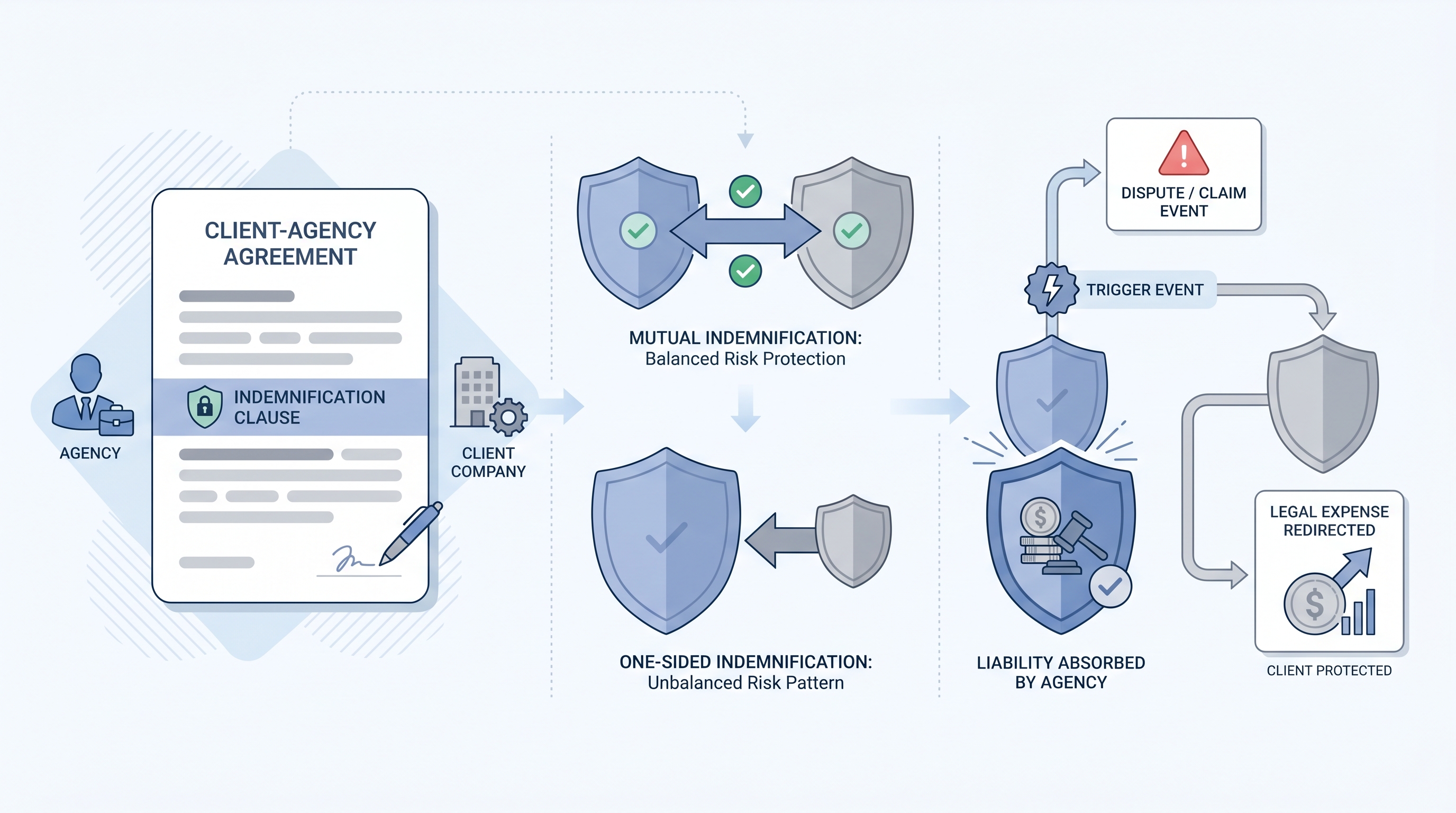
Indemnification clauses, sometimes called hold-harmless clauses, are the contractual provisions in client-agency recruiting agreements that define which party absorbs the financial and legal cost when something goes wrong. Instead of leaving liability open for courts to decide, the clause negotiates the answer upfront: if a candidate files a discrimination complaint naming both the agency and the client, which party funds the defence? If a data breach exposes candidate CVs that were in the agency's systems, who bears the cost of notification and litigation?
In most well-drafted contracts, indemnification is mutual: each party covers losses that arise from its own actions or negligence. The agency indemnifies the client for errors in screening, background check handling, or misrepresentation of candidate qualifications. The client indemnifies the agency for losses that stem from the client's own conduct, such as discriminatory selection decisions or a misleading job brief. Carve-outs for gross negligence and intentional misconduct are standard.
What makes these clauses worth reading carefully is their scope. Vague language like "any claim arising from the engagement" can be read to include events the agency had no part in causing. The trigger event definitions, the survival period after contract termination, and whether the indemnification is paired with a liability cap are all negotiating points that affect real financial exposure.
In practice
- A senior agency recruiter reviewing a new enterprise client contract flags a clause requiring the agency to indemnify the client for any employment claims arising from the engagement, including decisions the client made internally during interviews. She escalates to legal, who negotiates a mutual clause with a liability cap equal to twelve months of fees before the contract is executed.
- An agency founder receives a staffing agreement from a financial services firm that includes cyber liability indemnification covering candidate data breaches. Before signing, she confirms with her insurer that the agency's cyber policy covers personal data events at sufficient limits. She signs with documented evidence that the indemnification obligation is backed by real coverage, not just a contractual promise.
- A TA operations manager auditing five active agency vendor contracts discovers three different definitions of what constitutes a qualifying claim under the indemnification clauses. She standardises the trigger event language during contract renewal and logs the change in the vendor governance record.
Quick read, then how hiring teams use it
This page is for TA leaders and legal or procurement teams reviewing agency agreements, and for agency principals who want to understand how indemnification clauses affect both sides of the relationship. Skim the first section for the definition. Use the second when you are reviewing contract terms or setting up a vendor governance workflow.
Plain-language summary
- What it means for you: An indemnification clause decides who pays when a third-party claim arises from the recruiting engagement. Without a well-defined clause, you may absorb costs from events the other party caused.
- How you would use it: Read the trigger event definitions in every client contract before signing. Flag any clause that requires you to indemnify the other party for losses outside your control or that lacks a corresponding liability cap.
- How to get started: Pull your last five active agency contracts and check whether the indemnification clauses are mutual or one-sided, what the trigger events are, and whether a liability cap is included. That audit tells you where your current exposure sits.
- When it is a good time: Any time you are signing a new agency agreement, renewing an existing one, or building a vendor governance framework that covers contract risk.
When you are running live reqs and tools
- What it means for you: Indemnification clauses are not just a legal formality. They affect what happens operationally when a candidate complaint, a data incident, or a billing dispute escalates. Finance and legal teams need to know the trigger events before they arise, not after.
- When it is a good time: At contract intake, before signature. Do not wait until an incident to read the indemnification section.
- How to use it: Use workflow automation to flag incoming contracts that include broad indemnification language and route them to legal review before they reach the signing stage. A language model can pre-screen clause wording and summarise risk patterns for a non-legal reader.
- How to get started: Create a contract review checklist item that captures: mutual or one-sided, trigger event definitions, survival period, and whether a liability cap is present. Add this to your vendor onboarding template alongside fee terms.
- What to watch for: Clauses that survive termination for unusually long periods, trigger events that include the other party's own conduct, and indemnification obligations not backed by matching insurance requirements. See rebate and clawback clauses for the related placement fee protection provisions that often sit in the same contract section.
Where we talk about this
On AI with Michal live sessions, agency contract terms come up in the AI in recruiting track when participants who work with external agencies ask how to structure vendor relationships and what to automate versus keep manual. The Sourcing Lab cohort covers placement fee structures, retainer agreements, and contract governance alongside sourcing automation, so TA leaders and agency principals can align on vocabulary and risk before they negotiate.
Around the web (opinions and rabbit holes)
Third-party creators cover indemnification clauses in staffing and recruiting contracts from legal, operational, and procurement angles. These are starting points, not endorsements. Verify any clause template with a qualified employment or commercial lawyer before using it. Do not copy and paste clause language from a stranger's script that touches your client or candidate data.
YouTube
- Indemnification clauses explained for small business covers the basic mechanics of hold-harmless clauses from a commercial contract perspective applicable to agency agreements.
- Recruiting agency contract negotiation includes practitioner walkthroughs of liability and indemnification terms from both the agency and client side of the table.
- Staffing agency liability and indemnification covers employment law perspectives on indemnification exposure for staffing firms placing temporary and permanent workers.
- Staffing agency contract liability discussions in r/RecruitmentAgencies covers real situations where agency owners have encountered broad indemnification language in enterprise client contracts.
- Negotiating vendor contracts in HR in r/humanresources surfaces HR-side experiences reviewing agency agreements and flagging one-sided liability clauses.
- Small business contract indemnification in r/smallbusiness is a recurring discussion on which indemnification terms are standard and which are negotiable for service providers.
Quora
- How do indemnification clauses work in service contracts? collects practitioner and legal perspectives on how hold-harmless clauses are structured, triggered, and enforced across different service industries.
Mutual versus one-sided indemnification
| Aspect | Mutual indemnification | One-sided indemnification |
|---|---|---|
| Who is covered | Both parties for losses arising from their own actions | Client only; agency bears all specified losses |
| Common in | Standard agency agreements, SME client contracts | Large enterprise and procurement-led contracts |
| Financial risk | Balanced; each party's exposure tied to their own conduct | Agency absorbs risk it may not have caused |
| Negotiating position | Baseline to request if the initial draft is one-sided | Flag to legal; negotiate a mutual clause or a liability cap |
| Paired with | Liability cap limiting total exposure on both sides | Often presented without a cap; push to add one |
Related on this site
- Glossary: Rebate and clawback clauses on placement fees, Business development for recruiting agencies, Retainers and escrow for search engagements
- Glossary: Data room and due diligence when selling a recruitment agency, Recruitment agency software, Workflow automation
- Glossary: GDPR and first-touch outreach, Human-in-the-loop
- Workshops: Sourcing Lab
- Course: Starting with AI: the foundations in recruiting
- Membership: Become a member