GDPR and first-touch candidate outreach
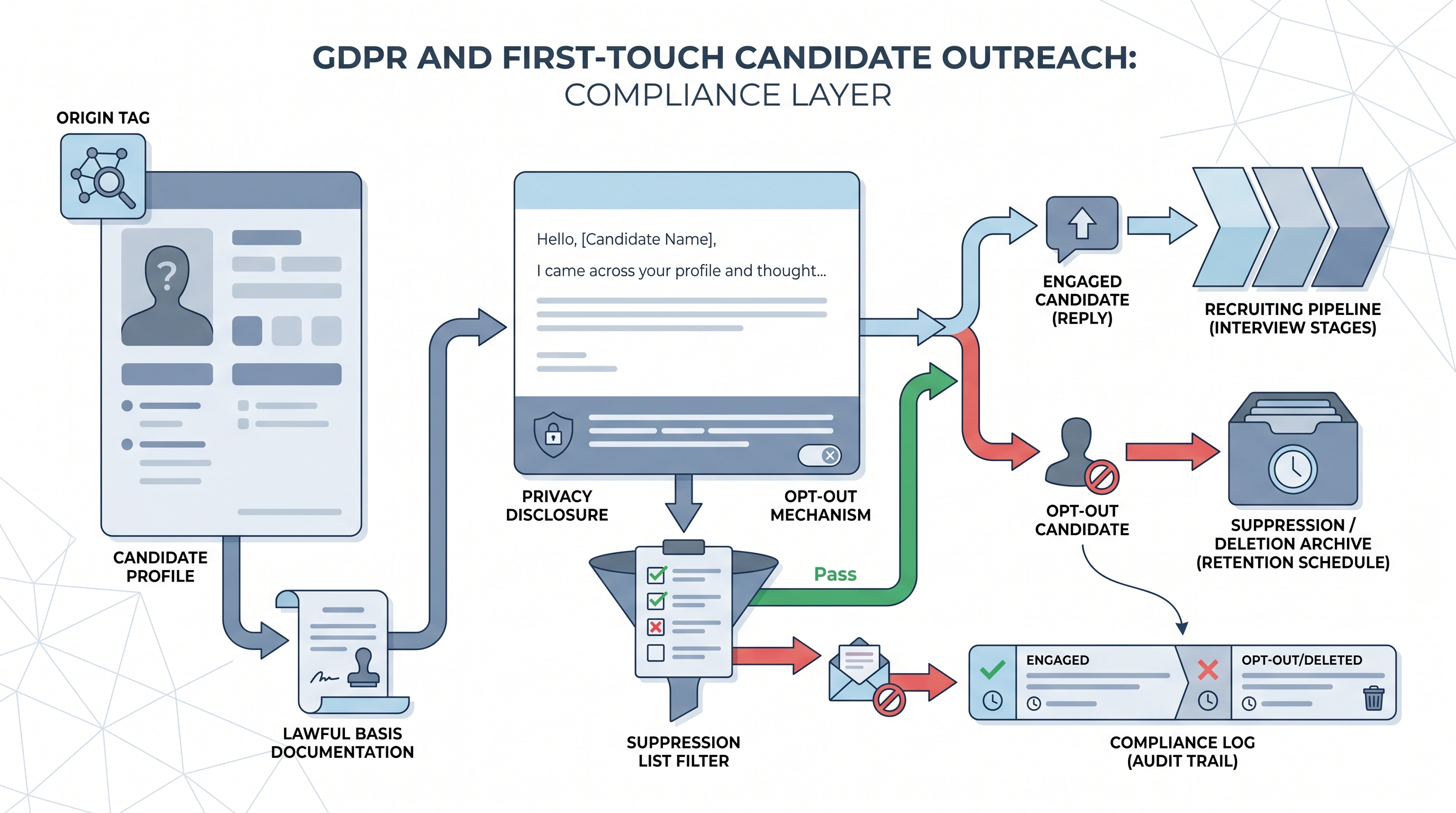
The set of legal obligations under GDPR that apply the moment a recruiter first contacts a passive candidate: documenting a lawful basis, disclosing data sources, offering opt-out rights, and retaining a record of the first communication and the consent status it established.
Michal Juhas · Last reviewed May 4, 2026
What is GDPR and first-touch candidate outreach?
GDPR and first-touch candidate outreach covers the legal obligations that activate the moment a recruiter contacts a passive candidate for the first time. Under the General Data Protection Regulation, that first message is not just a business communication: it is the point at which the recruiter must disclose that they hold the candidate's personal data, explain where they obtained it, state the purpose and legal basis for processing it, and make it easy for the candidate to opt out or request deletion.
Most sourcing compliance gaps are first-touch gaps. The data was collected lawfully, the outreach was well-intentioned, but the moment of disclosure was skipped or buried, which means the processing chain is technically non-compliant from the first send.
In practice
- A sourcer sends an InMail that says "I found your profile on LinkedIn and wanted to reach out about a role" without naming where their email address came from or how they can be removed from the recruiter's CRM. That gap is an Article 14 GDPR failure even if the message is polite and the candidate never complains.
- A TA ops lead adding a one-line privacy footer to every outreach template ("We found your details via [source]. To update or remove your record, reply to this email or visit [link]") is a minimal but meaningful compliance step that most teams have not taken before a session.
- When a candidate replies to a sequence saying "please remove me from your list" and the recruiter marks them as do-not-contact in the CRM but does not suppress them in the enrichment tool, the next monthly run re-adds them to the pipeline and the automated sequence fires again. That second contact after an opt-out is the moment a regulatory complaint becomes likely.
Quick read, then how hiring teams use it
This is for recruiters, sourcers, TA, and HR partners who need the same vocabulary in debriefs, vendor calls, and policy reviews. Skim the first section when you need a fast shared picture. Use the second when you are deciding how it shows up in the ATS, sourcing tools, or candidate communications.
Plain-language summary
- What it means for you: Every first message to a passive candidate triggers a legal obligation to tell them you hold their data, where you got it, why you are using it, and how they can ask you to stop. This applies even if the message is a friendly LinkedIn note.
- How you would use it: Add a privacy disclosure line to every outreach template. Document the lawful basis for each sourcing campaign. Maintain a suppression list and wire it to every tool in your sequence stack.
- How to get started: Pull your three most-used outreach templates today. Check whether each one names the data source and includes an opt-out mechanism. If not, add one line before the next send. Then document the lawful basis for the outreach in a one-page record.
- When it is a good time: Before you automate any outreach sequence. Automation at scale without a compliance layer multiplies every gap across every candidate it touches.
When you are running live reqs and tools
- What it means for you: When outreach runs through automation, the GDPR obligations do not scale down with the volume: every candidate in a sequence of 500 needs the same disclosure a recruiter would give in a one-to-one message. The suppression list, the DPA chain, and the deletion workflow all need to be in place before launch.
- When it is a good time: After legal has signed off on the lawful basis and template language, and after the suppression list is wired as a filter in every tool in the stack. Not while the outreach copy is still changing every cycle.
- How to use it: Include the disclosure in message step one of every sequence. Set a maximum follow-up count so the sequence stops before a non-response becomes evidence of unwanted processing. Log the disclosure date and channel per candidate record in your CRM.
- How to get started: Build a one-page compliance template: lawful basis, data sources, disclosure language, opt-out mechanism, suppression list location, and deletion workflow owner. Run it past legal before the first automated campaign. Update it when you add a new enrichment vendor or outreach channel.
- What to watch for: Sequences that fire a fourth or fifth follow-up after no response, enrichment tools that re-add opted-out candidates on the next run, outreach copy that skips the data source because the template was copied from a sales sequence, and DPAs that name the CRM but not the enrichment vendor that supplied the contact detail.
Where we talk about this
On AI with Michal live sessions, sourcing automation blocks address GDPR compliance as infrastructure, not an afterthought: lawful basis, template design, suppression lists, and DPA chains are part of the technical setup before any sequence launches. AI in recruiting sessions connect the same obligations to screening-stage decisions and candidate communications at scale. If you want a live room review of your current outreach templates and sequence design, join Sourcing Lab and bring your actual sequence copy and vendor list.
Around the web (opinions and rabbit holes)
Third-party creators move fast here. Treat these as starting points, not endorsements, and verify current regulatory guidance directly for your jurisdiction before making compliance decisions.
YouTube
- GDPR for Recruiters Explained covers the practical obligations that apply to sourcing and outreach for talent teams operating under EU law.
- Cold Email and GDPR: What You Need to Know walks the disclosure and opt-out requirements that apply equally to sourcing outreach and B2B sales sequences.
- Data Protection for HR Professionals covers retention, deletion, and DSAR handling for teams that manage candidate records at scale.
- GDPR and cold recruiting outreach: what do you actually include? in r/Recruitment is a frank thread on what practitioners are doing in practice versus what the regulation technically requires.
- Has anyone received a GDPR complaint from a candidate? in r/recruiting covers real post-mortems from teams that discovered their compliance gap the hard way.
- Suppression lists in recruiting sequences: how do you manage them? in r/sourcing covers the opt-out infrastructure that most sourcing automation setups skip until a problem surfaces.
Quora
- Do GDPR rules apply when recruiting passive candidates? collects legal and practitioner perspectives on the obligations that apply to sourcing outreach across EU and non-EU contexts.
Compliance checklist for first-touch outreach
| Step | What it covers | Who owns it |
|---|---|---|
| Document lawful basis | Legitimate interest balancing test per campaign | TA ops or legal |
| Add privacy disclosure | Source, purpose, opt-out link in message template | Recruiter or ops |
| Wire suppression list | Filter opted-out records from every tool in the stack | TA ops |
| DPA for enrichment vendors | Subprocessor named and agreement signed | Legal or procurement |
| Deletion workflow | Remove record from CRM and subprocessors within 30 days | TA ops |
Related on this site
- Glossary: Talent data aggregators for sourcing, Contact enrichment for sourcing, Proprietary talent pool, Workflow automation, Human-in-the-loop, Niche talent pool sourcing strategy
- Blog: AI sourcing tools for recruiters
- Guides: Sourcers
- Live cohort: Sourcing Lab
- Membership: Become a member