Agency invoice payment terms and collections
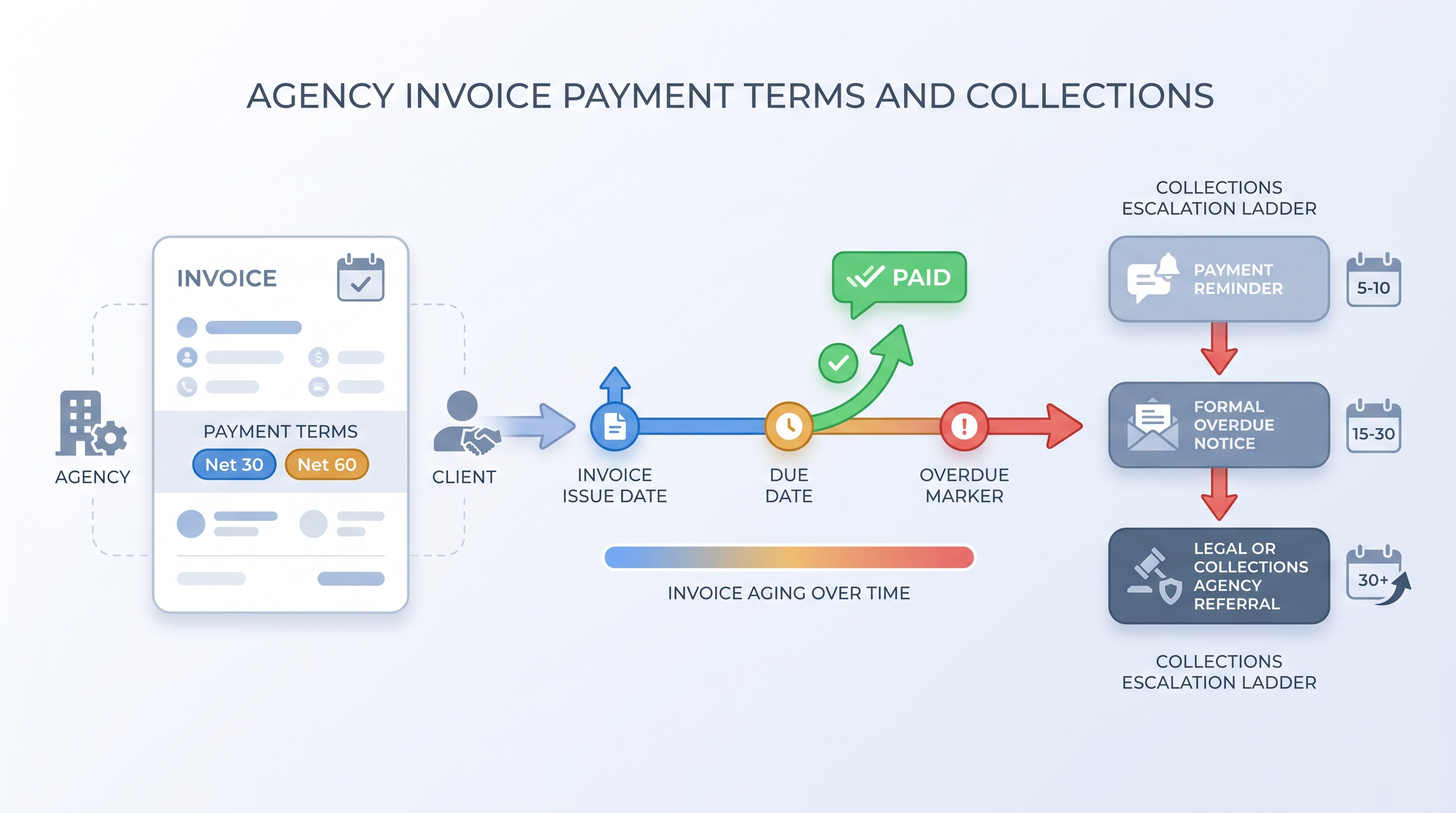
The contractual provisions in a recruiting agency agreement that specify when a client must pay a placement fee or retainer, typically expressed as Net 30, Net 60, or milestone-based schedules, together with the structured process the agency follows when payment is overdue or disputed.
Michal Juhas · Last reviewed May 5, 2026
What are agency invoice payment terms and collections?
Invoice payment terms in a recruiting agency contract are the provisions that define when and how a client must pay a placement fee, retainer installment, or other agreed fee. They are expressed as a time window from the invoice date, typically Net 30, Net 60, or Net 90, or tied to specific milestone events in the search or placement process. The collections process is the structured set of actions the agency takes when a client misses a payment deadline.
For a contingency agency, the entire fee arrives in a single invoice after candidate acceptance. The payment term then determines how long the agency waits between delivery of the hire and receipt of the cash. For a retained search firm, fees are split across milestones, so the payment term affects each installment separately. In both cases, the gap between invoice issue and payment receipt is an operational cashflow exposure that compounds as the agency grows its billing volume.
Understanding both the payment terms you agree to and the collections steps available to you before you sign a client contract is as important as negotiating the fee percentage itself. An agency that consistently accepts Net 90 terms without adequate working capital reserves will eventually face a cashflow constraint that limits its ability to hire, invest in sourcing tools, or sustain marketing spend.
In practice
- A contingency agency owner negotiates a new enterprise client contract with standard Net 60 terms and a placement fee of 22% on salary. Before signing, she runs a cashflow projection showing that two concurrent placements at Net 60 create a 40,000 gap in month two. She negotiates Net 45 with a 1.5% prompt-payment discount for settlement within 10 days, which the client accepts.
- A retained search firm invoices the first third of a retained fee on engagement signing. The client's accounts-payable team routes the invoice through a three-step approval process and pays 45 days after the invoice date despite the contract specifying Net 30. The firm sends a formal overdue notice at day 32, logs the contact, and receives payment within the week.
- An agency operations manager builds an automated invoice tracking workflow that sends a reminder email three days before each due date, flags invoices that pass the due date without a payment record, and generates a weekly overdue report for the owner. The owner handles escalation calls personally rather than delegating to a junior recruiter, keeping the client relationship intact while moving the balance forward.
Quick read, then how hiring teams use it
This page is for agency founders, operations managers, and finance leads who negotiate or manage client billing, and for TA leaders who work with external agencies and want to understand what their contracts commit them to on the payment side.
Plain-language summary
- What it means for you: Invoice payment terms define how long you are effectively financing your client after the placement is made. Collections is what you do when they do not pay on time.
- How you would use it: Review payment terms in every client contract before signing. Build a cashflow model that shows the impact of Net 30 versus Net 60 on your operating runway.
- How to get started: Pull your last five active client contracts and note the payment term on each. Calculate the average days to cash receipt from invoice date across your last 10 placements. If the gap is consistently longer than your contract terms, your collections process needs tightening.
- When it is a good time: When signing a new client contract, when renewing an existing agreement, or when a payment starts running late and you need to decide how to respond.
When you are running live reqs and tools
- What it means for you: Payment terms are not just a finance concern. A large unpaid invoice from an active client affects whether you can staff up for the next search without drawing down reserves.
- When it is a good time: At contract intake for new clients, and at the first missed payment milestone for existing ones.
- How to use it: Use workflow automation to automate invoice reminders and overdue flagging. Use a language model to draft formal demand letters that are clear and professional without being unnecessarily aggressive. Keep the escalation decision with a senior person who can weigh the relationship context.
- How to get started: Define your collections ladder explicitly: reminder at day minus 3, overdue notice at day plus 2, escalation call at day plus 15, formal demand letter at day plus 30, external collections or legal referral at day plus 60. Document the ladder in your standard operating procedure and follow it consistently so clients know the process is not discretionary.
- What to watch for: Clients who consistently pay late but always within the guarantee period, which can suppress rebate claims while still straining cashflow. See rebate and clawback clauses for how late payment interacts with the guarantee window, and indemnification clauses in client-agency contracts for the contract provisions that affect what you can recover when a dispute escalates.
Where we talk about this
On AI with Michal live sessions, agency billing and cashflow topics come up in the AI in recruiting track when agency founders and TA operations leads ask how to systematize the business side of running a search firm alongside sourcing and screening automation. The Sourcing Lab cohort covers placement fee structures, retainer agreements, and contract governance so TA leaders and agency principals can align on vocabulary and operational process before they negotiate.
Around the web (opinions and rabbit holes)
Third-party creators cover invoice payment terms and agency collections from legal, accounting, and operational perspectives. These are starting points, not endorsements. Verify any clause template or collections approach with a qualified commercial lawyer or accountant before applying it to your contracts.
YouTube
- How to collect unpaid invoices as a small business covers the escalation ladder from reminder to formal demand to legal referral, applicable to agency fee recovery.
- Invoice payment terms explained for freelancers and agencies covers the practical difference between Net 30, Net 60, and milestone-based billing from an agency and freelancer perspective.
- Cash flow management for recruiting agencies covers working capital planning, accounts receivable, and how agencies manage the gap between delivery and payment.
- Late payment and collections in r/RecruitmentAgencies covers real situations where agency owners have dealt with slow-paying enterprise clients and the steps that worked.
- Invoice terms negotiation in r/smallbusiness covers how service businesses negotiate Net 30 against enterprise procurement teams that push for Net 60 or Net 90.
- Accounts receivable and cashflow in r/Entrepreneur covers the operational realities of B2B invoicing, late payment, and building collections processes that protect relationships.
Quora
- How do staffing agencies handle non-payment of placement fees? collects practitioner accounts of collections escalation from internal outreach to formal legal steps in the staffing industry.
Net 30, Net 60, Net 90: quick comparison
| Aspect | Net 30 | Net 60 | Net 90 |
|---|---|---|---|
| Common in | SME and mid-market client contracts | Large enterprise and corporate accounts | Financial services, public sector |
| Cashflow impact | Moderate; manageable for most agencies | Significant; requires working capital buffer | High; treat as a credit risk evaluation trigger |
| Negotiating room | Baseline to offer for new clients | Push back to Net 45 or offer a prompt-pay discount | Escalate to owner; assess credit risk before agreeing |
| Typical workaround | Prompt-payment discount (2% if paid in 10 days) | Milestone billing to break up the exposure | Retainer upfront; escrow for the final installment |
Related on this site
- Glossary: Retainers and escrow for search engagements, Rebate and clawback clauses on placement fees, Indemnification clauses in client-agency contracts
- Glossary: Business development for recruiting agencies, Data room and due diligence when selling a recruitment agency, Workflow automation
- Glossary: Human-in-the-loop, Recruitment agency software
- Workshops: Sourcing Lab
- Course: Starting with AI: the foundations in recruiting
- Membership: Become a member