EU AI Act (hiring use cases)
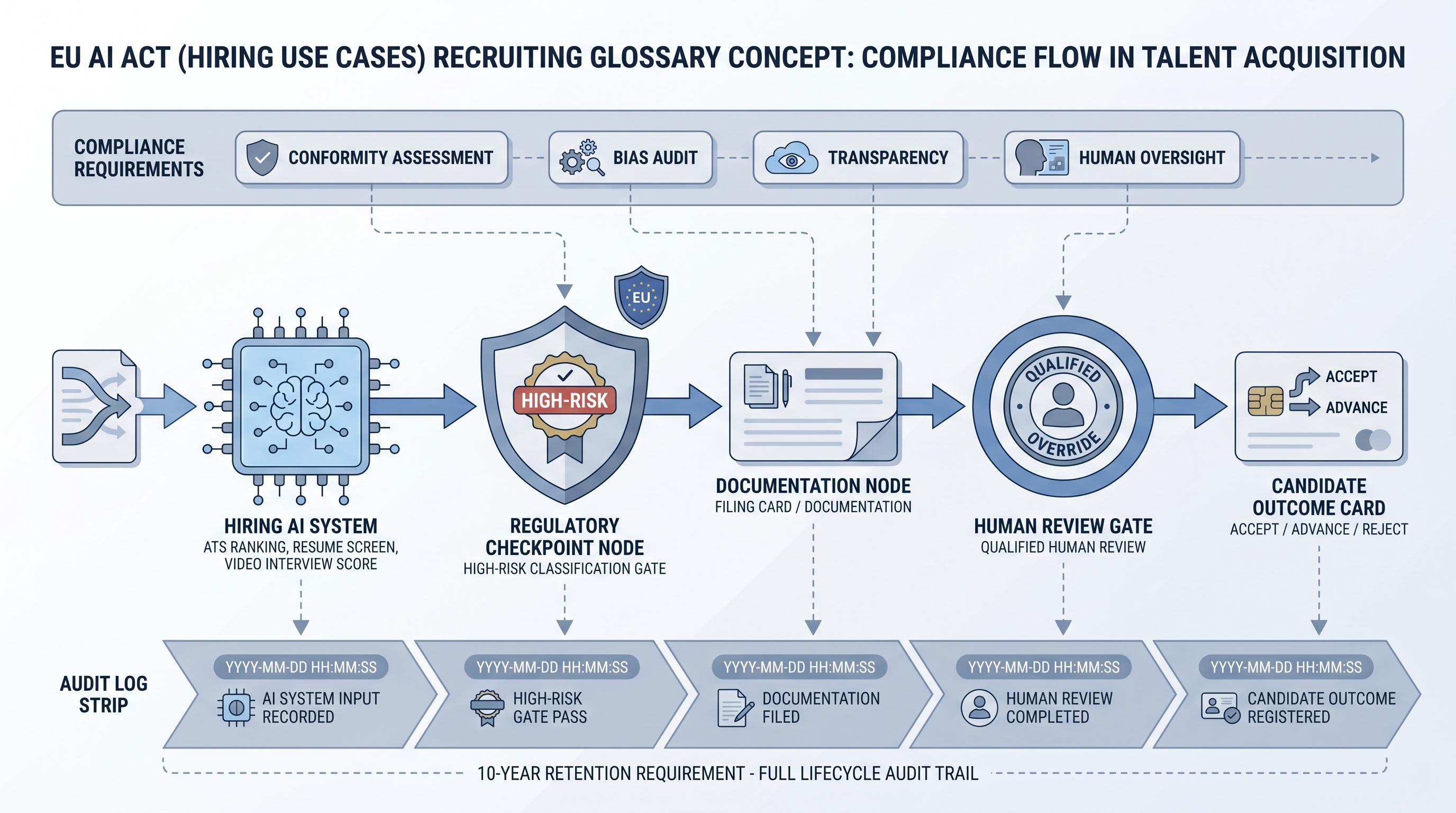
The EU AI Act classifies hiring-related AI systems as high-risk, requiring transparency, human oversight, bias testing, and technical documentation before deployment in recruitment or employment decisions for roles with EU-based workers or applicants.
Michal Juhas · Last reviewed May 26, 2026
What is the EU AI Act and how does it affect hiring?
The EU AI Act is a binding regulation that classifies AI systems by risk level and imposes obligations before those systems can be deployed. Annex III of the Act lists employment, worker management, and access to self-employment as a high-risk category, which means AI tools used to screen, rank, or evaluate candidates for EU-based roles carry significant compliance obligations.
The obligations are not hypothetical or future-dated. The high-risk employment AI provisions are phasing in from 2026 onward, and any company that uses AI in its EU hiring process, whether as an ATS feature or a standalone tool, needs to understand what is required before deployment rather than after a complaint.
In practice
- When an ATS vendor adds an AI matching score to candidate profiles and that score influences which candidates a recruiter views first for EU roles, that is a high-risk AI system under the Act regardless of whether the vendor calls it a recommendation or a filter.
- A TA ops team building a custom AI screening workflow in Make or n8n for EU-based roles has the same high-risk classification obligations as the ATS vendor, because the deploying organization is considered a provider under the Act when they configure a general-purpose AI into a specific hiring application.
- An HR legal team that asks for a vendor risk assessment before a new AI hiring tool goes live for EU roles is not being cautious for its own sake; they are responding to documentation and audit requirements that will be enforced by national supervisory authorities.
Quick read, then how hiring teams use it
This is for recruiters, TA leads, HR legal partners, and people ops teams who use AI tools in hiring for EU-based roles. Skim the first section for a working vocabulary to use in vendor conversations. Use the second when you are auditing your current toolstack, preparing for a legal review, or designing human oversight into a new AI-assisted workflow.
Plain-language summary
- What it means for you: If your ATS, sourcing tool, or screening workflow uses AI to score or filter candidates for EU roles, the EU AI Act likely applies. You need documentation, human oversight, and a disclosure process before you deploy.
- How you would use it: Start with an inventory of every AI feature in your current HR tech stack that touches EU-role candidates. Flag which ones make or influence a ranking, scoring, or filtering decision.
- How to get started: Ask each of your HR tech vendors whether their AI features are classified as high-risk under Annex III. The response quality tells you how seriously they have engaged with compliance.
- When it is a good time: Now. The conformity assessment, documentation, and oversight design all take time. Starting after the enforcement date is the most expensive approach.
When you are running live reqs and tools
- What it means for you: The human-in-the-loop requirement under the Act is not optional. A qualified person must be able to review AI outputs and override them before any candidate outcome is determined. This changes how you design screening workflows, not just what you document.
- When it is a good time: Every time you configure a new AI-assisted step in your EU hiring workflow. The oversight design should be built in from the start, not retrofitted after the workflow is running.
- How to use it: Map each AI-assisted step in your hiring process. For each step, name the person responsible for reviewing the AI output, define what override authority they have, and log the review. That log is part of your compliance documentation.
- How to get started: Take one AI feature you currently use for EU roles. Write a one-page description of what it does, what data it uses, how the output affects candidate outcomes, and who reviews it. That document is the start of your technical file.
- What to watch for: Vendors who describe their AI features as recommendations or assists to avoid the high-risk classification, ATS configurations where AI scores are visible to recruiters before they review the underlying profile, and any workflow that advances or rejects candidates based on AI output without a documented human review step.
Where we talk about this
On AI with Michal live sessions, EU AI Act questions come up when participants are mapping their current toolstack and discovering that features they use daily, such as ATS ranking scores or async video interview evaluation, carry compliance obligations they have not yet addressed. The conversation usually moves quickly from vocabulary to vendor audit questions. Start at Sourcing Lab if you want the room discussion, or bring specific vendor questions to membership office hours where the compliance conversation can go deeper than a single session allows.
Around the web (opinions and rabbit holes)
Third-party creators move fast. Treat these as starting points, not endorsements, and verify any legal interpretation with your employment counsel before acting.
YouTube
- EU AI Act Explained for HR and Recruiting (search) surfaces practitioner and legal commentary on Annex III classification and what it means for TA operations.
- High-Risk AI in the Workplace: Compliance Guide (search) covers the technical and process obligations that HR and legal teams need to understand before the 2026 deadlines.
- AI in Hiring and EU Regulation (search) includes commentary from employment lawyers and HR technology analysts on practical implementation challenges.
- EU AI Act and ATS compliance in r/humanresources covers the early practitioner experience of asking vendors for conformity documentation.
- GDPR and AI in hiring: what has changed in r/recruiting is a useful thread on how the AI Act changes the GDPR-only compliance picture for EU recruiting.
- AI bias audits: what does the law require in r/MachineLearning includes technical discussion of what constitutes a valid bias test under EU standards.
Quora
- How does the EU AI Act affect recruitment? collects answers from HR professionals, employment lawyers, and HR tech analysts on the Act's practical implications for talent acquisition teams.
High-risk vs general-purpose AI in hiring
| Use case | High-risk (Annex III) | General-purpose (lower risk) |
|---|---|---|
| CV ranking or scoring | Yes | No |
| Async video interview evaluation | Yes | No |
| Chatbot FAQ response | No | Yes |
| AI-assisted JD drafting | No | Yes |
| Candidate filtering in ATS | Yes | No |
| Interview summary generation | Borderline: depends on how output is used | Often lower risk |
Related on this site
- Glossary: Human-in-the-loop, AI bias audit, One-way video interview, GDPR first-touch outreach, Applicant tracking software
- Blog: AI sourcing tools for recruiters
- Live cohort: Sourcing Lab
- Commercial: AI workshops for teams
- Membership: Become a member