Niche talent pool sourcing strategy
Building and maintaining a curated pipeline of passive candidates for hard-to-fill specialties before a req opens, so sourcing effort compounds over time rather than restarting from zero each time a role goes live.
Michal Juhas · Last reviewed May 4, 2026
What is a niche talent pool sourcing strategy?
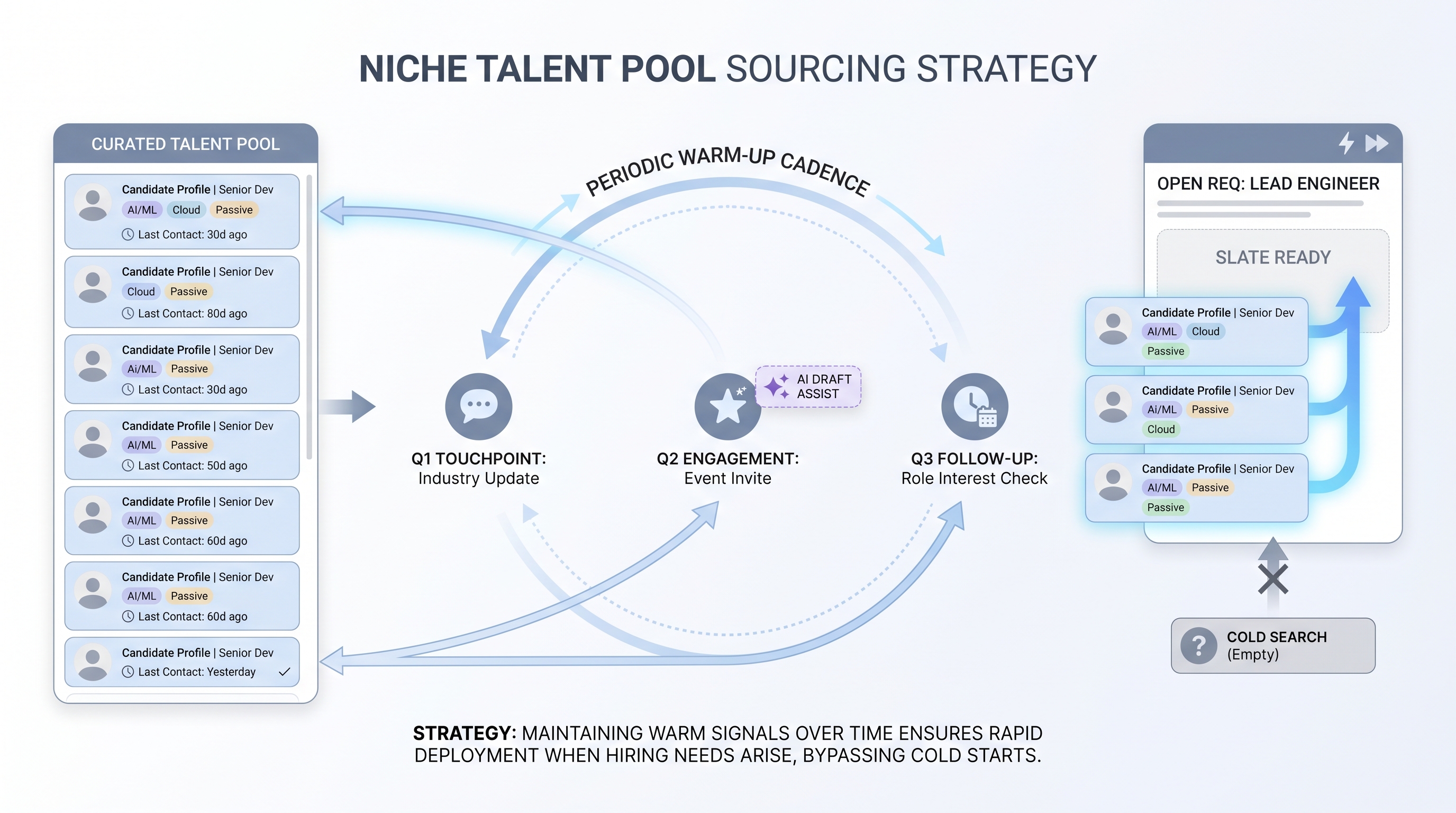
A niche talent pool sourcing strategy means building and maintaining a curated pipeline of passive candidates for a specific, hard-to-fill specialty before a req ever opens. Instead of restarting from zero every time a rare role goes live, a sourcing team keeps relationships warm with a small group of high-fit people so the first conversation has already happened by the time a hiring manager approves headcount.
In practice
- A sourcer covering a rare language engineering specialty keeps a pool of 80 vetted profiles in a CRM and tags each with the last outreach date and career signal, so when a req opens the first five candidates receive a contextual note the same day rather than a cold InMail two weeks later.
- A TA lead saying "our niche pool saved us six weeks on that senior security hire" means a relationship the team maintained for four months moved to an offer faster than open-market sourcing would have allowed.
- When sourcers say a pool has "gone cold," they mean contact records are over a year old, email addresses are bouncing, and re-engagement rates have dropped below five percent, which makes the pool a risk to sender reputation rather than an asset.
Quick read, then how hiring teams use it
This is for recruiters, sourcers, TA, and HR partners who need the same vocabulary in debriefs, vendor calls, and policy reviews. Skim the first section when you need a fast shared picture. Use the second when you are deciding how it shows up in the ATS, sourcing tools, or candidate communications.
Plain-language summary
- What it means for you: Instead of hunting from scratch every time a hard-to-fill role opens, you build a small, well-kept list of pre-qualified people in that specialty so the queue already exists on day one.
- How you would use it: Pick one specialty that appears in headcount plans repeatedly, source 50 to 100 high-fit profiles, set a 90-day touchpoint cadence, and track engagement so you know who is warm when a req opens.
- How to get started: Choose a niche the team has struggled to fill at least twice in the last 12 months. Build a sourcing string, load profiles into a CRM with owner and date fields, and send a first warm message before any role is live.
- When it is a good time: When the same specialty keeps appearing in headcount plans and open-market sourcing for it takes more than four weeks per req.
When you are running live reqs and tools
- What it means for you: A niche pool changes time-to-slate for specialty reqs because conversations started months earlier. It also creates GDPR obligations around consent, retention, and enrichment data that need a documented owner.
- When it is a good time: After sourcing criteria for the specialty are stable, the CRM has consent and date fields, and there is a named owner who will maintain the cadence for at least two hire cycles.
- How to use it: Automate signal-based triggers (role change, publication, conference) into a draft queue, but keep a human-in-the-loop review gate before any message sends. Log source, enrichment date, and opt-out status per record. Pair with workflow automation so the cadence runs without manual copy-paste.
- How to get started: Pilot with 50 records for one specialty. Measure engagement rate and time-to-slate against the open-market baseline for the same role type before scaling to a second specialty.
- What to watch for: Pool records aging past 12 months without a refresh cycle, GDPR lawful-basis gaps, email bounce rates climbing above two percent, and no named owner for cadence after the sourcer who built the pool moves to a new req.
Where we talk about this
On AI with Michal live sessions, sourcing automation blocks cover how niche pools connect to trigger-based outreach and enrichment APIs, and AI in recruiting blocks bring the hiring manager and compliance lens. If you want to map your own specialty and pool structure against peers who are running live reqs, join Sourcing Lab and bring your actual headcount plan.
Around the web (opinions and rabbit holes)
Third-party creators move fast here. Treat these as starting points, not endorsements, and double-check anything before you wire candidate data.
YouTube
- Building a Talent Community from Scratch covers the lifecycle from first contact to engaged pipeline that mirrors a niche pool strategy.
- Passive Candidate Sourcing Strategies walks the outreach and engagement patterns that keep niche pools warm between open reqs.
- How to Source Hard-to-Find Candidates focuses on the discovery layer, before pool management, which is where most niche strategies stall.
- How do you manage a talent pipeline for hard to fill roles? in r/recruiting surfaces practical CRM choices, cadence failures, and what 'warm' actually means for different specialties.
- What tools are you using for passive candidate engagement? in r/sourcing covers the outreach and sequencer layer that sits on top of a niche pool.
- Is a talent pool worth the maintenance overhead? in r/Recruitment is a candid thread on whether the return on investment holds up across different team sizes.
Quora
- How do recruiters build pipelines for niche technical roles? collects practitioner answers on sourcing signals, pool tools, and engagement cadence for hard-to-fill specialties.
Niche pool versus open-market sourcing
| Dimension | Niche talent pool | Open-market sourcing |
|---|---|---|
| Time to first contact | Days (warm) | Weeks (cold) |
| Relationship context | Pre-built | None |
| GDPR overhead | Ongoing | Per campaign |
| Scales for | Recurring specialty roles | One-off or broad roles |
Related on this site
- Glossary: Proprietary talent pool, Outbound talent sourcing, Multi-channel talent sourcing, Candidate data enrichment, Boolean search, Semantic search, Talent acquisition metrics
- Blog: AI sourcing tools for recruiters, Boolean search vs AI sourcing
- Guides: Sourcers
- Live cohort: Sourcing Lab
- Membership: Become a member