Internal mobility
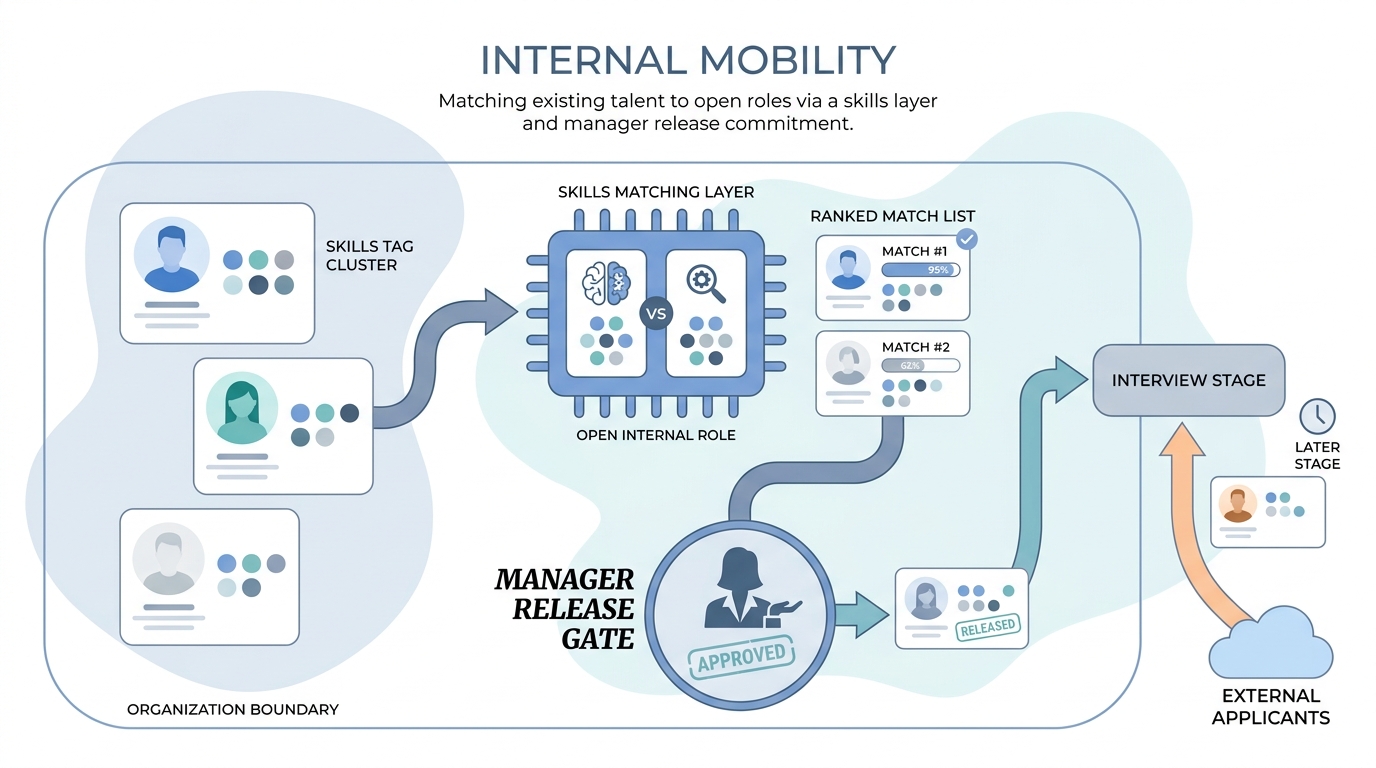
The movement of employees into new roles, projects, or teams within the same organisation, supported by internal job posting systems, talent marketplaces, skills matching tools, and cultural norms that make switching roles accessible rather than risky.
Michal Juhas · Last reviewed May 27, 2026
What is internal mobility?
Internal mobility is the ability of employees to move into new roles, teams, or projects within the same organisation rather than having to leave for career growth. It includes lateral moves, promotions, project rotations, and gig assignments. Organisations with strong internal mobility fill open roles faster, retain experienced people longer, and build institutional knowledge that external hires cannot provide on day one.
In practice
- A customer success manager at a SaaS company expresses interest in moving to product management. An internal talent marketplace surfaces two open associate PM roles she qualifies for based on her skills profile, and she interviews for them instead of applying to external companies.
- A recruiter filling an engineering lead role checks the internal candidate pool before posting externally and finds a senior engineer from another team who has been asking for more leadership scope. The role fills in two weeks instead of twelve.
- A company with high voluntary attrition audits exit interviews and finds that most departing employees cite lack of career growth opportunities, despite having an internal job board. Investigation reveals the board is updated monthly and most open roles close before employees see them.
Quick read, then how hiring teams use it
This is for recruiters, HR business partners, talent management teams, and TA leaders who want to build or improve an internal mobility programme. Skim the first section for shared vocabulary. Use the second when you are configuring talent marketplace tools, setting up internal posting workflows, or building the business case for a programme investment.
Plain-language summary
- What it means for you: Internal mobility means your best candidates may already work at your company. If there is no process to surface them for open roles, they leave to find growth elsewhere.
- How you would use it: Include an internal sourcing step in every req before posting externally. Set up a way for employees to signal interest in lateral or promotional moves so you are not waiting for them to find and apply to a posting.
- How to get started: Audit your last 20 external hires and ask: were there internal employees with adjacent skills who were not considered? If yes, why not?
- When it is a good time: When voluntary attrition is rising and exit interviews cite lack of growth, and when you are about to invest in a new hiring cycle that could partly be filled internally.
When you are running live reqs and tools
- What it means for you: Talent marketplace tools surface internal candidates based on skills matching, but they only work if employee profiles are maintained and if managers do not block the process informally.
- When it is a good time: Before implementing a talent marketplace, audit the completeness of skills data in your HRIS. A tool running on empty profiles produces meaningless matches.
- How to use it: Integrate internal job posting with proactive outreach: when a role opens, the system notifies relevant employees based on skills overlap rather than relying on them to browse the board.
- How to get started: Add a required field to every req intake: "Were internal candidates considered?" Track the answer. When the answer is consistently no, investigate whether the issue is awareness, process, or manager behaviour.
- What to watch for: Talent marketplace tools that generate matches but have no mechanism for employees to signal interest or for hiring managers to see and act on internal referrals. Also watch for metrics that count internal applications without tracking whether internal candidates receive fair evaluation.
Where we talk about this
On AI with Michal live sessions, internal mobility comes up in the context of talent acquisition metrics and strategic TA conversations about sourcing cost and time-to-fill. Building an internal sourcing step into every req workflow is a practical tactic covered in AI Recruiting Accelerator sessions. Join a AI Sourcing Lab to discuss how to integrate internal talent data into your sourcing stack without relying on a talent marketplace budget.
Around the web (opinions and rabbit holes)
Third-party creators move fast. Treat these as starting points, not endorsements, and validate any specific programme designs against your own organisation's culture and constraints.
YouTube
- Search "internal mobility talent marketplace" on YouTube for vendor demos and case studies from Gloat, Eightfold, and similar platforms showing how AI matching works in practice.
- "Career pathing HR strategy" videos from SHRM and talent development practitioners cover the culture and manager enablement side that technology alone cannot fix.
- r/humanresources has frank threads on why internal mobility programmes fail, including the manager hoarding and hiring manager bias issues.
- r/recruiting covers the practical recruiter side: how to run an internal search before posting externally and what happens when it goes wrong.
Quora
- How do companies encourage internal mobility? collects answers from HR practitioners and people leaders at companies where programmes have worked or failed.
Internal hire vs external hire comparison
| Dimension | Internal hire | External hire |
|---|---|---|
| Time to productivity | Faster (knows the organisation) | Slower (ramp-up required) |
| Cost | Lower (no agency fee, lower sourcing cost) | Higher |
| Cultural fit signal | Proven | Inferred |
| Fresh perspective | Less likely | More likely |
| Manager risk tolerance | Often lower | Often higher |
Related on this site
- Glossary: Talent acquisition metrics, Skills ontology, Talent marketplace, Scorecard, Candidate experience, Proprietary talent pool
- Live cohort: AI Recruiting Accelerator
- Membership: Become a member