Talent marketplace
An internal platform that creates a visible labor market inside an organisation, connecting employees to open roles, short-term projects, mentoring, and learning opportunities based on their skills and career goals.
Michal Juhas · Last reviewed June 22, 2026
What is a talent marketplace?
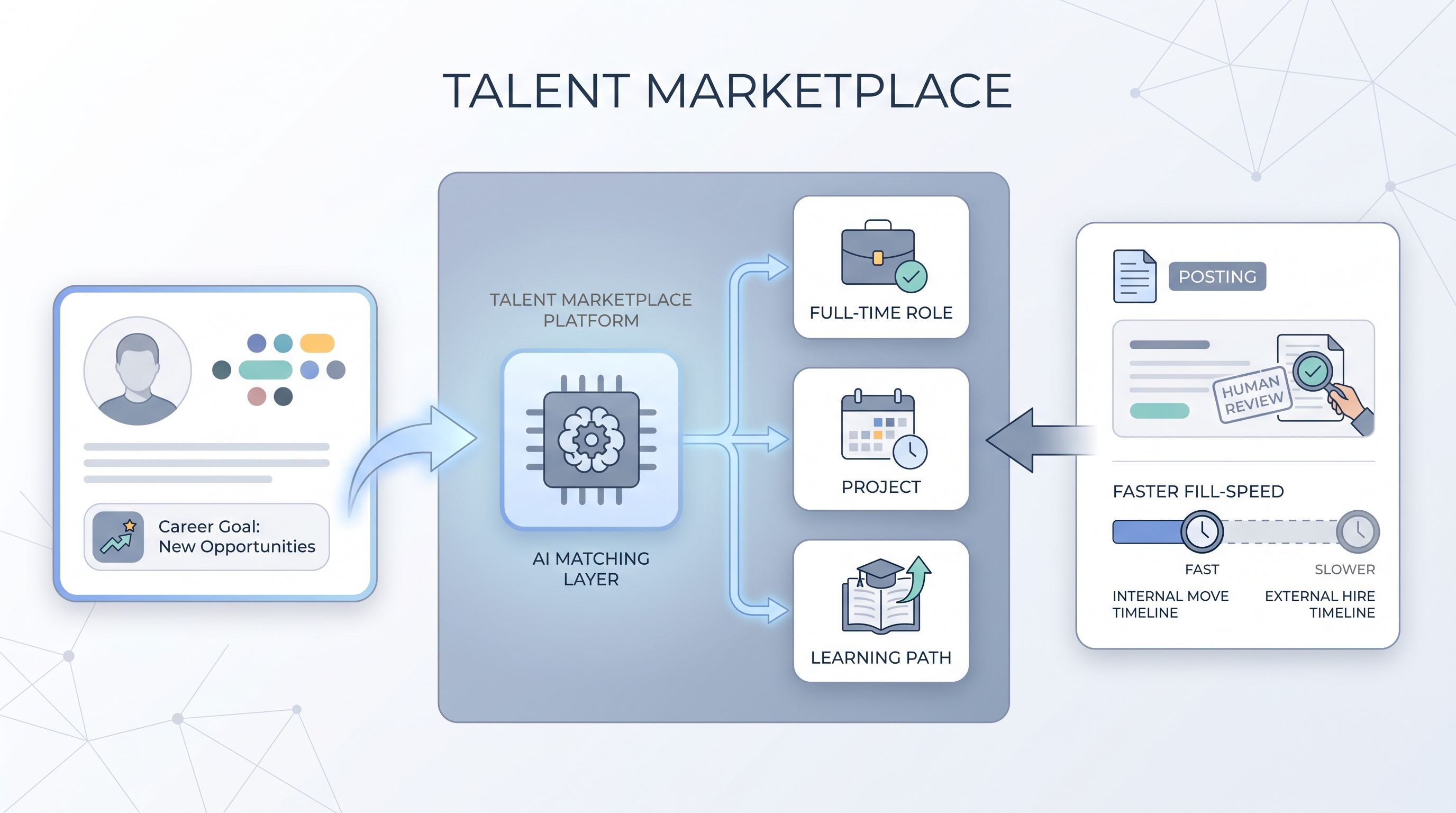
A talent marketplace is an internal platform that creates a visible labor market inside an organisation. Employees build a skill profile, the platform uses AI to match them to open roles, short-term projects, mentoring opportunities, and learning paths, and managers post internal work before going external. The goal is to make internal movement the path of least resistance when someone on the team wants to grow.
In practice
- A product manager at a 2,000-person company discovers through their company's talent marketplace that the data analytics team is looking for someone with her exact skill set for a six-month project. She applies internally and transitions without ever updating her LinkedIn.
- A CHRO reports at a quarterly board meeting that 34% of open roles were filled internally last quarter, citing the talent marketplace as the mechanism. The metric is tracked directly from platform data.
- An HR business partner says "put it in the marketplace" when a team needs a short-term contractor-style contribution from another internal team, using the platform as an internal gig layer.
Quick read, then how hiring teams use it
This is for recruiters, sourcers, TA, and HR partners who need the same vocabulary in debriefs, vendor calls, and policy reviews. Skim the first section when you need a fast shared picture. Use the second when you are deciding how it shows up in the ATS, sourcing tools, or candidate communications.
Plain-language summary
- What it means for you: A talent marketplace is the internal job board grown up: it matches employees to opportunities based on skills and goals, not just keyword search, and includes projects and mentoring alongside full-time roles.
- How you would use it: Before posting a role externally, check whether someone inside already has the skill and has signalled interest in a move. The platform surfaces that without requiring an employee to formally apply.
- How to get started: Audit whether your organisation has one of the major platforms already deployed. If not, start the business case with retention data: cost of replacing a high performer versus cost of internal move facilitation.
- When it is a good time: When attrition from lack of growth opportunity is measurable, when external hiring costs are high, or when a CHRO is setting a target for internal fill rate.
When you are running live reqs and tools
- What it means for you: The talent marketplace is a pre-sourcing check that can eliminate the need for a full external search when internal supply exists. It feeds directly into internal mobility reporting for TA operations.
- When it is a good time: Before every external search opens, as a first-pass check. Especially important for roles where cultural fit and ramp time are strong arguments for internal promotion.
- How to use it: Integrate the marketplace with your ATS so that internal applications flow through the same pipeline as external ones, giving managers a single view. Report internal fill rate as a TA efficiency metric alongside cost-per-hire and time-to-fill.
- How to get started: Run one req through the marketplace before going external. Track time-to-fill and manager satisfaction for that internal move versus comparable external hires. Use the comparison to build the case for expanding the program.
- What to watch for: Manager resistance and stale skill profiles are the two biggest deployment killers. Both require cultural change alongside technology. Do not launch a platform without an executive sponsor who will publicly move their own team members internally.
Where we talk about this
On AI with Michal live sessions, talent marketplaces come up in the AI in recruiting track when we examine how mature TA operations reduce dependence on external sourcing by activating internal supply first. We look at how platforms wire into ATS and HRIS data, what GDPR and data governance are needed, and how to measure the ROI of internal mobility programs. Start at AI Sourcing Lab.
Around the web (opinions and rabbit holes)
Third-party creators move fast. Treat these as starting points, not endorsements, and double-check anything before you wire employee data.
YouTube
- Search "talent marketplace internal mobility HR" on YouTube for practitioner discussions of Gloat, Eightfold, and similar platforms, including honest talk about adoption challenges.
- Josh Bersin Company publishes reports and videos on the talent marketplace landscape that are worth scanning before a vendor evaluation.
- r/humanresources has threads on internal mobility programs and the platforms organisations use to support them, including candid adoption failure stories.
- r/recruiting covers the recruiter's perspective on how talent marketplaces change the sourcing step for internal roles.
Quora
- What is a talent marketplace in HR? collects practitioner explanations of the concept and real-world use cases from TA and HR leaders.
Internal marketplace versus external job board
| Feature | Internal talent marketplace | External job board |
|---|---|---|
| Audience | Current employees | External candidates |
| Match logic | Skill and career-goal matching | Keyword search |
| Non-role opportunities | Projects, mentoring, gigs | Rare |
| Cost per fill | Very low | Medium to high |
| GDPR scope | Employee personal data (HR context) | Candidate personal data |
Related on this site
- Glossary: internal mobility, headcount planning, applicant tracking system
- Glossary: talent acquisition (TA), source of hire, talent CRM
- Glossary: AI-native, skills-based hiring
- Live cohort: AI Recruiting Accelerator
- Membership: Become a member