Job architecture and leveling
A structured framework that defines job families, career levels, and the criteria that distinguish each level across a company, used to ensure consistent titling, equitable pay, and clear career progression paths.
Michal Juhas · Last reviewed May 30, 2026
What is job architecture and leveling?
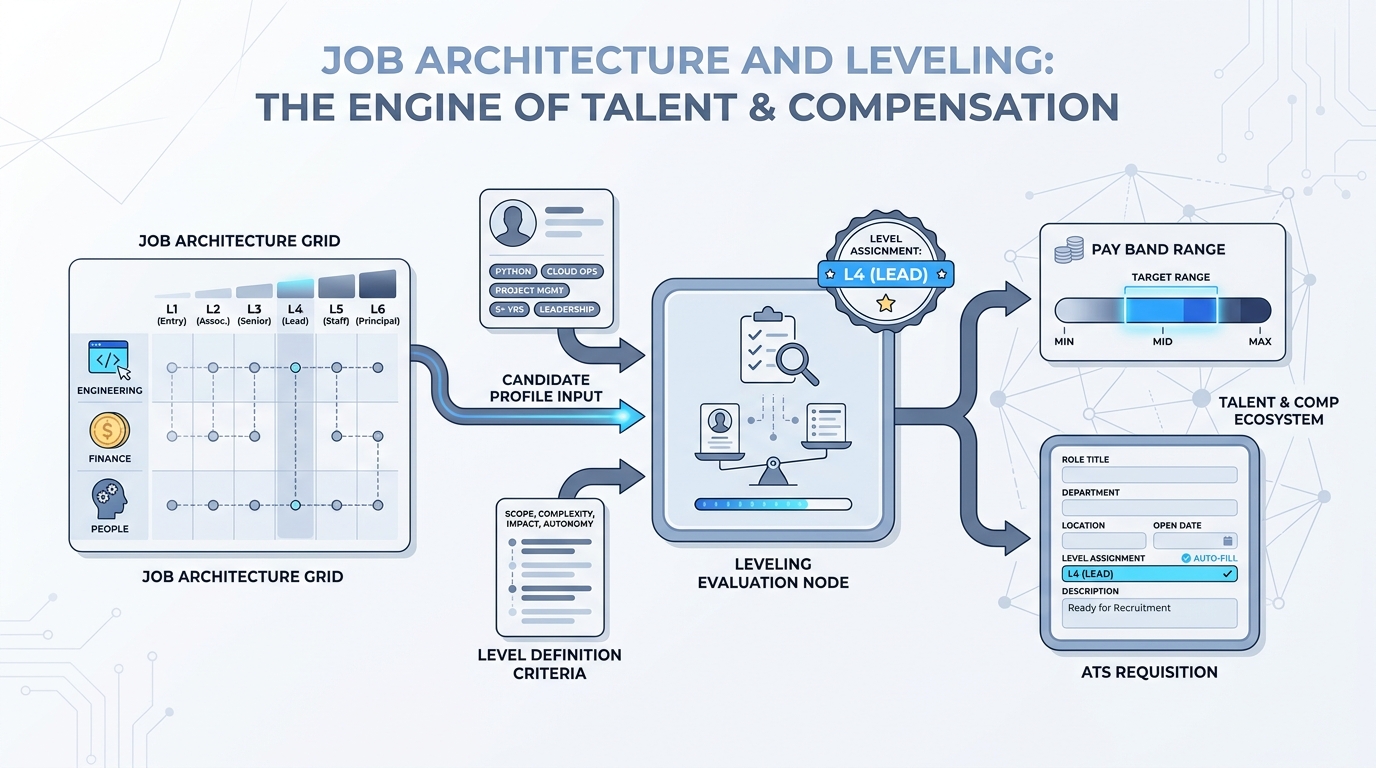
Job architecture is the skeleton of how a company organises its roles. It groups positions into job families (like Engineering or Finance), defines career levels within each family (from entry to senior to leadership), and writes down what each level actually requires in terms of scope, independence, and impact. Leveling is the process of deciding which level a given role or person sits at within that architecture.
In practice
- A TA leader at a 400-person company realises that five different engineering teams use "Senior Engineer" for roles that pay anywhere from 90K to 145K. An architecture project reveals that three of those teams are using the title for what the framework calls Level 3, and two for Level 4. The pay equity gap becomes a documented remediation plan rather than a quiet inconsistency.
- A recruiter at a growth-stage SaaS company spends the first 20 minutes of every kickoff call negotiating what "senior" means with the hiring manager. After a leveling framework is introduced, the manager selects a level on the intake form, the criteria auto-populate, and the kickoff focuses on sourcing strategy instead.
- An HRBP doing a compensation review discovers that three women in the same job family are one level below male peers despite similar scope and tenure. The leveling audit is what makes the problem visible; without the framework, the disparity stays hidden in disparate titles and offer histories.
Quick read, then how hiring teams use it
This is for recruiters, TA leaders, HR business partners, and compensation professionals who deal with titles, levels, and pay decisions. Skim the first section for a shared vocabulary. Use the second when you are building intake workflows, evaluating offers, or making the case for an architecture project.
Plain-language summary
- What it means for you: When your company has a clear leveling framework, "Senior" means the same thing in every team and every offer conversation, which makes your job as a recruiter significantly easier.
- How you would use it: Check a candidate's experience against the published level criteria before you make an offer, rather than negotiating seniority based on what the hiring manager feels in the moment.
- How to get started: Ask HR or Total Rewards whether a job architecture exists. If it does, get a copy. If it does not, document the inconsistencies you see across reqs in your next pipeline review as evidence for why one is needed.
- When it is a good time: Before the next compensation review cycle, or when a pay equity complaint or offer negotiation reveals that the same title means different things in different teams.
When you are running live reqs and tools
- What it means for you: A job architecture connected to your ATS intake form means every req opens with a defined level, a pay band, and criteria the recruiter and hiring manager agreed on before sourcing starts.
- When it is a good time: Before a period of rapid hiring, not after pay equity problems have compounded across 50 misleveled offers.
- How to use it: Use level criteria as a structured screening rubric. If the role is a Level 4 Individual Contributor, you have a clear answer when a hiring manager wants to extend an offer to a Level 3 candidate: what specifically meets the Level 4 bar?
- How to get started: Map your top 10 open roles to draft level criteria. Run the hiring managers through a calibration session where they rate two or three sample candidates against the draft criteria. The disagreements in that session will tell you exactly where the framework needs to be sharpened.
- What to watch for: Levels that become negotiating tools ("we will call them Level 5 to justify the offer") rather than evaluation anchors, and level definitions that are too vague to actually differentiate candidates.
Where we talk about this
On AI with Michal workshops, job architecture comes up in the context of headcount planning, AI-assisted JD generation, and compensation benchmarking. We discuss how a working architecture changes the quality of AI-drafted job descriptions and makes sourcing briefs significantly more specific. Join a AI Sourcing Lab to explore how other TA teams have built or improved leveling frameworks and what the data-driven business case looks like.
Around the web (opinions and rabbit holes)
Third-party creators move fast. Treat these as starting points, not endorsements, and always adapt frameworks to your specific company context.
YouTube
- Search "job architecture HR" or "career levels framework" on YouTube for practitioner walkthroughs from Total Rewards and People Operations leaders at companies of different sizes.
- Radford and Mercer publish educational content on compensation benchmarking that covers how pay bands connect to level definitions.
- r/humanresources has detailed threads on building job architectures from scratch, including how to handle the political challenges of reclassifying people who are currently misleveled.
- r/recruiting covers the recruiter-facing side: how inconsistent leveling affects offer acceptance rates and what recruiters can do when there is no framework.
Quora
- What is job leveling in HR? collects explanations from HR professionals across industries with real examples of level criteria.
Levels vs bands vs titles
| Dimension | Job levels | Pay bands | Job titles |
|---|---|---|---|
| What it defines | Scope and criteria for the work | Compensation range for the level | External label for the role |
| Stability | Stable; changes with business model | Updated annually against market data | Can drift independently |
| Primary owner | HR / Total Rewards | Compensation / Finance | TA / Hiring Manager |
| Risk of misuse | Leveling as a negotiation tool | Bands ignored in favour of candidate asks | Title inflation to win offers |
Related on this site
- Glossary: Headcount planning, Compensation benchmarking, AI-assisted job description generation, Applicant tracking system, Talent acquisition metrics
- Live cohort: AI Recruiting Accelerator
- Membership: Become a member