Headcount planning
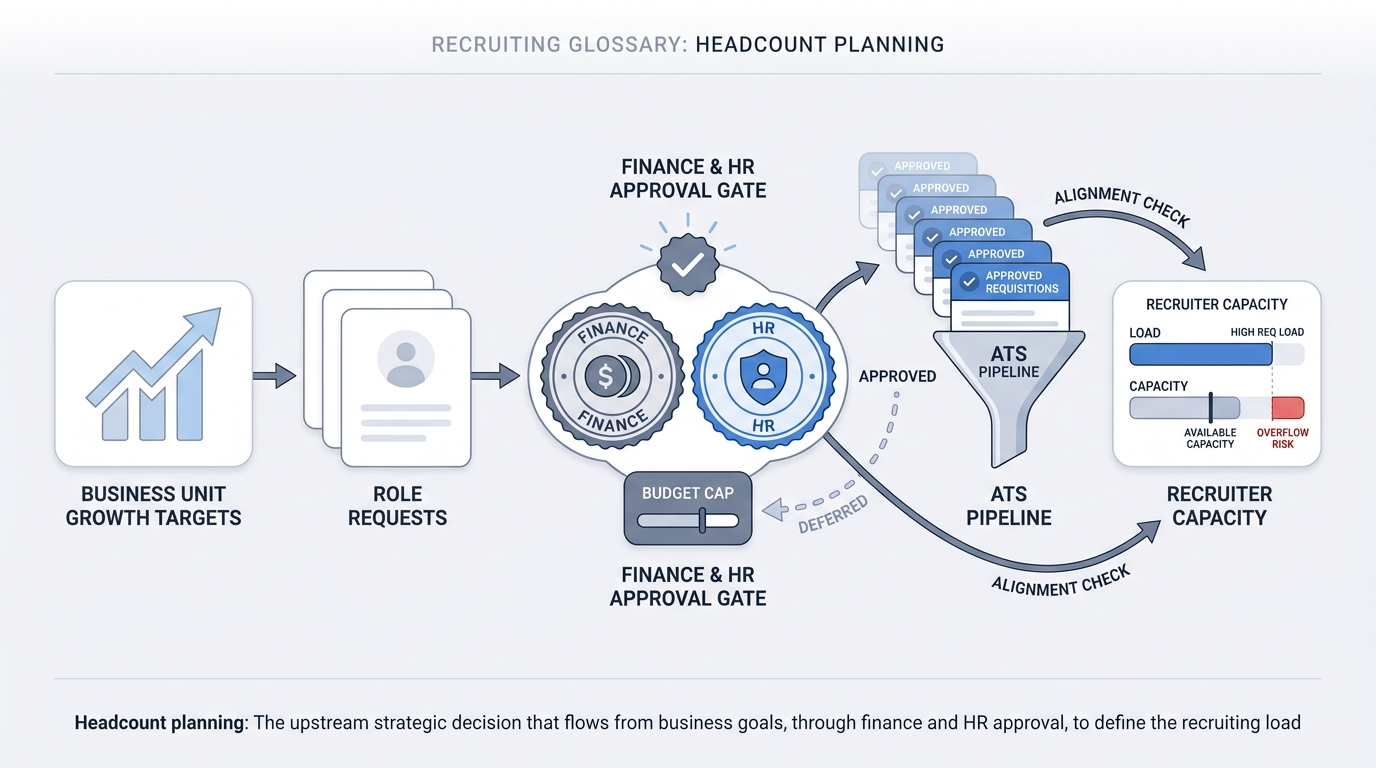
The process of forecasting and aligning staffing needs with business goals, translating growth plans, attrition assumptions, and budget constraints into approved requisitions that TA can recruit against.
Michal Juhas · Last reviewed May 27, 2026
What is headcount planning?
Headcount planning is the process of deciding how many people to hire, in which roles, when, and at what cost, so the business can meet its growth or operational goals. It produces the approved requisitions that TA teams recruit against. Without a clear headcount plan, sourcing starts without a budget, a timeline, or a hiring manager who has formally committed to the role.
In practice
- A TA leader at a 300-person SaaS company sits in the annual planning cycle with Finance and each business unit head, presenting time-to-fill benchmarks and recruiter capacity data to negotiate a hiring plan that is actually fillable within the year.
- When a business unit says "we need 10 engineers by March," the headcount planner checks whether the budget is approved, whether 10 engineers can realistically be sourced in that market in that timeframe, and whether any internal candidates should be considered first.
- A recruiter working from a poorly built headcount plan starts sourcing a role only to discover three weeks in that the budget was not formally approved, the hiring manager has left, or the role requirements have changed since the plan was signed off.
Quick read, then how hiring teams use it
This is for recruiters, TA leaders, HR business partners, and ops professionals who interact with headcount approvals. Skim the first section for a fast shared picture. Use the second when you are building intake workflows, capacity models, or SLA commitments tied to an annual plan.
Plain-language summary
- What it means for you: Headcount planning determines which roles you are allowed to recruit for and when the budget is available to fill them. It is the upstream decision that makes or breaks TA delivery timelines.
- How you would use it: Track which headcounts are approved, pending approval, or deferred. Use that data to prioritise sourcing, manage recruiter workload, and communicate realistic timelines to hiring managers.
- How to get started: Get a copy of the current headcount plan and compare it to open reqs in your ATS. If they do not match, find out why before starting sourcing on unapproved roles.
- When it is a good time: Before the annual planning cycle, when TA can contribute time-to-fill and cost-per-hire data to make the plan more realistic.
When you are running live reqs and tools
- What it means for you: Headcount plan data should flow directly into your ATS to open requisitions with pre-populated fields. Manual handoffs via email or spreadsheet introduce delays and data errors that compound across a large hiring plan.
- When it is a good time: Set up the ATS integration with your planning tool before the annual cycle kicks off, not mid-year when roles are already slipping.
- How to use it: Use approved headcount data to build a recruiter capacity model: reqs per recruiter, expected time-to-fill by role type, and total hires the team can realistically close in the period.
- How to get started: Pull your ATS close data for the last two cycles and calculate average time-to-fill by role category. Bring that data to the next planning conversation as a constraint, not a complaint.
- What to watch for: Plans that approve headcount in Q1 but assume every role fills in 30 days regardless of market conditions, and plans with no mechanism to flag when a role is no longer being filled so budget can be reallocated.
Where we talk about this
On AI with Michal workshops, headcount planning comes up in the context of talent acquisition metrics and building the business case for TA investment. Understanding headcount cycles helps recruiters time their automation and tooling investments to the planning rhythm of the business rather than reacting to surprises. Join a AI Recruiting Accelerator to discuss how teams connect planning data to sourcing workflows in practice.
Around the web (opinions and rabbit holes)
Third-party creators move fast. Treat these as starting points, not endorsements, and validate any specific planning frameworks against your own business context.
YouTube
- Search "headcount planning HR" on YouTube for practitioner walkthroughs of planning tools and Finance-HR collaboration models at different company sizes.
- "Strategic workforce planning" explainers from HR associations like SHRM provide the longer-term framework that headcount planning sits within.
- r/humanresources has threads on headcount planning processes, approval workflows, and what breaks when Finance and HR are not aligned.
- r/recruiting covers the downstream recruiter perspective: what happens when headcount plans are unrealistic or poorly communicated to TA.
Quora
- How does headcount planning work in large companies? collects practitioner answers from HR and Finance professionals with real experience running the process.
Headcount planning vs workforce planning
| Dimension | Headcount planning | Workforce planning |
|---|---|---|
| Horizon | 6 to 18 months | 2 to 5 years |
| Output | Approved requisitions | Capability and skills strategy |
| Primary owner | Finance and HR | Strategic HR and leadership |
| TA involvement | Execution | Input on market constraints |
Related on this site
- Glossary: Talent acquisition metrics, Applicant tracking system (ATS), Time to fill, Requisition intake, Talent acquisition (TA)
- Live cohort: AI Sourcing Lab
- Membership: Become a member