AI-assisted job description generation
Using large language models to draft or refine job descriptions from hiring manager inputs, reducing writing time and improving consistency, inclusion, and searchability across postings.
Michal Juhas · Last reviewed May 30, 2026
What is AI-assisted job description generation?
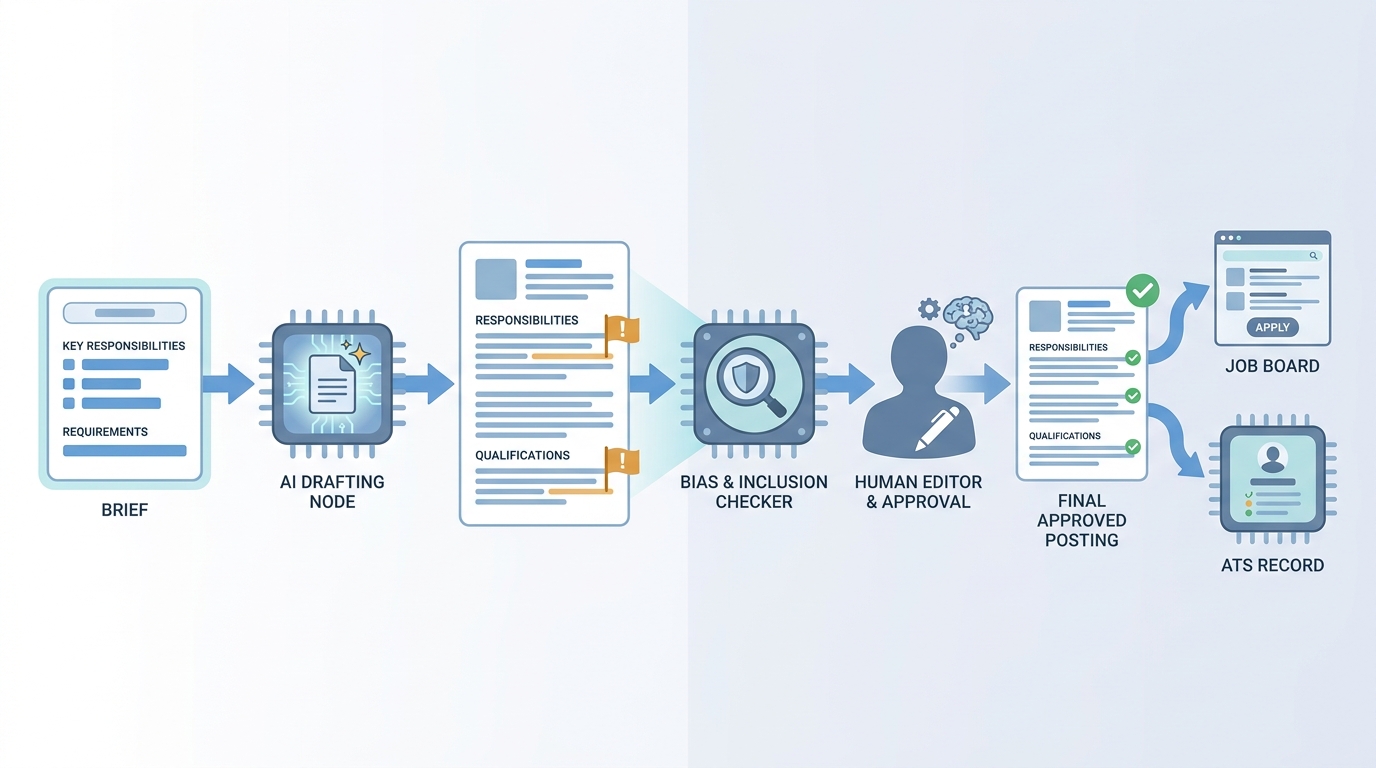
AI-assisted job description generation uses a large language model to turn a recruiter or hiring manager's brief into a full job posting draft. You provide the role title, key responsibilities, and a few qualifications; the AI returns a structured posting in minutes. The draft then goes through a human editing review for accuracy, inclusion, legal compliance, and brand voice before it is published.
In practice
- A recruiter at a 150-person startup needs to post three engineering roles in one afternoon. Instead of writing from scratch, they paste a two-paragraph brief from the engineering manager into a JD generation tool and get a first draft for each role in under a minute. The editing pass takes 20 minutes per role instead of the usual 90.
- A TA ops leader notices that job descriptions across the company are wildly inconsistent in length, tone, and requirement levels. They build a prompt template that references the company's job architecture criteria and requires the AI to format every posting to a shared structure before a human edits it.
- A hiring manager submits a JD draft with 22 "required" qualifications, several of which have nothing to do with the role. Running it through an AI editor with a bias and requirement check cuts the list to 9 and removes three phrases flagged as potentially gendered.
Quick read, then how hiring teams use it
This is for recruiters, TA ops professionals, and HR partners involved in creating or approving job postings. Skim the first section for a shared picture. Use the second when you are evaluating tools, building a JD template system, or designing a quality-review workflow.
Plain-language summary
- What it means for you: AI can turn a rough hiring brief into a structured job posting draft in seconds, cutting writing time significantly and giving you a consistent starting point across every role.
- How you would use it: Provide a clear brief (title, key duties, 3 to 5 requirements), generate the draft, then spend your editing time on accuracy and inclusion rather than on formatting and structure.
- How to get started: Try a general-purpose model (Claude or ChatGPT) with a structured prompt before buying a dedicated JD tool. If the output quality is good enough, build an internal prompt template and share it with the team.
- When it is a good time: When JD writing is a bottleneck, when posting quality is inconsistent across teams, or when a new team is hiring roles the TA team has not recruited for before.
When you are running live reqs and tools
- What it means for you: AI-generated JDs can be connected to your job architecture framework, ATS intake form, and careers site so postings go from brief to published with fewer handoffs and less manual reformatting.
- When it is a good time: After you have defined what a good posting looks like for each level in your job architecture, so the AI has a consistent anchor for seniority and scope.
- How to use it: Embed JD generation in the req intake workflow: when the hiring manager submits an intake form, the tool auto-generates a draft and routes it to the recruiter for editing rather than starting from a blank page or a three-year-old template.
- How to get started: Audit your 20 most recent postings for consistency in length, requirement count, and tone. Use that audit to write a prompt template that enforces your standards, then test it on the next five new reqs before committing to a vendor tool.
- What to watch for: Requirement inflation (AI adds qualifications the role does not need), pay transparency gaps (AI does not know your budget), and bias that survives the first draft because the editing step was too fast.
Where we talk about this
On AI with Michal workshops, JD generation comes up in sessions on AI-assisted recruiting workflows and sourcing automation. We walk through prompt design, editing checklists, and how to connect AI drafting to job architecture so postings are consistent from the first word. Join a AI Sourcing Lab to see the full workflow in action and bring your own JD quality problems.
Around the web (opinions and rabbit holes)
Third-party creators move fast. Treat these as starting points, not endorsements, and always run AI-generated postings through a human review before they go live.
YouTube
- Search "AI job description generator" on YouTube for tool walkthroughs covering ChatGPT-based prompts, Textio, and ATS-native JD tools with live editing demos.
- LinkedIn Talent Solutions publishes content on writing effective job descriptions that applies directly to editing AI-generated drafts.
- r/recruiting has threads on which AI tools practitioners actually use for JD writing, including honest feedback on output quality and editing time saved.
- r/humanresources covers the bias and inclusion angle, with HR leaders sharing their review workflows for AI-generated postings.
Quora
- How do you write a good job description? collects recruiter and HR practitioner answers that highlight the editing criteria AI alone cannot satisfy.
AI draft vs final posting
| Stage | What AI contributes | What humans must add |
|---|---|---|
| First draft | Structure, length, common requirements | Accurate role-specific duties |
| Requirement review | Suggested must-haves from training data | Verification against actual role needs |
| Bias check | Flagging gendered or exclusionary language | Judgment on final wording |
| Compliance | Generic pay transparency language | Actual salary range, local legal review |
Related on this site
- Glossary: Job architecture and leveling, Diversity sourcing, Careers site SEO, Workflow automation, Candidate experience
- Live cohort: AI Recruiting Accelerator
- Membership: Become a member