Labor market intelligence
Data-driven analysis of talent supply, demand, compensation benchmarks, and competitor hiring activity used to inform sourcing strategy, headcount planning, and location decisions.
Michal Juhas · Last reviewed May 30, 2026
What is labor market intelligence?
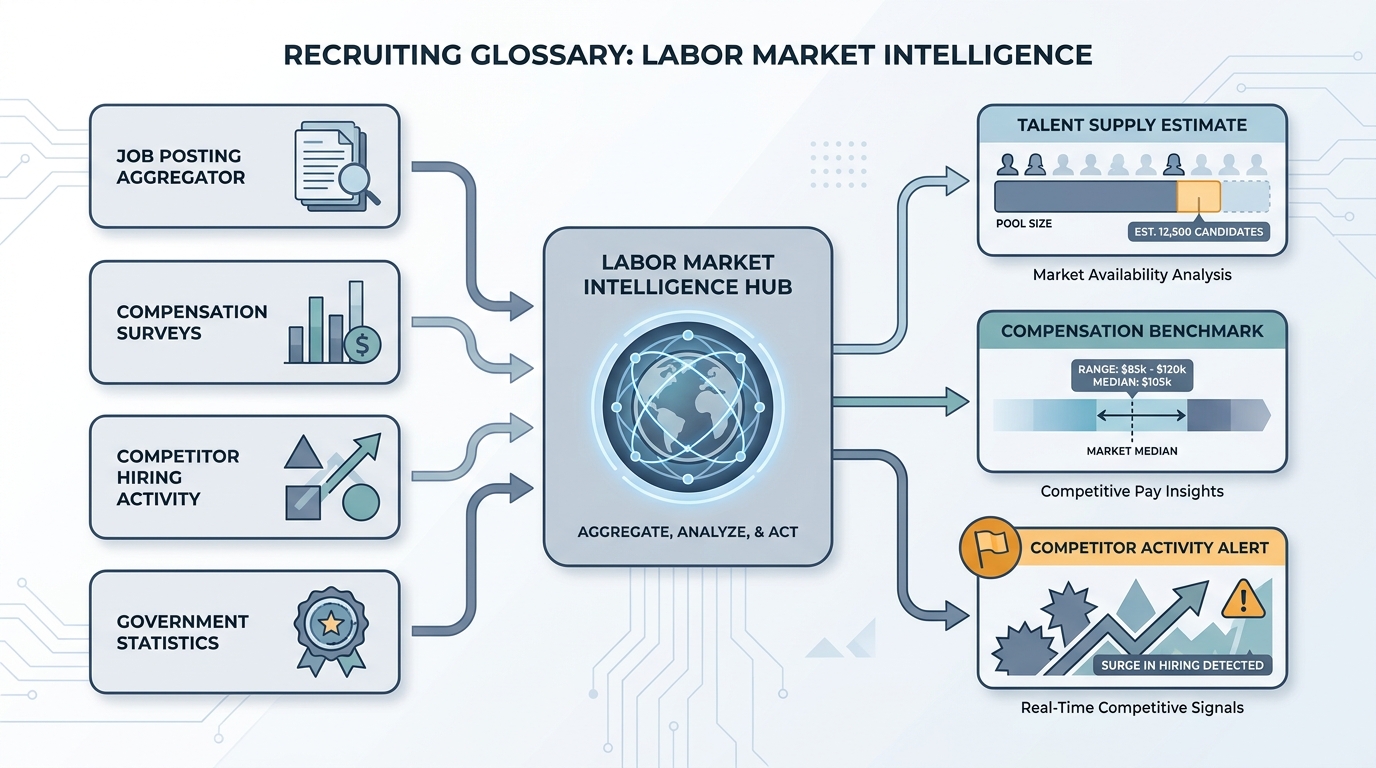
Labor market intelligence (LMI) is the use of external talent data to understand supply, demand, compensation, and competitive dynamics for specific roles, skills, or geographies. It answers the questions a recruiter cannot answer from their ATS alone: how many qualified candidates exist in this market, what are they being paid elsewhere, and which companies are competing for the same profiles right now.
In practice
- A TA leader at a scale-up pulls LMI data before the annual planning cycle and discovers that the approved pay bands for senior data engineers in their primary location are 18 percent below the market median. She brings that benchmark to the compensation review before headcount is approved, rather than after three consecutive declined offers.
- A sourcer building a pipeline for a niche compliance role uses an LMI platform to filter by skill cluster and geography, finding that 70 percent of qualified candidates are concentrated in two cities the company had not considered as hiring locations. The sourcing strategy changes before the role is even posted.
- A VP of TA uses competitor hiring data to identify that a key rival has tripled its AI engineering headcount in the past six months, signalling a strategic shift that will tighten the talent pool for their own roadmap. The insight feeds the workforce planning discussion three quarters before the sourcing pressure hits.
Quick read, then how hiring teams use it
This is for recruiters, TA leaders, workforce planners, and HR business partners who work with hiring decisions that depend on external talent market conditions. Skim the first section for a shared vocabulary. Use the second when you are evaluating LMI tools, building a sourcing strategy, or making the case for a pay band adjustment.
Plain-language summary
- What it means for you: LMI gives you data-backed answers when a hiring manager asks "how hard is this role to fill?" or when Finance asks "why does it take 60 days to hire a data scientist?"
- How you would use it: Pull market data before you commit to a time-to-fill estimate, a sourcing geography, or a compensation range. Use it to calibrate expectations before a req opens, not to explain missed targets after it closes.
- How to get started: Check whether your ATS or LinkedIn Recruiter account includes market insights features. If not, use free proxies (LinkedIn search result counts, Indeed salary tool, BLS OES data) to build a baseline before requesting budget for a dedicated LMI platform.
- When it is a good time: Before headcount planning conversations, before entering a new hiring market, or when time-to-fill for a specific role family is consistently above your SLA.
When you are running live reqs and tools
- What it means for you: LMI platforms integrate with sourcing workflows to surface supply signals alongside candidate records, so a recruiter searching for candidates can see in real time how competitive that search is in the target geography.
- When it is a good time: When you are building a talent pipeline for roles you will hire repeatedly, so LMI informs both the immediate search and the long-term sourcing investment.
- How to use it: Combine LMI supply data with your ATS time-to-fill history. If the market shows 800 qualified candidates but your ATS history shows 90-day fills, the bottleneck is not supply: it is outreach, screening, or offer competitiveness.
- How to get started: Export your last 12 months of filled roles by title and location. Map each title to the LMI supply estimate for that role and location. The roles where your fill time is highest relative to available supply are your first tooling or process investments.
- What to watch for: False precision in LMI dashboards, recency lag in government data, and the gap between candidate supply and candidate reachability (a large pool does not mean they are interested in your offer).
Where we talk about this
On AI with Michal workshops, labor market intelligence comes up in sourcing strategy sessions and headcount planning discussions. We look at which LMI signals are worth paying for, how to use free proxies effectively, and how to translate market data into a business case for pay band adjustments or location changes. Join a AI Recruiting Accelerator to hear how other TA leaders are using LMI to influence decisions before they become recruiting problems.
Around the web (opinions and rabbit holes)
Third-party creators move fast. Treat these as starting points, not endorsements, and validate any market data against your own sourcing experience before using it in a planning conversation.
YouTube
- Search "talent intelligence Lightcast" or "LinkedIn Talent Insights" on YouTube for product walkthroughs that show how LMI data surfaces in a recruiting workflow.
- SHRM and HRCI publish conference sessions on workforce analytics that cover LMI methodology and how to present market data to Finance and leadership.
- r/recruiting has threads on which LMI tools practitioners use at different budget levels, including honest takes on data quality and ROI.
- r/humanresources covers the workforce planning use case, with HR leaders sharing how they use external market data to support headcount decisions.
Quora
- What is labor market intelligence and how is it used in HR? collects practitioner answers that illustrate real use cases across company sizes.
LMI data sources compared
| Source | Strength | Lag | Cost |
|---|---|---|---|
| Job posting aggregators | Real-time demand signals | 2 to 4 weeks | Paid (Lightcast, Burning Glass) |
| LinkedIn Talent Insights | Supply depth, competitor activity | Near real-time | Paid (Enterprise) |
| Government BLS / Eurostat | Reliable, longitudinal | 6 to 18 months | Free |
| Compensation surveys | Detailed pay benchmarks | Annual cycle | Paid participation |
| Free proxies (Indeed, LinkedIn search counts) | Accessible, directional | Days | Free with caveats |
Related on this site
- Glossary: Headcount planning, Compensation benchmarking, Market mapping (talent), Diversity sourcing, Talent acquisition metrics
- Live cohort: AI Sourcing Lab
- Membership: Become a member