Market mapping (talent)
A systematic process of identifying, cataloging, and segmenting the relevant talent pool in a specific market, function, or competitor set, used to inform executive search, pipeline development, and workforce planning.
Michal Juhas · Last reviewed May 30, 2026
What is market mapping in talent acquisition?
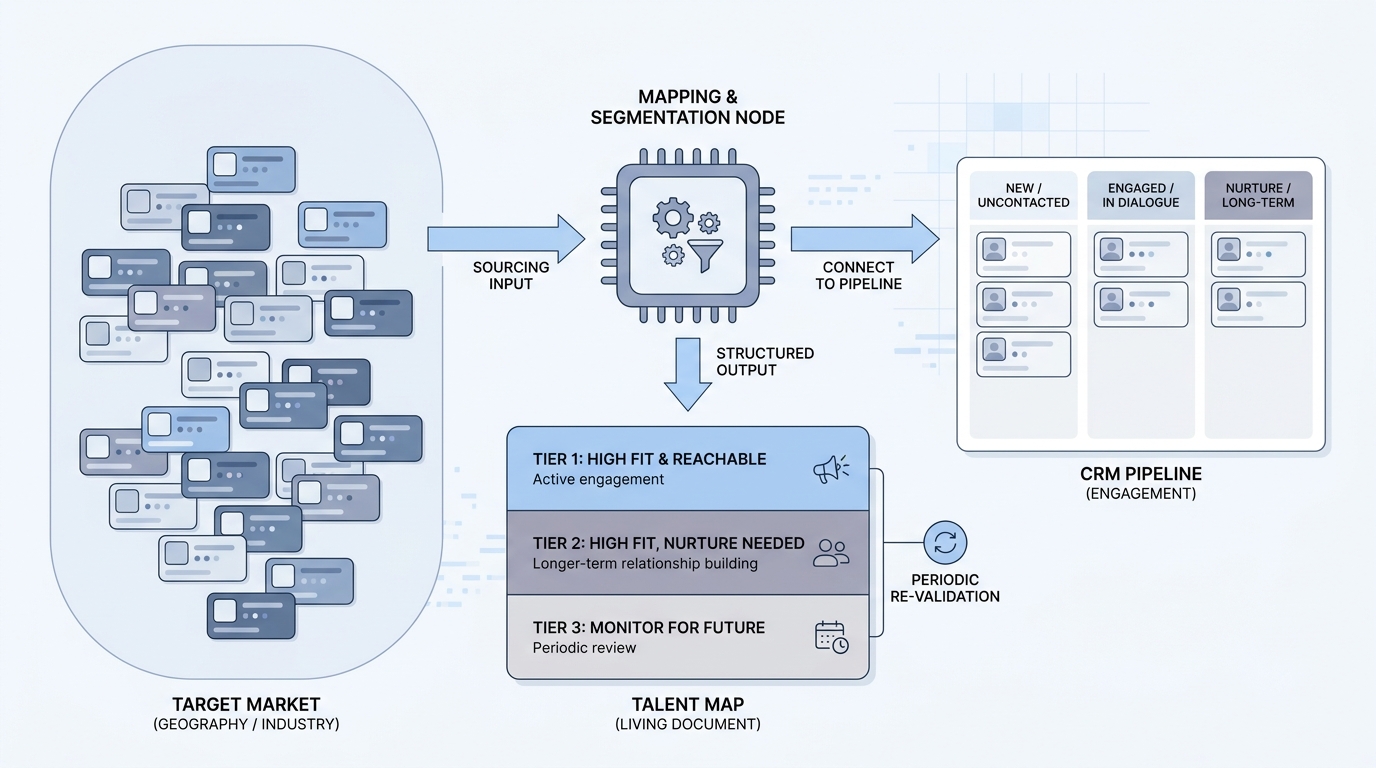
Talent market mapping is the process of systematically identifying who exists in a specific talent pool before you need to hire from it. A recruiter or sourcer builds a structured picture of the people in a target market, what companies they work for, how long they stay, and what their career trajectories look like. The output is a research document that makes the next sourcing project faster and better-informed because you already know the landscape.
In practice
- An executive search firm builds a market map of all VP-level Product leaders in European fintech for a retained search. The map covers 80 profiles, noting current role tenure, board exposure, and whether any have been contacted by the client before. The first outreach list comes from the 15 profiles where tenure is over two years and there has been no prior engagement.
- A TA leader at a scale-up maintains a living market map of senior data scientists in two target cities. When the VP of Data opens three reqs in Q2, the team already has a warm pipeline of 12 people who have responded positively to a soft reach-out over the previous six months, cutting time-to-first-interview from 30 days to 11.
- A People team uses a competitive market map to discover that a key rival has hired 30 percent of its senior engineering talent from the same four universities, concentrating risk in a narrower talent pool than assumed. The insight shifts the sourcing strategy for the next hiring cycle.
Quick read, then how hiring teams use it
This is for sourcers, executive search practitioners, TA leaders, and workforce planners who need a shared vocabulary around talent mapping. Skim the first section for the essentials. Use the second when you are deciding whether to build a map, choosing a tool, or designing a maintenance workflow.
Plain-language summary
- What it means for you: Market mapping is the research phase that happens before active sourcing, so when a req opens you already know the relevant pool and have a head start on the outreach.
- How you would use it: Build a map for roles you hire repeatedly or strategically important roles where getting the wrong hire is expensive. Use it to identify the 20 to 40 most relevant people in a target market and warm-touch them months before you need a hire.
- How to get started: Pick one critical open or upcoming role. Spend two to three hours in LinkedIn Recruiter or a similar tool identifying the top 30 candidates by fit. Record them in a shared spreadsheet with current company, title, and tenure. That is your first map.
- When it is a good time: When a role is expected but not yet approved, when the market for a function is tightening, or when the last three hires for the same role took longer than your SLA.
When you are running live reqs and tools
- What it means for you: A market map connected to your CRM means sourcing picks up where research left off: engagement history, outreach dates, and responses are all visible so the recruiter does not duplicate effort or damage a relationship the team has been building.
- When it is a good time: Before you open the req in the ATS, not the week the hiring manager is waiting for a slate.
- How to use it: Set up automated change alerts on mapped profiles in your sourcing tool. When a key candidate changes roles or gets promoted, the map updates automatically and the recruiter gets a notification: a job change is one of the highest signals that someone may be open to a conversation.
- How to get started: Audit your last five hires for critical roles. How many came from a pre-existing network or pipeline, and how many required starting from zero? The roles where you started from zero are your best candidates for a proactive mapping project.
- What to watch for: Maps that are built once and never refreshed (30 percent stale in six months), engagement history not connected to the CRM (so the next recruiter duplicates outreach), and GDPR obligations on stored profile data.
Where we talk about this
On AI with Michal workshops, market mapping comes up in sourcing automation and talent intelligence sessions. We discuss how AI tools accelerate the map-building phase, how to maintain a living pipeline without a full-time researcher, and how to connect a market map to a candidate nurturing workflow so the research pays off over months, not just for the immediate req. Join a AI Recruiting Accelerator to see how other teams have operationalised market mapping at different company sizes and budgets.
Around the web (opinions and rabbit holes)
Third-party creators move fast. Treat these as starting points, not endorsements. Do not move candidate data between platforms without checking privacy terms and your own data retention policy first.
YouTube
- Search "talent market mapping executive search" on YouTube for walkthroughs from executive search practitioners who build maps as a core deliverable, including how they present findings to hiring committees.
- "Sourcing intelligence" content from SOSU (Sourcing Summit) covers AI-assisted mapping tools with practitioner commentary on signal quality.
- r/recruiting has threads on whether market mapping is worth the time investment at different company stages, including frank debate on tooling ROI versus manual research.
- r/ExecutiveSearch covers the retained search use case with discussion on how maps differentiate search firm pitches.
Quora
- How do recruiters do market mapping? collects practitioner answers covering both manual and tool-assisted approaches across agency and in-house recruiting contexts.
Market mapping vs reactive sourcing
| Dimension | Reactive sourcing | Market mapping |
|---|---|---|
| Timing | Starts when req opens | Starts before req exists |
| Output | Candidate slate for current req | Structured picture of the talent pool |
| Speed to first screen | Slower (starting from zero) | Faster (warm pipeline already built) |
| Maintenance required | None after req closes | Ongoing refresh every 3 to 6 months |
| Best for | High-volume, common roles | Critical, scarce, or strategic roles |
Related on this site
- Glossary: Direct sourcing, Candidate nurturing, Labor market intelligence, Deduplication and merge rules, Candidate data enrichment
- Live cohort: AI Sourcing Lab
- Membership: Become a member