Diversity sourcing
Deliberate outreach practices designed to build candidate pools that include people from underrepresented groups, typically applied at the top of the funnel before and independent of standard job posting flows.
Michal Juhas · Last reviewed May 24, 2026
What is diversity sourcing?
Diversity sourcing is the deliberate practice of building candidate pools that include people from underrepresented groups. It works at the top of the funnel: before the first interview is scheduled, before any screening criterion is applied, and before the standard job posting flow can self-select on the existing network.
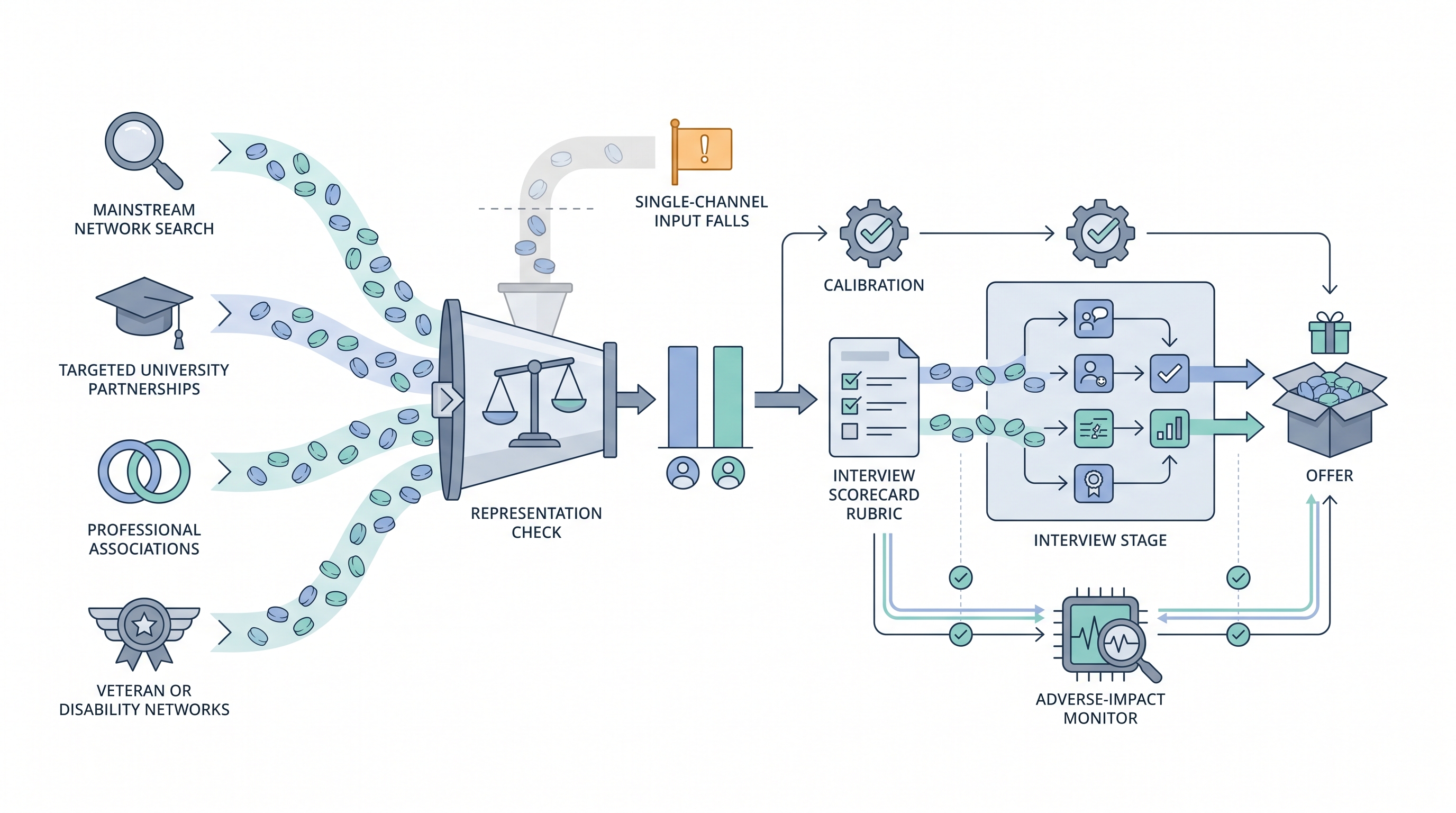
The premise is that passive candidates from underrepresented groups often do not find roles through the same channels that majority-group candidates use. A sourcer who relies only on their existing network, a single professional platform, or a keyword-based search is likely to replicate whatever representation patterns already exist in their pipeline.
In practice
- A sourcer who reports that every engineering pipeline they build is 90 percent male acknowledges they know the problem, but they continue using the same sourcing channels and Boolean strings that produced that result, which is the pattern diversity sourcing is designed to interrupt.
- A TA leader who says "we have a diverse sourced pool but the slate looks the same after screening" is describing a funnel where the sourcing program worked and the screening process undid it, which is a different problem requiring a different fix.
- An HRBP reviewing a hiring cohort and finding that candidates from HBCU networks advanced at the same rate as candidates from target universities after a structured interview process was implemented is seeing what the combination of diversity sourcing and calibrated evaluation can produce.
Quick read, then how hiring teams use it
This is for sourcers, recruiters, TA leaders, and HR partners who are responsible for representation outcomes in hiring. Skim the first section for a shared vocabulary. Use the second when you are designing a diversity sourcing program, auditing an existing process, or evaluating AI tools for their effect on candidate pool diversity.
Plain-language summary
- What it means for you: Finding candidates from underrepresented groups requires sourcing from different channels than you currently use, not just applying a diversity label to your existing search.
- How you would use it: Identify the representation gap in a specific role or team. Map which channels are likely to reach the underrepresented group. Add those channels to your sourcing workflow before the first interview is scheduled.
- How to get started: Take the last five roles where you felt the candidate pool was not representative. List the channels you sourced from. Identify what you did not use. That gap is your starting list of channels to add.
- When it is a good time: At the beginning of every search for a role where a representation gap exists, not after the shortlist is already built and someone notices the demographic pattern.
When you are running live reqs and tools
- What it means for you: AI sourcing tools optimize for profiles that resemble past hires unless you explicitly intervene. Diversity sourcing in an AI-assisted workflow requires checking tool output for group-level representation at each stage, not assuming the model has solved bias because it does not use demographic labels directly.
- When it is a good time: Before you run any AI sourcing tool on a role where representation is a known gap, audit a sample of its output for diversity across visible candidate signals (school, employer type, career path) before scaling.
- How to use it: Set a minimum representation target for the sourced pool before the first interview is scheduled. Track channel yield by group, not just overall. Use structured screening with anchored criteria to prevent the sourcing effort from being undone at the next stage.
- How to get started: Add one new diversity-focused channel to your next search for a role with a known gap. Compare the representation of candidates from that channel against your standard channels. Measure advancement rate, not just application rate.
- What to watch for: AI tools replicating historical bias by optimizing for profiles similar to current employees, job description language that filters before sourcing begins, adverse impact appearing at screening or interview stages after a diverse sourced pool was built, and diversity sourcing being treated as a checkbox rather than a process change with measurement attached.
Where we talk about this
On AI with Michal live sessions, diversity sourcing comes up when participants examine their current sourcing queries and find them optimized for a profile that reflects past hires rather than a broader market. The practical exercise is rebuilding the query with explicit channel diversity and testing output for representation before any message is sent. If you want the room conversation with peers, start at Sourcing Lab and bring a role where you know representation is a gap.
Around the web (opinions and rabbit holes)
Third-party creators move fast. Treat these as starting points, not endorsements, and verify legal applicability in your jurisdiction before changing your sourcing process.
YouTube
- Diversity Sourcing Strategies That Actually Work (search) covers practitioner approaches to channel diversification, job description audits, and funnel measurement.
- How to Audit Your Recruiting Process for Bias (search) connects sourcing to the downstream process changes that determine whether diverse candidates advance.
- AI and Diversity Hiring: Risks and Opportunities (search) includes practitioner discussions of when AI tools help and when they replicate existing gaps.
- What channels actually work for diversity sourcing in tech? in r/recruiting is a candid practitioner thread on what moves the needle versus what sounds good in a strategy deck.
- Diversity hiring: where does sourcing end and the problem begin? in r/humanresources covers the full funnel question of whether representation gaps are a sourcing problem or a process problem.
- Using AI for diversity sourcing: what are the risks? in r/recruiting includes real experiences with AI tools on diversity-sensitive searches.
Quora
- How do you source candidates from underrepresented groups effectively? collects answers from sourcers, DEI practitioners, and TA leaders on channel strategy and funnel measurement.
Diversity sourcing vs. standard sourcing
| Dimension | Standard sourcing | Diversity sourcing |
|---|---|---|
| Channel selection | Optimized for speed and fit | Expanded to reach underrepresented groups |
| Job description | Standard requirements language | Audited for exclusionary language before posting |
| Pool target | First qualified candidates | Minimum representation target before first screen |
| Success metric | Time-to-fill, offer acceptance | Representation at each funnel stage, adverse impact |
| AI tool use | Optimizes for profile similarity | Audited for group-level output before scaling |
Related on this site
- Glossary: Adverse impact, AI bias audit, Calibration session (hiring), Scorecard, Semantic search, Boolean search, Direct sourcing
- Blog: AI sourcing tools for recruiters
- Guides: Sourcers
- Live cohort: Sourcing Lab
- Self-paced: Starting with AI: the foundations in recruiting
- Membership: Become a member