Managed service provider (MSP)
A third-party company hired to manage an organisation's contingent workforce programme, including vendor relationships, compliance, timesheets, and spend consolidation.
Michal Juhas · Last reviewed June 11, 2026
What is a managed service provider (MSP) in workforce?
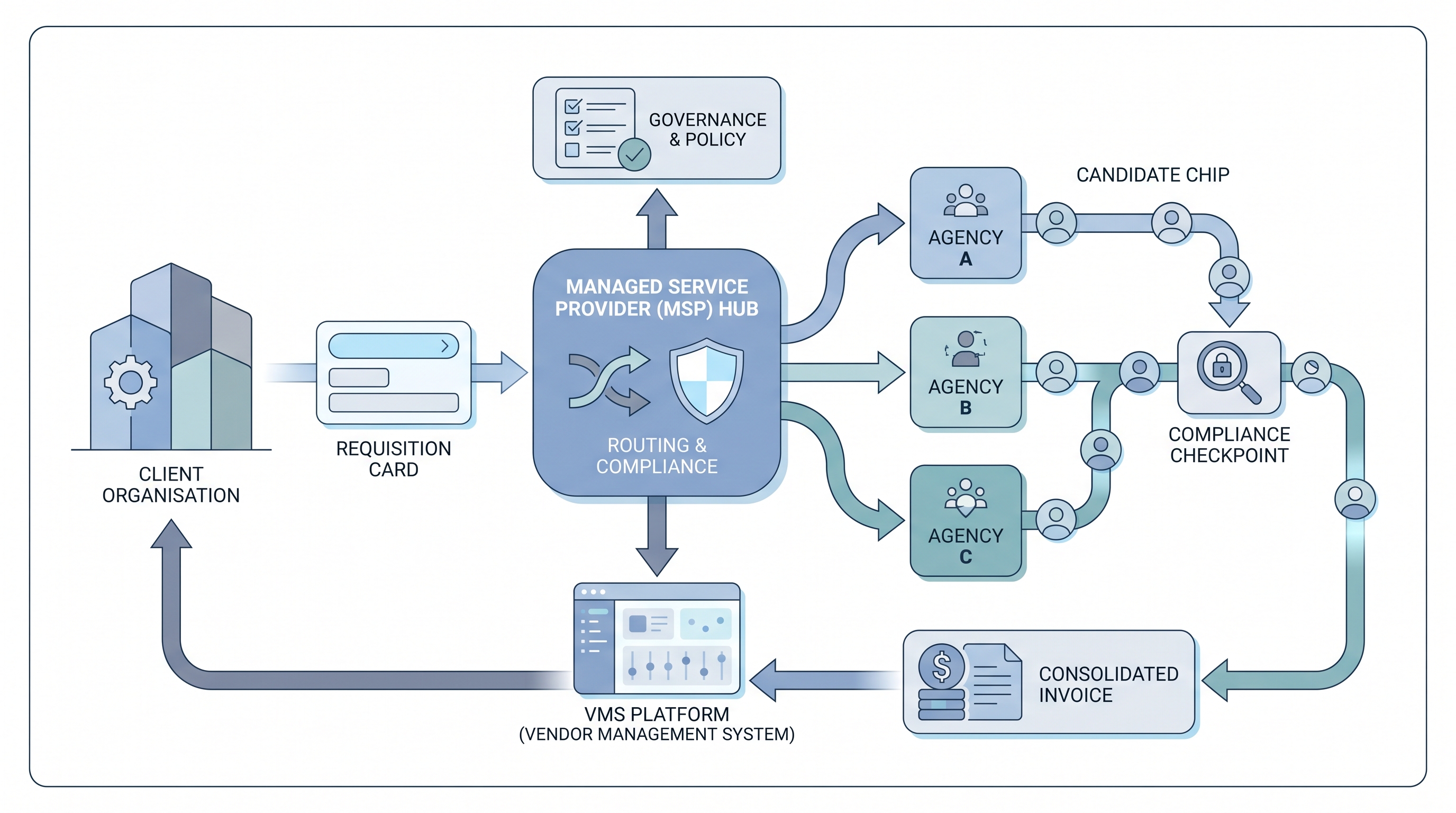
A managed service provider in workforce or staffing is a third-party company that runs an organisation's contingent workforce programme. It manages the supplier relationships, owns the vendor management system, handles compliance and invoicing, and holds the agencies accountable to agreed service levels.
In practice
- A global logistics company runs 300 contingent workers across 25 agencies. Instead of each business unit managing its own supplier relationships, they hire an MSP that runs a single VMS, consolidates all invoicing into one monthly statement, and holds quarterly business reviews with each agency.
- A TA leader says the MSP freed up three hours a week of recruiter time previously spent chasing timesheet approvals, but added two weeks of lead time on niche tech roles because the MSP routing rules did not have the right specialist agencies on the panel.
- An HR ops manager signs an MSP contract without a clause about AI tools in the supplier stack, then discovers six months later that three agencies are using an AI screening tool with no documented bias evaluation. Adding the requirement retroactively takes four months of negotiation.
Quick read, then how hiring teams use it
This is for TA leaders, HR ops, and procurement partners who manage or are considering a contingent workforce programme. Skim the first section for shared vocabulary. Use the second for practical considerations when setting up or reviewing an MSP arrangement.
Plain-language summary
- What it means for you: An MSP is a third party that sits between you and your staffing agencies. You raise a req, the MSP routes it to the right supplier, tracks the worker through their contract, and sends you one consolidated invoice.
- How you would use it: For high-volume or multi-supplier contingent programmes, the MSP handles supplier management, compliance, and spend reporting so internal TA can focus on permanent hiring and strategic workforce decisions.
- How to get started: Map your current contingent spend by category and supplier count. If you have more than 10 active suppliers and spend over a few million annually, get an MSP shortlist and ask each to show you their VMS and their AI governance policy.
- When it is a good time: When managing supplier relationships is consuming internal TA capacity, when compliance risk is high (IR35, SOX, co-employment), or when spend data is scattered across business units.
When you are running live reqs and tools
- What it means for you: Inside an MSP programme, your recruiter is no longer the first call for a contingent req. The workflow goes: hiring manager to MSP, MSP to approved supplier, supplier to candidate. Know the escalation path before a req stalls.
- When it is a good time: When supplier performance data shows consistent fill-rate gaps in specific role types, review the MSP routing rules rather than calling individual agencies directly.
- How to use it: Build a governance checklist into the MSP contract: which AI tools are permitted in the supplier workflow, what evaluation data backs their use, and how the MSP reports on fairness and compliance.
- How to get started: Run a supplier audit with the MSP twice a year. Ask each agency on the panel to confirm whether they use any AI tools for screening or outreach, and request the evaluation records.
- What to watch for: Fill-rate averages that mask niche-role failures, AI tools in the supplier chain without documented bias evaluation, and co-employment exposure when on-site contingent workers blur the client-agency line.
MSP versus direct supplier management
| Factor | MSP model | Direct management |
|---|---|---|
| Supplier count sweet spot | 15 or more | Up to 15 |
| Spend transparency | Consolidated | Fragmented unless TA ops builds it |
| Niche role speed | Slower (routing layer) | Faster (direct call) |
| Compliance audit trail | Centralised | Depends on internal resource |
| AI governance in supplier chain | Requires contract clause | Requires same due diligence |
Where we talk about this
In AI with Michal cohorts, MSP structures come up in the agency and TA operations tracks when participants are deciding whether to manage supplier relationships internally or externally. The practical question is almost always the same: at what scale does the overhead of running a supplier panel exceed the cost of an MSP fee? Bring your supplier count and spend figures to a AI Recruiting Accelerator and work through the decision with others in similar roles.
Around the web (opinions and rabbit holes)
Starting points only. Verify specifics against your programme requirements before acting.
YouTube
- What is an MSP and VMS in Contingent Workforce? (Staffing Industry Analysts) gives a clean overview of the model structure.
- Managed Service Provider vs Staffing Agency covers the difference from a procurement perspective with common programme pitfalls.
- r/humanresources: does your company use an MSP for contingent workers? has practitioner threads on what worked and what did not in real programmes.
- r/recruiting: working inside an MSP programme as an agency recruiter gives the agency-side view of how MSP routing and rate cards affect placement quality.
Quora
- What is the difference between an MSP and a staffing agency? has a range of answers from practitioners worth reading before vendor selection.