Contingent workforce
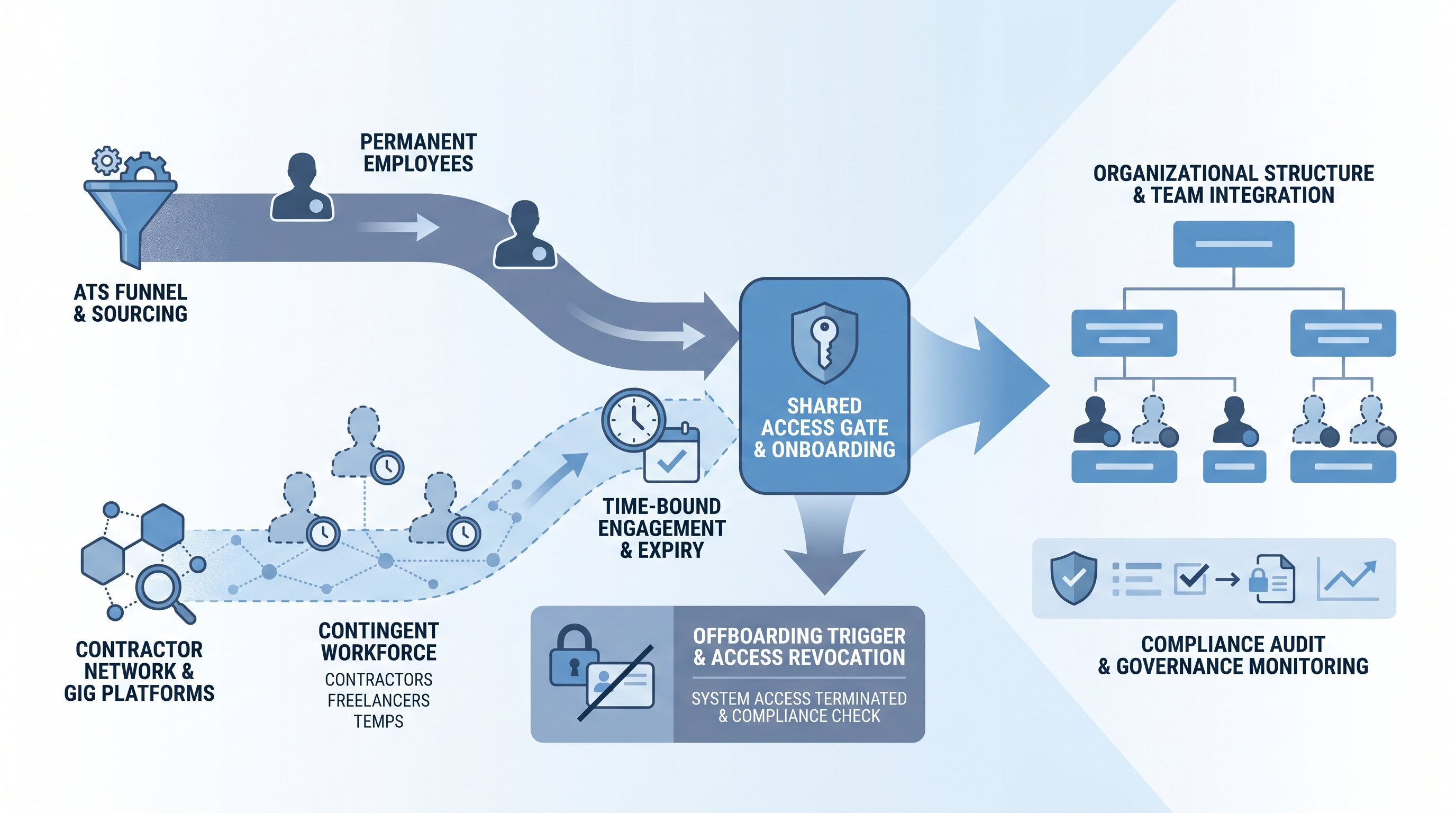
Workers engaged on a non-permanent basis, including freelancers, independent contractors, temp-agency staff, and statement-of-work consultants, who fill capacity or specialist gaps without permanent headcount commitment.
Michal Juhas · Last reviewed May 24, 2026
What is a contingent workforce?
A contingent workforce includes all workers engaged on a non-permanent basis: freelancers, independent contractors, temporary staff placed through agencies, statement-of-work consultants, and gig platform workers. They fill capacity gaps, cover specialist needs, or replace headcount that cannot be added to payroll quickly under current budget constraints.
The term surfaces in conversations between TA, finance, and legal when someone asks why the headcount report does not match the actual number of people doing work in the organization. Contingent workers are often invisible in those counts, yet they carry the same data risk and cultural impact as permanent employees.
In practice
- When a hiring manager says "we need someone in two weeks but I cannot open a permanent req," the answer is usually a contractor or temp, which means TA needs a contingent sourcing channel that is not dependent on waiting for a staffing agency to restart from scratch.
- A TA ops team tracking attrition will often find that contractor turnover is not measured at all, because the ATS was set up only for permanent roles, which means the true cost of contingent churn stays hidden.
- An HRBP reviewing a data incident will ask who had access to candidate records and when it was removed; contingent workers who finished an engagement six months earlier frequently appear with access that was never revoked.
Quick read, then how hiring teams use it
This is for recruiters, TA leads, and HR partners who manage both permanent and non-permanent talent channels. Skim the first section for a shared vocabulary. Use the second when you are designing a contingent sourcing strategy, reviewing vendor contracts, or auditing system access for non-employees.
Plain-language summary
- What it means for you: Any worker not on your permanent payroll is contingent, and that group needs its own sourcing, onboarding, and offboarding workflow, not just an agency call.
- How you would use it: Map your current contingent roles by category (contractor, temp, SOW), then identify which ones could be filled from a maintained talent pool rather than restarting with an agency each time.
- How to get started: Pull the last six months of contingent hires from your vendor management system or ATS. Identify any role that repeated more than twice. Those are your direct-sourcing candidates.
- When it is a good time: Before the next budget cycle, when finance asks what the total workforce cost looks like beyond headcount.
When you are running live reqs and tools
- What it means for you: Contingent workers touch the same ATS, email tools, and candidate data as your team. A contractor without a scoped access review or an offboarding trigger is a data governance gap, not just a workforce planning issue.
- When it is a good time: Every time a contingent engagement ends, renews, or extends, an automated workflow should fire. If you are building those automations now, contingent offboarding is the first one to add.
- How to use it: Maintain a separate pipeline or tag in your ATS for contingent roles. Store engagement start and end dates, access level, and contractor contact in a format your workflow automation can read. Wire an offboarding trigger to the end date field.
- How to get started: Ask IT and security for a list of non-employee accounts with active system access. Compare that list to your HR records for engagement end dates. The gap is your starting audit.
- What to watch for: Worker misclassification signals (contractor directing others, working exclusively for you for more than 12 months, using only company equipment), agency margins you cannot justify against your direct-sourcing alternative, and ATS configurations that let permanent-role workflows fire for contingent candidates.
Where we talk about this
On AI with Michal live sessions, contingent workforce comes up when participants build their full sourcing picture and realize their ATS workflows, consent language, and outreach templates were designed only for permanent hires. The practical fix usually starts with a parallel pipeline and a dedicated offboarding trigger. If you want the room conversation with other TA practitioners building these systems, start at Sourcing Lab and bring your actual vendor and ATS setup.
Around the web (opinions and rabbit holes)
Third-party creators move fast. Treat these as starting points, not endorsements, and double-check anything before you wire candidate data to a new tool.
YouTube
- How to Build a Contingent Workforce Strategy (search) surfaces practitioner walkthroughs of vendor management, direct sourcing, and headcount classification.
- Contractor vs Employee: Classification Explained (search) covers the legal tests across US, UK, and EU frameworks.
- Contingent Workforce Management for TA Teams (search) includes examples from TA ops teams that have built direct contingent sourcing channels alongside agency relationships.
- How do you manage contractor sourcing at scale? in r/recruiting covers what TA teams actually build versus what vendor management systems promise.
- Worker classification and IR35 in practice in r/humanresources is a candid thread on classification tests, mistakes, and remediation.
- Contingent worker offboarding and access revocation in r/sysadmin shows the security and IT perspective that TA rarely sees until a breach occurs.
Quora
- What is the difference between contingent workers and permanent employees? collects answers from HR practitioners, lawyers, and workforce planners on classification, benefits, and sourcing strategy.
Permanent hire vs. contingent worker
| Dimension | Permanent hire | Contingent worker |
|---|---|---|
| Headcount impact | Adds to headcount | Usually excluded |
| Sourcing lead time | Weeks to months | Days to weeks (faster with a direct pool) |
| Access and offboarding | Standard IT onboarding and exit | Often ad hoc without a dedicated trigger |
| Classification risk | Minimal | High if terms mimic employment |
| Long-term talent pool | Core of TA strategy | Often underdeveloped |
Related on this site
- Glossary: Direct sourcing, Proprietary talent pool, Talent acquisition metrics, Workflow automation, AI in recruiting
- Blog: AI sourcing tools for recruiters
- Guides: Sourcers
- Live cohort: Sourcing Lab
- Self-paced: Starting with AI: the foundations in recruiting
- Membership: Become a member