Co-employment risk for staffing agencies
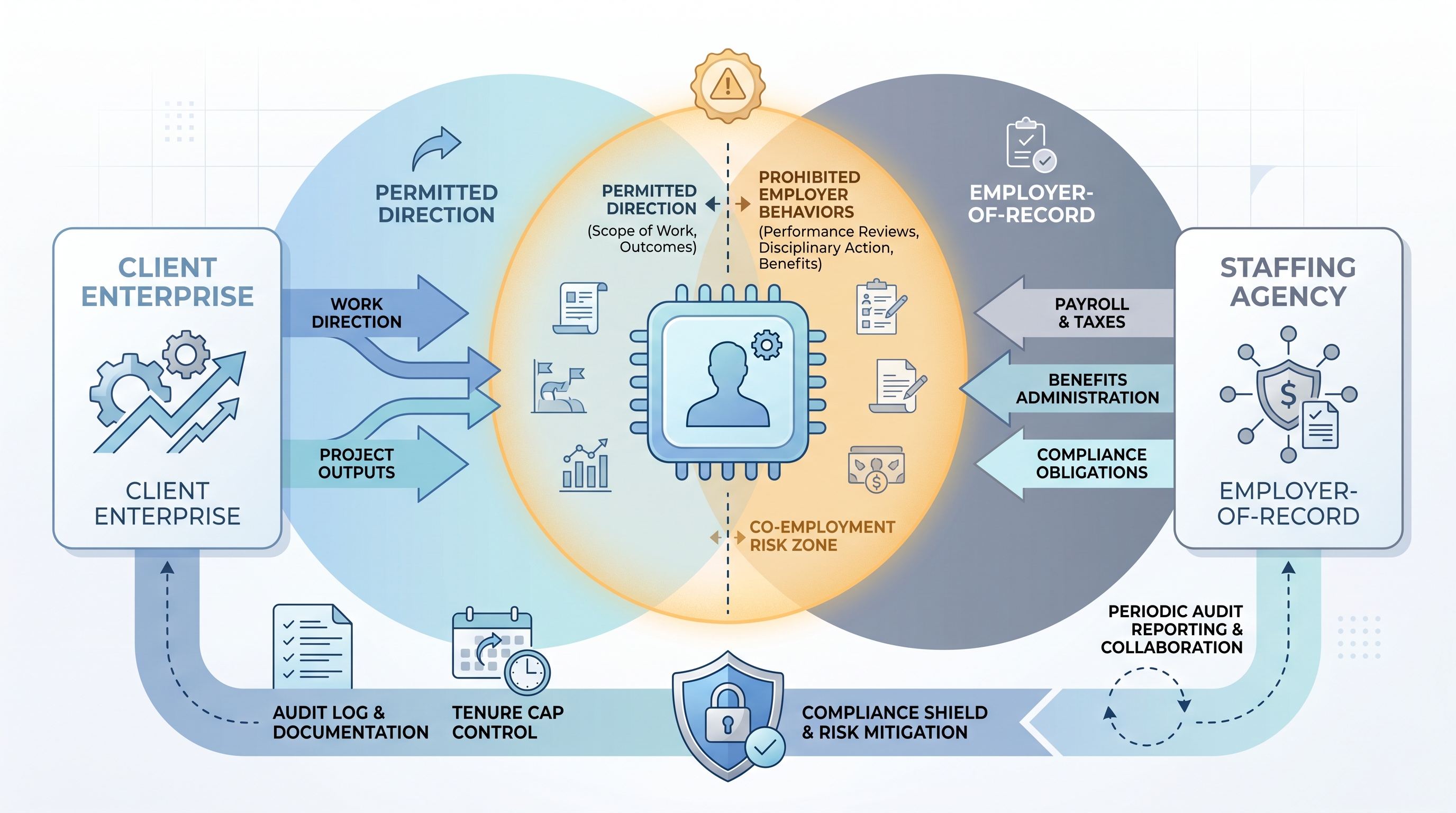
Co-employment risk is the legal exposure created when a client organisation exercises enough direct control over a staffing agency's contractor that a court, tax authority, or employment tribunal could find joint employer status, triggering statutory benefits obligations, payroll tax liability, or employment rights for a party that did not intend to be an employer.
Michal Juhas · Last reviewed May 7, 2026
What is co-employment risk for staffing agencies?
Co-employment risk is the legal exposure created when a client organisation exercises enough direct control over a staffing agency's contractor that a court, tax authority, or employment tribunal could find joint employer status. The risk matters because joint employer status can trigger statutory benefits obligations, payroll tax liability, and employment rights for a party that never intended to be an employer.
The concept sits at the intersection of employment law, contract structure, and day-to-day supervision habits. The written staffing agreement may be perfectly drafted, but if a client manager assigns tasks, approves leave, and conducts performance reviews, the legal picture may diverge from the contractual one. Most co-employment disputes trace back not to bad contracts but to supervision behaviours that were never reviewed against the contract terms.
For contract staffing agencies managing large contractor populations across enterprise accounts, co-employment is an ongoing operational risk that must be priced, monitored, and managed as a standing business practice.
In practice
- An enterprise technology firm audits its contingent workforce programme and discovers that two senior contractors have been on-site for 26 months, received company-issued email addresses, and were included in the annual performance review cycle alongside permanent employees. Legal flags these as potential joint-employer situations and initiates a review of the staffing agreement and contractor engagement terms.
- A staffing agency managing 80 active contractors across three enterprise clients builds a tenure dashboard that alerts account managers when any contractor passes 10 months on a single assignment, giving both sides time to decide between re-scoping, extension, or planned end before the 12-month policy cap is reached.
- A mid-market financial services firm adopts a vendor management system from its MSP and discovers for the first time that three contractors have exceeded the firm's 18-month cap, two others are using company email addresses, and one hiring manager has been signing off on contractor timesheets using language lifted from the permanent employee handbook.
Quick read, then how hiring teams use it
This page is for agency principals, operations managers, in-house TA leaders, and compliance teams who manage or negotiate contractor staffing arrangements. Skim the first section for the definition. Use the second when you are reviewing a new MSA, managing a contractor population, or preparing for a client compliance audit.
Plain-language summary
- What it means for you: If a client starts acting like your contractor's employer through daily supervision, task assignment, or performance management, that client could be found legally responsible for employment obligations it never budgeted for. Your agency could face similar exposure if contractors are found to be employees.
- How you would use it: Build tenure tracking into your contractor management system. Review MSA language before signing to confirm who is the employer of record and which supervision behaviours are prohibited.
- How to get started: List every active contractor placement, the start date, and the client contact responsible for day-to-day direction. Flag any placement exceeding 12 months and any where the client manager is assigning work directly without an agency intermediary step.
- When it is a good time: At MSA renewal, at each contractor re-engagement, and at least annually as a standing compliance review.
When you are running live reqs and tools
- What it means for you: Co-employment risk is not only a legal document concern. It shifts whenever a client changes how it manages contractors on site, adopts new AI task routing tools, or includes contractors in processes designed for permanent staff.
- When it is a good time: Before signing or renewing any MSA, when a client deploys new workflow tools that touch contractor populations, and when a contractor tenure cap is approaching.
- How to use it: Maintain a per-client co-employment risk register: employer-of-record confirmation, tenure cap dates, prohibited supervision behaviours, and last audit date. Cross-reference against your indemnification schedule so you know which exposure falls to you and which falls to the client.
- How to get started: Start with your highest-volume contract staffing account. Map who directs each contractor daily, check tenure against your cap, and review the latest MSA for co-employment protocol language. You will almost certainly find at least one gap.
- What to watch for: AI tools deployed by the client that assign, score, or route contractor work. These create a supervision signal that may not be captured in the original MSA. Add a clause requiring the client to notify you before deploying automated management tools that touch your contractors.
Where we talk about this
On AI with Michal live sessions, agency contract structure, including MSAs, supplier compliance, and contractor management risk, comes up in the AI in recruiting track when agency owners discuss how to run scalable, compliant contract staffing operations. The Sourcing Lab cohort covers the business and legal side of agency agreements so both in-house TA leaders and agency principals understand what they are agreeing to and why each clause exists.
Around the web (opinions and rabbit holes)
Third-party content on co-employment risk spans employment law commentary, staffing industry association guidance, and HR compliance forums. These are starting points, not endorsements. Verify any legal position with employment counsel before relying on it in a live agreement or audit response.
YouTube
- Co-employment risk and staffing agency contracts covers how joint employer findings arise in contingent staffing and what contractual language helps limit exposure.
- Contractor vs employee classification for staffing firms walks through the control factors that courts and tax authorities use when evaluating worker status.
- Managed service programmes and co-employment mitigation discusses how MSPs create a compliance buffer between client supervision and agency employer-of-record status.
- Co-employment concerns in r/recruiting includes TA and agency owner accounts of how co-employment issues surface in practice and how different organisations manage the risk.
- Contractor tenure policies in r/humanresources surfaces HR leader perspectives on setting and enforcing tenure caps across contingent workforce programmes.
- Staffing agency MSA and joint employer risk in r/RecruitmentAgencies covers agency owner experience negotiating co-employment protocol schedules with enterprise clients.
Quora
- What is co-employment risk in staffing agencies? collects practitioner and legal perspectives on how joint employer exposure arises and what agencies can do to limit it.
Co-employment risk by engagement type
| Engagement type | Typical risk level | Main control factor | Common mitigation |
|---|---|---|---|
| Long-tenure contract staffing (PSA) | High | Daily task direction and performance management | Tenure cap, co-employment protocol schedule |
| Short-term project placement | Medium | Scope of deliverables vs hours supervised | Deliverable-based contract, short engagement window |
| Payrolled contractor (EOR) | Low to medium | Rate card only, no supervision | Employer-of-record structure, full employment by agency |
| Permanent placement | Low | Ends at placement, no ongoing supervision | Guarantee clause governs, not employment relationship |
Related on this site
- Glossary: Agency indemnification clauses, Client pass-through compliance for agency vendors
- Glossary: Agency markup in contract staffing, Bench cost and recruiter pipeline management
- Glossary: Backfill periods and replacement guarantees, Agency data room and due diligence
- Glossary: Workflow automation, Client concentration risk for recruitment agencies
- Workshops: Sourcing Lab
- Course: Starting with AI: the foundations in recruiting
- Membership: Become a member