Offer management
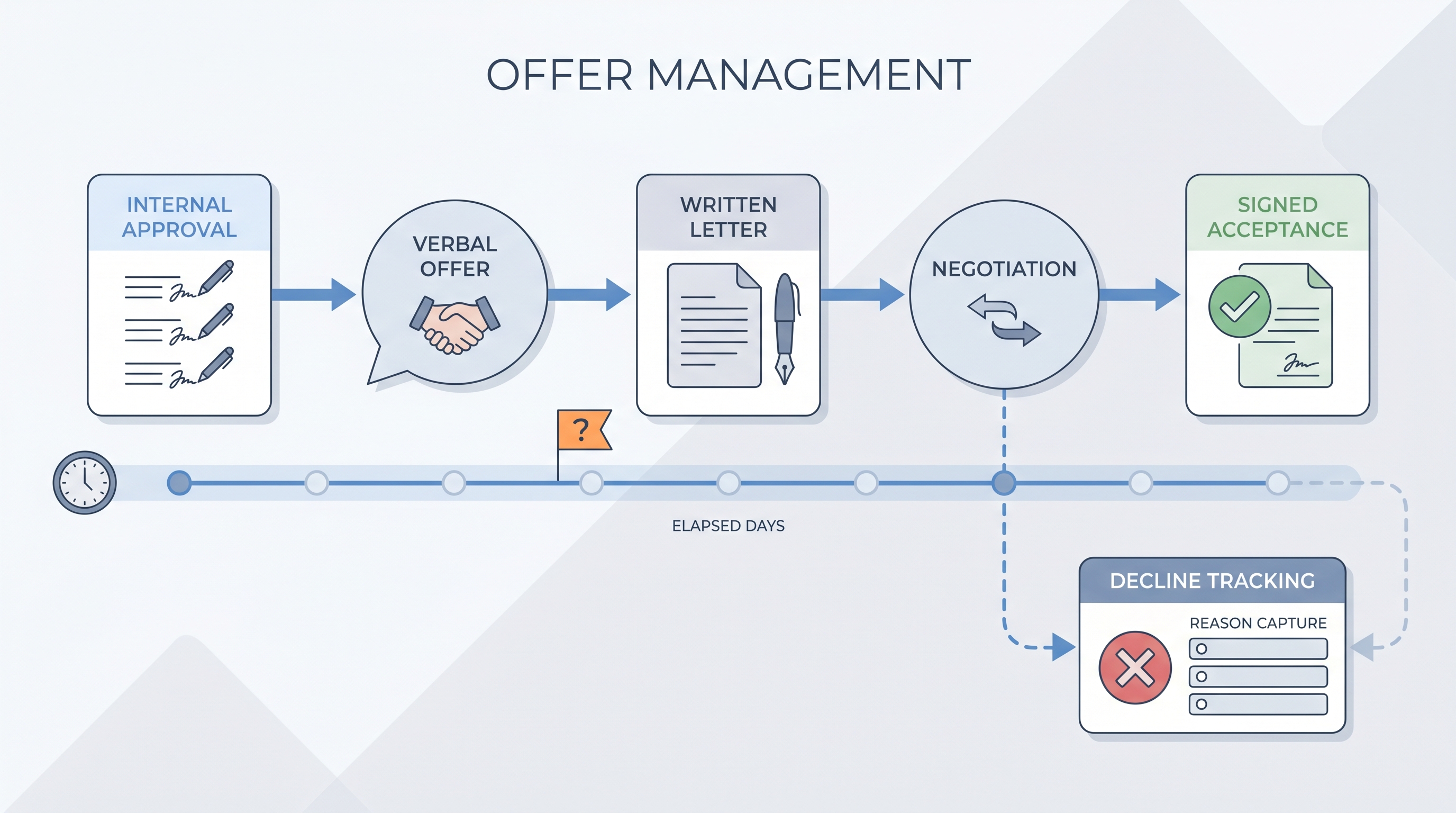
The end-to-end process of creating, approving, extending, and closing employment offers, from compensation benchmarking through verbal discussion to signed letter, including negotiation and decline tracking.
Michal Juhas · Last reviewed June 11, 2026
What is offer management?
Offer management covers everything from the moment a recruiter knows they want to make an offer to the moment a candidate signs, including compensation discussion, internal approvals, negotiation, and the written letter. Done well, it is invisible to the candidate. Done slowly, it is the stage where strong candidates accept elsewhere.
In practice
- A recruiter gets verbal approval on a package Monday morning, spends two days chasing finance for the second signature on an exception to the band, and emails the written offer Wednesday afternoon. The candidate accepts a competing offer Tuesday night. The ATS shows no declined offer because the written one was never sent.
- A TA leader runs a quarterly offer review and discovers the team has a 68% acceptance rate for senior roles but 91% for individual contributors. Digging into decline reasons reveals the senior comp band has not been benchmarked in 18 months.
- A sourcing team builds a shared offer handoff template after a case where a verbal promise of a signing bonus did not appear in the written letter and the candidate caught it. One field, one source of truth.
Quick read, then how hiring teams use it
This page is for full-cycle recruiters, TA leaders, and HR ops partners who want a cleaner offer stage and fewer lost candidates in the last mile of the funnel. Skim for shared language, then use the second section for the operational setup.
Plain-language summary
- What it means for you: Offer management is the sequence of steps between "we want to hire this person" and "they signed." Most of the candidate drops that feel personal ("they ghosted") actually happen because the internal process is slower than the candidate's other options.
- How you would use it: Map your current approval chain. Count the days from verbal to written offer. That number is your baseline. Reducing it by two days often recovers one in five lost offers.
- How to get started: Pick the one approval step that adds the most delay and ask whether it can run in parallel with another step rather than sequentially.
- When it is a good time: Before starting a high-urgency hiring push, and after any quarter where acceptance rates dropped by more than five percentage points.
When you are running live reqs and tools
- What it means for you: Every day between verbal and written offer is a day the candidate is exposed to counter-offers and competing processes. Track that interval as a pipeline metric, not just a final outcome.
- When it is a good time: Review your offer approval workflow annually and after any change to compensation policy, org structure, or approval authorities.
- How to use it: Build a shared field in your ATS or tracker for verbal offer date, written offer date, and accepted or declined date. Without those three timestamps you cannot diagnose where the delays are or whether the issue is speed or comp.
- How to get started: Run a retro on the last five declined offers. Were they lost on comp, timeline, or something else? That categorisation is the cheapest diagnostic tool you have.
- What to watch for: Approval chains that require sequential sign-off when parallel would work, verbal commitments that do not appear in the written letter, and negotiation notes that live in recruiter email instead of the shared record.
Where we talk about this
In AI with Michal cohorts, offer management comes up in the AI in recruiting track when teams are mapping which stages of the funnel they want to speed up with AI. Benchmarking, draft generation, and decline analysis are the three most common starting points. The harder conversation is internal: approval chain governance and equity review are not things a tool solves on its own. Bring your current acceptance rate and your approval flow to a AI Recruiting Accelerator if you want a structured debrief with others in similar roles.
Around the web (opinions and rabbit holes)
Starting points only. Verify specifics against your comp policy and legal context before changing any approval workflow.
YouTube
- Offer Management Best Practices in Recruiting (SHRM) covers the end-to-end flow with common mistake patterns.
- Why Candidates Decline Offers includes practitioner interviews on the most preventable decline reasons.
- r/recruiting: anyone else losing candidates between verbal and written offer? surfaces dozens of practitioner threads on approval delays and how teams addressed them.
- r/humanresources: how do you handle offer negotiation equity? covers the pay equity angle of negotiation policy with real examples.
Quora
- How long should offer management take from verbal to signed? has a range of benchmarks from practitioners worth checking against your own data.