Weekly hiring funnel report
A recurring summary that tracks candidate movement across every hiring stage for the past seven days, surfaces where volume stalled, and signals whether open requisitions are on pace for their target close dates.
Michal Juhas · Last reviewed May 5, 2026
What is a weekly hiring funnel report?
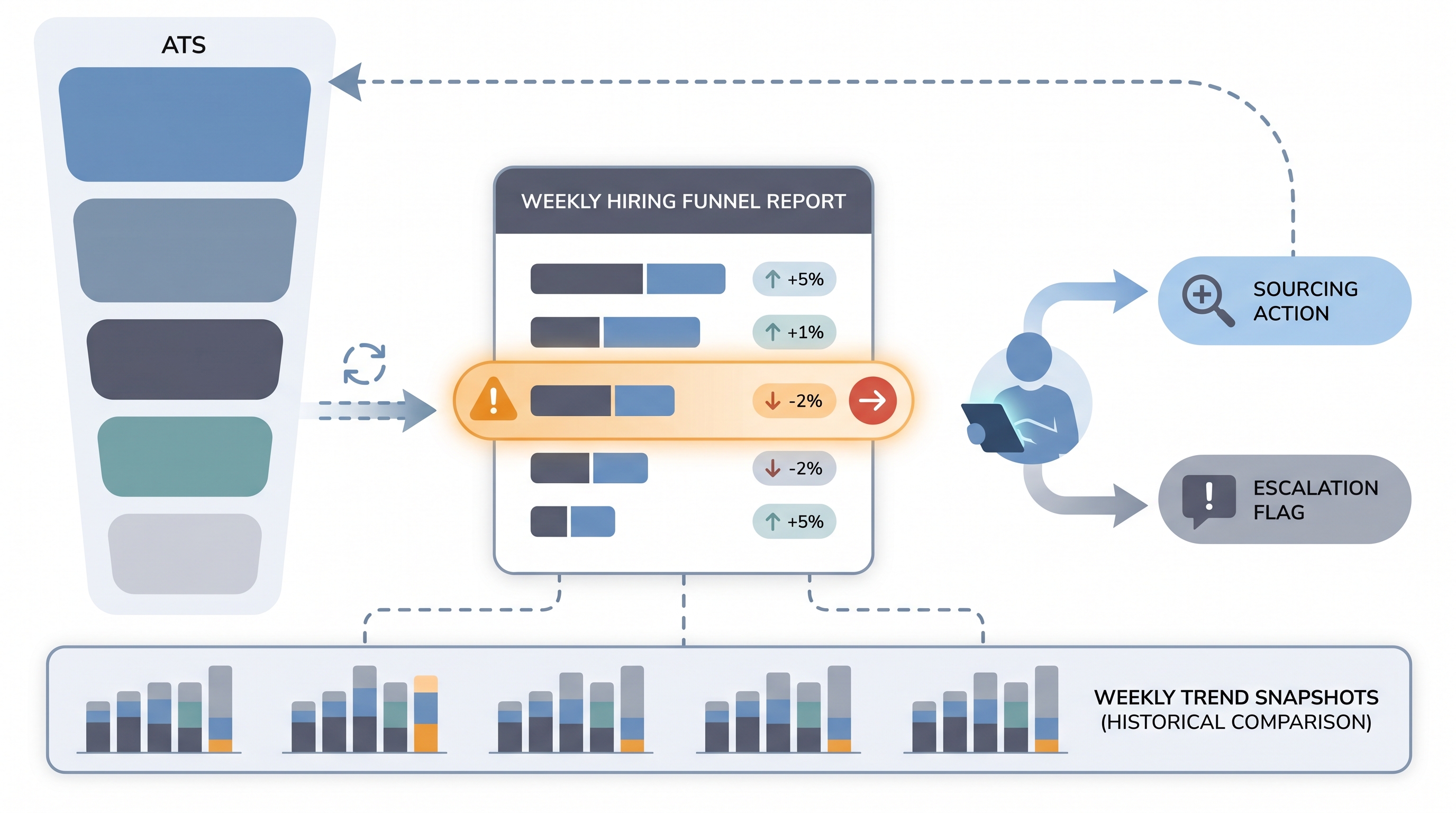
A weekly hiring funnel report is a recurring summary that tracks candidate movement across every stage of the hiring pipeline for the past seven days. The goal is early detection: if phone screens are flat while applications spiked, that mismatch surfaces a week before the queue overflow becomes a recruiter complaint. If interviews are running but offers are not, you have a calibration or approval delay the weekly cadence identifies before it compounds into a missed hire date.
The report works best when it is short enough to read in five minutes and consistently formatted so trends are visible across weeks, not buried in changing layouts.
In practice
- A TA ops lead at a 600-person company sets up a Friday afternoon Slack summary that pulls the week's stage counts from the ATS API, compares them to the four-week rolling average, and flags any req where forward movement dropped below the team's baseline. The hiring manager reviews the same summary in their Monday briefing.
- A recruiter running four open reqs keeps a simple Google Sheet with stage counts by req. Each Monday she enters last week's numbers, checks whether any req is coverage-negative (fewer candidates in late stages than the expected close rate requires), and either sources more or escalates to the hiring manager.
- A TA leader presenting to the VP of People uses the weekly report data to explain why time-to-fill for engineering roles is tracking two weeks longer than the prior quarter. The stage breakdown shows interviews completing on time but offers taking four additional days to generate, pointing to an approval chain issue rather than a sourcing problem.
Quick read, then how hiring teams use it
This is for recruiters, sourcers, TA, and HR partners who need the same vocabulary in pipeline reviews, status calls, and capacity planning. Skim the first section when you need a fast shared picture. Use the second when you are deciding what to pull from your ATS or how to structure the reporting rhythm.
Plain-language summary
- What it means for you: A weekly hiring funnel report shows how many candidates moved through each stage last week and whether that pace is normal, slow, or fast for the req.
- How you would use it: Check it at the start of each week to spot reqs with thin coverage, stages with unexpected drops, and roles where forward movement has stalled.
- How to get started: Export stage counts from your ATS for one req for the past four weeks. Put them in a simple table. That is your baseline. Repeat weekly.
- When it is a good time: Any time you have at least two active reqs and a hire deadline you care about. The cadence pays off most when multiple reqs compete for sourcer time.
When you are running live reqs and tools
- What it means for you: The weekly report is the heartbeat check for your pipeline. It does not tell you why something is off, but it tells you which stage to investigate before it becomes a miss.
- How to use it: Pull stage counts by req from your ATS weekly. Compare the current week to the prior four-week average. Flag any stage where movement dropped by more than 30 percent. Route the flag to the owner of that stage.
- How to get started: If your ATS has saved reports, set one up now for stage counts by req, scheduled to send Friday at 5pm. If not, use the ATS API through ATS API integration to pull data into a shared sheet or Slack summary via workflow automation.
- When it is a good time: Weekly when reqs are active. Monthly when headcount is frozen. The cadence should match the urgency of your pipeline.
- What to watch for: Activity metrics sneaking in (calls made, emails sent) instead of stage movement. A report full of effort data with no transition data is a status report, not a funnel report. Ensure definitions are consistent across recruiters before you trend the data.
Where we talk about this
On AI with Michal live sessions, weekly funnel reporting comes up in both the AI in recruiting and sourcing automation tracks. AI in recruiting sessions cover how to structure the report, which ATS exports to use, and how to use a prompt to generate a plain-English interpretation from stage data. Sourcing automation sessions add the operational layer: wiring ATS stage counts to a Slack bot or a shared sheet without manual entry. Start at Sourcing Lab and bring your current ATS name and reporting setup so the feedback is grounded in what you actually have, not a hypothetical stack.
Around the web (opinions and rabbit holes)
Third-party creators move fast. Treat these as starting points, not endorsements, and double-check anything before you wire candidate data.
YouTube
Search "hiring pipeline dashboard recruiting metrics" for TA practitioners showing ATS reporting setups and weekly review formats. Look for videos where the presenter walks through an actual report rather than a vendor feature demo.
r/recruiting has threads on what TA leaders track weekly and what gets cut. Searches for "pipeline reporting ATS" and "TA metrics weekly" surface practitioner views on what works and what turns into admin overhead.
Quora
"What metrics do recruiting teams track weekly?" surfaces answers from TA ops practitioners who explain which stage transitions carry the most predictive signal and which are vanity counts.
Weekly vs. monthly reporting cadence
| Cadence | Best for | Risk |
|---|---|---|
| Weekly | Active reqs with near-term deadlines | Over-managing if nothing changed |
| Monthly | Headcount planning, trend analysis | Misses bottlenecks until they compound |
| Ad hoc | Escalations, executive asks | No trend line to reference |
Related on this site
- Hiring funnel conversion rates - stage-by-stage rate benchmarks for interpreting weekly data
- Talent acquisition metrics - the broader metrics framework weekly reports plug into
- Time to fill - the outcome the weekly report is designed to protect
- Interview to offer ratio - late-stage conversion the weekly report tracks
- ATS API integration - automating stage count extraction
- Workflow automation - routing weekly data to Slack or shared sheets
- Human in the loop - governance for AI-assisted report interpretation
- Scorecard - stage evaluation consistency that makes weekly data trustworthy
- Sourcing Lab - live sessions on recruiting analytics and pipeline management
- Become a member - office hours for reporting setup and ATS-specific questions