Backfill periods and replacement guarantees
A contractual commitment in agency recruitment agreements requiring the agency to find a replacement candidate at no additional fee if the original hire exits within a defined guarantee window, typically 30 to 90 days from their start date.
Michal Juhas · Last reviewed May 5, 2026
What are backfill periods and replacement guarantees?
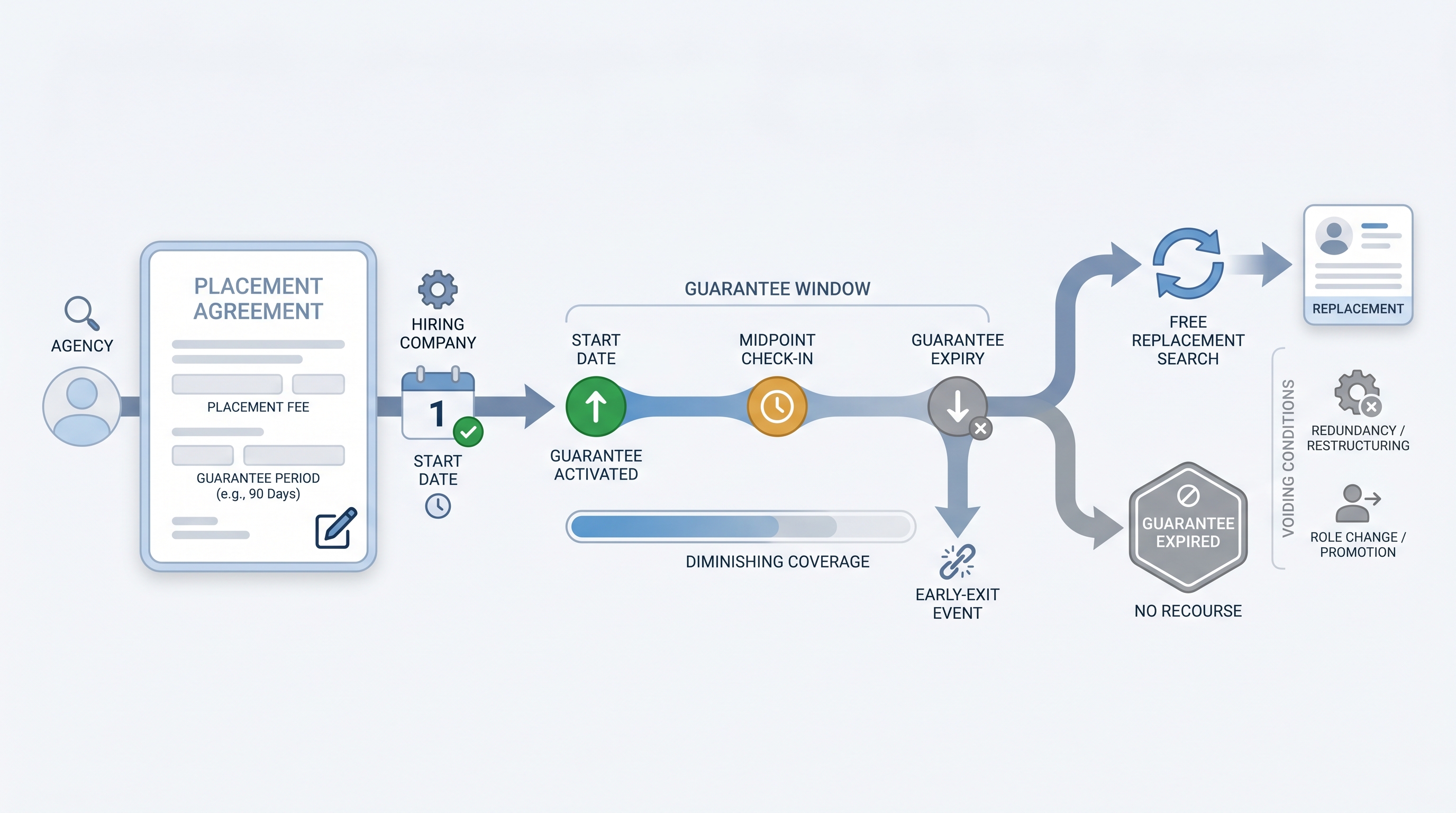
A backfill period is the window in an agency recruitment agreement during which the agency commits to sourcing and presenting a replacement candidate at no additional fee if the original placement exits the role. The replacement guarantee is the contractual obligation that makes this commitment enforceable.
In practice, both terms describe the same protection: you pay a placement fee, the candidate starts, and if they leave or are terminated within the agreed window, the agency delivers a free backfill search. The protection exists to offset the inherent risk in any permanent placement: even a well-qualified candidate can exit quickly for reasons neither the client nor the agency fully controls.
Guarantee windows typically run from 30 to 90 days for permanent hires. Contract or temporary placements rarely carry a replacement guarantee at all. Senior roles sometimes carry extended windows of 120 to 180 days. The exact terms belong in the written agreement, not in a verbal summary from the recruiter.
In practice
- A TA manager at a fintech company places a senior financial controller through an agency with a 90-day guarantee. The controller resigns at day 55 citing a culture mismatch. The TA manager submits a replacement request the same day and the agency presents three candidates within three weeks at no additional fee.
- An agency consultant calls the placed candidate at the 30-day mark and discovers the hiring manager changed the role scope significantly after the start date. She documents the conversation and flags it to both parties, because a material role change often voids the replacement guarantee under the contract terms.
- A finance team reviewing invoices from six months earlier finds an agency payment where the placed candidate left at day 62 but no replacement request was ever filed. The 90-day window had expired unnoticed because no one owned guarantee period tracking.
Quick read, then how hiring teams use it
This page is for TA managers and HR leaders reviewing agency agreements, and for agency recruiters who want to understand how backfill obligations work from both sides. Skim the first section for the definition. Use the second when you are setting up a placement tracking workflow or negotiating replacement guarantee terms before you sign.
Plain-language summary
- What it means for you: A replacement guarantee is the safety net in an agency agreement. If the hire does not last through the backfill period, the agency sources a replacement at no extra cost.
- How you would use it: Log every agency placement date, guarantee period length, and voiding conditions in your ATS or HRIS the day the new hire starts. Assign one person to own the expiry date and monitor for early exits.
- How to get started: Pull your last ten agency placements and check whether any guarantee periods are still open or recently lapsed. That audit tells you whether you have unclaimed replacement searches or a tracking gap worth fixing now.
- When it is a good time: Any time you are signing a new agency agreement, renegotiating terms, or seeing a higher-than-expected early attrition rate from agency placements.
When you are running live reqs and tools
- What it means for you: Guarantee period tracking is a finance and compliance workflow as much as an HR one. Finance teams that approve invoices without checking open guarantee windows miss recoverable replacement searches. See hiring funnel conversion rates for context on how early attrition signals fit into your broader pipeline health.
- When it is a good time: After each agency placement, on the day the new hire starts. Do not wait until you need to file a request.
- How to use it: Add a custom field in your ATS for the guarantee expiry date and an assigned owner. Set a calendar alert at the halfway point and again one week before expiry. Wire your offboarding checklist to a check that flags whether any exit falls inside an open guarantee window.
- How to get started: Use workflow automation to trigger a guarantee window check whenever an employee status changes to terminated or resigned within 90 days of their hire date.
- What to watch for: Voiding conditions that invalidate the clause after a minor role change, guarantee clocks that start from offer acceptance rather than first day on site, replacement guarantees that require re-engaging the same agency only, and agencies that interpret the replacement brief more narrowly than the original search.
Where we talk about this
On AI with Michal live sessions, agency contract terms and placement guarantee mechanics come up in the AI in recruiting track when participants working with external agencies ask how to structure vendor relationships and what to automate versus keep manual. The Sourcing Lab cohort covers placement fee structures alongside sourcing automation, so TA leaders and agency recruiters can align on vocabulary and process before they negotiate.
Around the web (opinions and rabbit holes)
Third-party creators cover agency guarantee periods and replacement clauses from legal, operational, and recruiter perspectives. These are starting points, not endorsements. Verify any clause language or tracking template with a qualified employment lawyer before using it in a live contract.
YouTube
- Recruitment agency guarantee periods explained surfaces practitioner walkthroughs of guarantee windows and replacement search obligations from recruiters and TA leaders.
- How replacement guarantees work in staffing agreements covers the practical dynamics of backfill searches, voiding conditions, and what agencies do when a placement exits early.
- Agency contract terms for hiring managers gives a hiring manager perspective on fee structures, guarantee clauses, and negotiating replacement terms before signing.
- Agency guarantee period replacement experiences in r/RecruitmentAgencies covers real situations where recruiters and clients have disagreed on whether a voiding condition applied.
- Tracking placement guarantee expiry in r/recruiting covers how TA teams handle guarantee period monitoring and what happens when claims are filed late.
- Agency replacement search disputes in r/humanresources surfaces HR-side experiences when replacement searches are denied or delayed after an early exit.
Quora
- How do replacement guarantees in recruitment agencies work? collects practitioner opinions on guarantee window lengths, replacement versus refund models, and common voiding conditions across agency and role types.
Replacement guarantee versus cash rebate
| Aspect | Replacement guarantee | Cash rebate |
|---|---|---|
| What you get | Free replacement candidate search | Partial or full refund of the placement fee |
| Agency revenue impact | Agency retains the fee | Agency loses some or all of the fee |
| Best when | You need the role filled and trust the agency | You want financial recovery and flexibility to use a different agency |
| Typical guarantee window | 30 to 90 days; senior roles up to 180 days | Same window; shorter or none for contract placements |
| Risk for you | Agency may draw from the same shortlist | You carry the cost of a new search with a new agency |
Related on this site
- Glossary: Rebate and clawback clauses on placement fees, Business development for recruiting agencies, Recruitment agency software
- Glossary: Workflow automation, Human-in-the-loop, Hiring funnel conversion rates
- Glossary: Weekly hiring funnel report, Interview to offer ratio
- Guides: Sourcers
- Workshops: Sourcing Lab
- Course: Starting with AI: the foundations in recruiting
- Membership: Become a member