Best AI recruiting software
AI recruiting software that fits your actual hiring volume, compliance posture, and workflow constraints, evaluated against the real edge cases your team encounters rather than vendor demo paths.
Michal Juhas · Last reviewed May 4, 2026
What is the best AI recruiting software?
There is no universal winner. The best AI recruiting software is the one your recruiters can run without heroic workarounds, your integrations keep candidate identities clean, and your security and legal partners can audit. Buyers compare AI sourcing platforms, ATS-native AI features, screening tools, and outreach automation, then judge how honestly each vendor handles the edge cases the team already hits in production.
The word "best" signals buying intent: someone evaluating a shortlist, renewing a contract, or migrating from a platform that no longer fits how the team works. This page focuses on evaluation criteria, not vendor rankings, because platform fit depends on your req volume, integration stack, and compliance posture.
In practice
- A TA ops manager says "we are evaluating whether our current platform still fits" after AI sourcing volume doubled and response rates dropped - the system was optimizing for profiles that looked like past hires, not current ICP.
- A recruiter says "the best AI recruiting software is the one I actually trust" when asked to justify a switch: adoption and explainability beat feature lists when the evaluation is about daily production speed, not quarterly demos.
- An HRBP flags a compliance gap when she discovers the AI screening vendor added an enrichment subprocessor outside the DPA review cycle - a common signal that the platform has grown faster than the security partner can audit it.
Quick read, then how hiring teams use it
This is for recruiters, TA leads, TA ops, and HR partners evaluating platforms, renewing contracts, or migrating from a tool that no longer fits. Skim the first section for shared vocabulary. Use the second when making the actual purchase or migration decision.
Plain-language summary
- What it means for you: "Best AI recruiting software" is always relative to your workflows, your req volume, and your team's capacity to maintain configuration. No vendor earns the label across all contexts.
- How you would use it: Build a demo script from real workflows your team runs every week, not the scenario the sales rep wants to show. Test each finalist on your hardest edge case.
- How to get started: List five moments in the last month where your current tooling failed your team. Turn each failure into a test every shortlisted vendor must pass before a second meeting.
- When it is a good time: Before signing a multi-year contract, before a major headcount surge, or when compliance requirements have changed since the last evaluation.
When you are running live reqs and tools
- What it means for you: AI recruiting software makes implicit ranking decisions that traditional ATS platforms leave to the recruiter. Every AI-assisted shortlist or filter needs a documented audit trail so you can answer a candidate's question or a regulator's inquiry without a fire drill.
- When it is a good time: When TA is being asked to justify AI tool spend, improve sourcing quality, or demonstrate that automated screening is compliant with local hiring law.
- How to use it: Configure a human-in-the-loop gate before AI-ranked candidates reach hiring managers. Log which model version ran and what prompt or criteria it used. Align with IT and legal before any AI feature goes live on candidate-facing workflows.
- How to get started: Audit your current platform's AI feature set and confirm which ones are active. Many teams have AI scoring or enrichment enabled from a vendor default without realizing it is running on every new application. Find the toggle before the audit does.
- What to watch for: Vendor contracts that grant retraining rights on your candidate data, audit logs that expire before your retention period, and AI features shipped in quarterly updates without change notifications to your security team.
Where we talk about this
AI with Michal Sourcing Lab covers AI recruiting software evaluation in the context of real stack decisions: which integrations hold under production load, which AI features require legal sign-off before go-live, and how to build a vendor scorecard that survives the first year of production. Come with your actual shortlist and compliance questions.
Around the web (opinions and rabbit holes)
Third-party creators move fast. Treat these as starting points, not endorsements, and double-check anything before you wire candidate data.
YouTube
- AI Recruiting Software Compared (Recruiting Daily Advisor) walks a practical evaluation framework recruiters can run without a dedicated ops team.
- How to Choose the Right AI Recruiting Platform (AIHR) covers compliance criteria alongside sourcing and screening feature evaluation for TA practitioners.
- AI in Recruiting: What Actually Works (SHRM) provides practitioner perspectives on which AI recruiting features deliver ROI versus which ones create new governance burdens.
- Has anyone used AI recruiting software in production? in r/recruiting collects candid post-go-live feedback on specific platforms.
- AI screening tools and compliance concerns in r/humanresources surfaces legal and ethical questions that vendor documentation usually does not address.
- What broke after switching to an AI ATS in r/RecruitmentAgencies is a frank thread about post-migration failures that demo day did not surface.
Quora
- What is the best AI recruiting software? collects practitioner responses across company sizes; read critically for ICP and compliance context before drawing conclusions.
AI recruiting software evaluation criteria
| Criterion | What to test | Red flag |
|---|---|---|
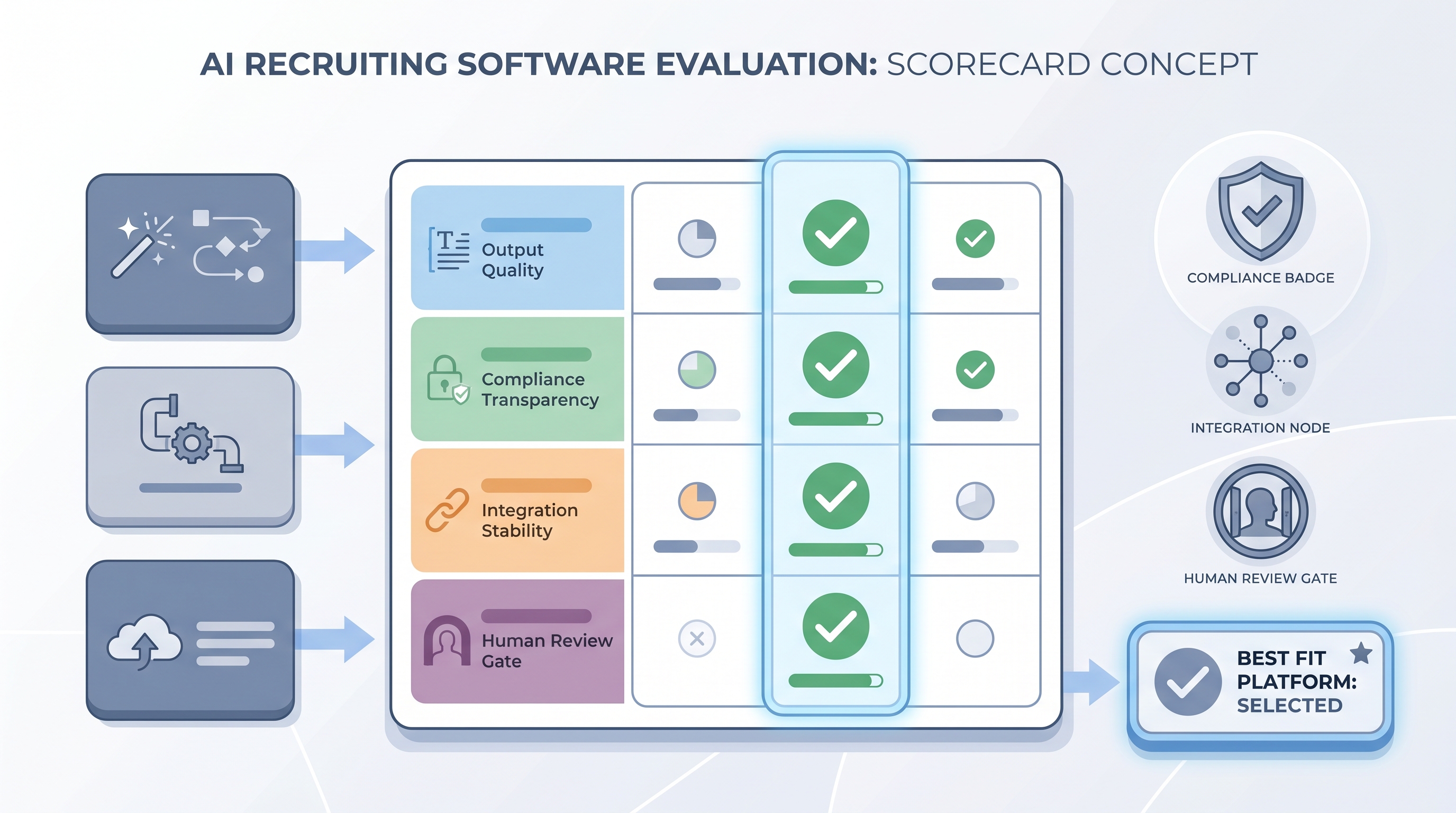
| Output quality | Real req mix, not demo scenarios | Only vendor-supplied sample data |
| Explainability | Can candidate ask why they were ranked? | No audit log or reasoning output |
| Integration stability | API under your ATS load | Demo only on sanitized tenant |
| Compliance transparency | DPA template, subprocessor list | Marketing copy instead of architecture diagram |
| Bias methodology | Published audit approach | "We take bias seriously" with no specifics |
Related on this site
- Glossary: AI recruiting tools, Applicant tracking software, Human-in-the-loop, AI bias audit, Resume parsing
- Blog: AI sourcing tools for recruiters
- Guides: Sourcers, Hiring managers
- Course: Starting with AI: the foundations in recruiting
- Live cohort: Sourcing Lab
- Membership: Become a member