AI for Hiring Managers
Hiring managers and the AI adoption ladder: intake and panel prep by stage (Chatting through AI-Native), scorecard habits, and consulting without owning TA ops.

If this is your job
You run a team that ships product, closes revenue, or keeps operations upright. Hiring is a side quest with outsized consequences. You do not need to become a sourcer. You need clarity on outcomes, respectful interviews, and decisions you can explain to your peers and your candidates.
This guide is for hiring managers who want practical AI adoption without owning TA operations. Your team may already use AI for product; hiring is a different workflow. The AI adoption ladder (see the cornerstone section) is the shared picture: you can be great at delivery and still only Chatting when it comes to intake briefs and panel prep. The sections below show where that shows up and how to climb without outsourcing fairness.
How to think about AI as a hiring manager
These habits layer on your ladder rung: draft versus decide stays true from Chatting through AI-Native. The cornerstone section helps you see whether you are improvising (Chatting) or rehearsing the same brief structure each loop (Systemizing).
Your leverage is intake clarity, not model choice. Most noisy pipelines trace back to fuzzy outcomes. AI can help you articulate those outcomes faster if you feed real constraints, not slogans.
Use AI for prep and structure, not for sorting people. Screening fairness belongs with recruiters and documented processes your company trusts.
Panels need shared scoring before interviews. AI can draft question banks; humans align on what "good" sounds like before candidates walk in.
Your calendar is the bottleneck. Tools will not create time for debriefs; they reduce prep friction so you use the time you already have better.
The tension between delivery and hiring
Delivery milestones do not pause because you are interviewing. Candidates compare your speed and clarity to their last process. Your recruiter needs decisions while you are in backlog grooming or on a customer call.
That tension shows up as:
Shifting bars. You want "someone senior enough to own X" until you see compensation or availability. Without written outcomes, every resume debate becomes taste. A concrete sign: you and your recruiter argue whether a staff engineer from a late-stage startup is "too senior" when nobody wrote down that the role is really a strong mid-level with path to lead in twelve months.
Noisy pipelines. Too many profiles that miss the problem you are trying to solve. Often the fix is fifteen minutes tightening outcomes before approvals go wide, not more volume. You know you are here when the recruiter sends five "maybes" and you reject all of them for different reasons you did not share up front.
Interview theater. Panels optimize for clever questions instead of evidence tied to scorecards. Everyone leaves tired; nobody agrees what signal they heard. Red flag: two interviewers use the same thirty minutes to test "culture fit" with no shared note on which competency they are actually scoring.
Late calibration. You discover disagreement after candidates invested hours. AI cannot fix that; structure before the loop can. Fix tomorrow: before the first screen, post in your team channel "We advance if they show X; we pass if we see Y" and ask for emoji agreement from every interviewer.
Executive pressure. You need headcount filled without lowering the bar. Clear outcomes help you explain tradeoffs when the market is thin.
Where you are on the AI adoption ladder (cornerstone)
Start here. Hiring managers often jump between Chatting (night-before interview ideas in a fresh chat) and Systemizing (panel brief template in the calendar invite) without naming it. You are still on the same AI adoption ladder as your TA partners: Offline → Chatting → Systemizing → Automating → AI-Native. Your job is to move clarity and prep up the ladder; pass or fail on people stays with humans and your policy.
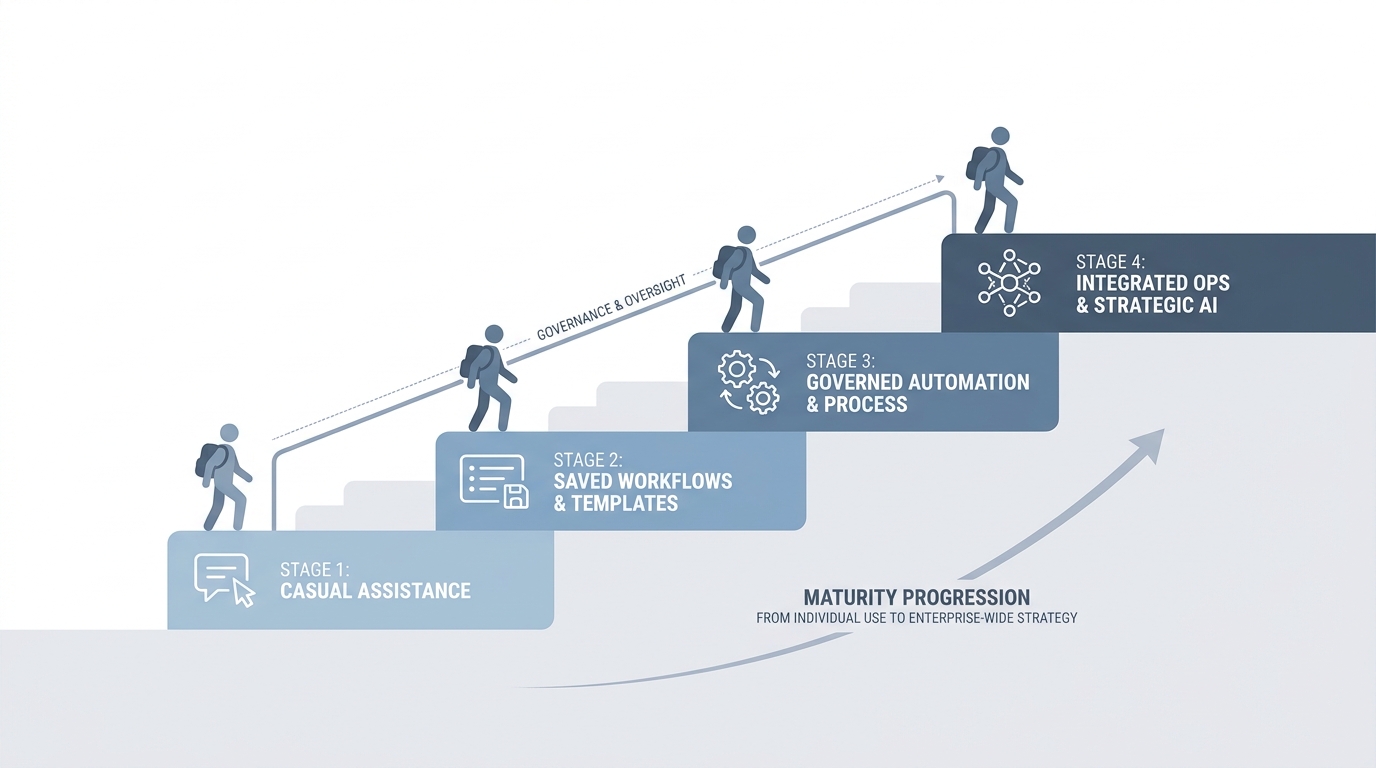
Explore the stages interactively on the AI adoption ladder page. Deeper context lives in the AI adoption ladder glossary entry.
Signals hiring managers often recognize
- Offline / early Chatting: You run interviews from memory; the JD is a wish list; you ask the model for "good questions" without a scorecard row.
- Chatting: You get useful drafts, but every req starts from zero and your panel still improvises.
- Systemizing: One frozen panel brief and scorecard per version of the req; questions mapped to competencies; everyone sees the same doc before the first screen.
- Automating (lighter for HMs): Low-risk internal only, e.g. debrief form pre-filled with scorecard rows for you to edit, or a scheduled prompt to your future self to lock outcomes before approvals.
- AI-Native (for this role): Intake is outcomes-first by default; you would not open a search before the one-pager is agreed; AI speeds structure, not who gets hired.
Example climbs
- Chatting → Systemizing (this week): Run the panel brief template from this guide for your next open role; pin
v1in the interview calendar description. You will feel the shift in the second interview when nobody duplicates the first round. - Systemizing → a taste of Automating: Add a recurring fifteen-minute hold with your recruiter the day before each onsite block to force one last alignment (human step, zero candidate automation).
- Moving the org: When TA talks "automation," you ask where human review sits for your population. You stay at Systemizing on drafting until that is clear.
If you are unsure which rung fits, compare your last hire loop to the cues on AI adoption ladder.
High-leverage use cases (with examples)
Challenge vague language. Paste the JD laundry list and ask for outcomes for the first ninety days, constraints your recruiter can defend, and anti-patterns this hire should not be expected to fix (culture debt, missing roles elsewhere). You edit hard; the model breaks bullet dumps into decisions.
Example: Trading "must have strong communication" for "runs weekly stakeholder updates across engineering and GTM with written follow-ups" gives your panel something observable.
Second example: Your JD says "self-starter." Ask the model: "Replace with behaviors we can test in interview: planning, escalation, and prioritization." Output might become "Proposes a quarterly plan for their domain," "Escalates blockers within forty-eight hours with options," "Cuts scope when timelines slip." Paste those into your recruiter sync so sourcing stops chasing vague hustle culture keywords.
Interview plans tied to the scorecard. Generate a first draft of questions mapped to each competency, with follow-ups that probe evidence. Delete generic lines. Align your panel on scoring before candidates arrive.
Example: For "ownership," ask for a situation where scope exploded and how they bounded it. Follow up on metrics they tracked and mistakes they admit. Score against your rubric, not charisma.
Briefing memos for panelists. Send a one-page panel brief the day before interviews. A template that works in practice:
- Role in one line: e.g. "Own the payments API migration to the new stack; no people management in year one."
- What good looks like (3 bullets): observable outcomes, e.g. "shipped a zero-downtime cutover," "wrote a runbook the on-call team used," "disagreed with product and still shipped."
- What is out of scope for this loop: e.g. "Do not expect them to fix org politics between sales and eng; that is a separate hire."
- What to ignore in this round: e.g. "Gaps in mobile are fine; we are hiring for backend."
- Signal we still lack: e.g. "We have not seen them run a production incident; please probe with a real postmortem story."
- Who covers which competency: e.g. "Alex: system design. Sam: ownership and conflict. Pat: code quality walkthrough."
Paste your scorecard row and the JD into the assistant, ask for a first draft in that structure, then edit. Same-day result: your second interviewer stops re-testing what the first already cleared.
Feedback drafts you still own. After a debrief, you have scattered notes: "good energy," "weak on tests," "I would not pair with them." Ask the model to group notes under your scorecard rows, then draft a two-paragraph update you could send, with factual language only. You still add the human line about fit. Example output shape: "Thank you for your time. We are moving forward with other candidates because we need deeper experience running live production migrations in a regulated environment," not "you were not a culture fit."
Stakeholder translation. When the VP asks why the slate is thin, you need a paragraph, not a vent. Try pasting three facts: your comp band, how many qualified profiles the recruiter submitted this week, and one market anchor (e.g. "two offers fell through at peer companies"). Ask for a neutral summary under one hundred words for exec email. Tomorrow morning you answer "why no hire yet" without sounding defensive.
Role-playing uncomfortable scenarios. When you hire managers, you might screen for hard feedback. Pick a scenario from your world: "Their sprint keeps slipping and they blame upstream." Ask the model to play the candidate reacting defensively while you practice your opening line and boundary. Keep the real interview honest: do not pretend the rehearsal was a real candidate. Use rehearsal to tighten your questions, not to script theater in the room.
Helpful reads: AI candidate screening, how to use AI in recruiting. Glossary: scorecard, structured output, async screening.
What we often see effective hiring managers do
They hold a fifteen-minute intake sync before approving reqs: outcomes, level, tradeoffs. Running agenda that fits in one calendar hold: (1) What does shipped work look like in ninety days? (2) What level is this versus Jane and Alex on the team? (3) What are we willing to trade (remote, comp band, niche stack)? End with one sentence the recruiter can paste into the req header.
They share the scorecard with every interviewer and refuse panel drift mid-loop. Practical habit: drop the scorecard PDF or Notion link into the calendar invite description so nobody screens "from memory."
They use AI to shorten briefings, not to skip debriefs. Decisions stay synchronous with humans. Typical split: AI drafts the panel brief from notes; the hiring manager still runs the fifteen-minute live debrief and records hire or no-hire with reasons.
They escalate compensation and visa questions to recruiters and People partners instead of trusting chat summaries. If ChatGPT "explains" visa sponsorship policy, treat that as a reminder to open the email to People Ops, not as the answer you give the candidate.
What tends not to work
Pasting candidate resumes into random assistants when your employer restricts candidate data handling. If you are unsure, the test is: "Would I forward this file to a personal email?" If no, do not paste it into a personal chat account.
Letting AI rank applicants without a structured rubric and human oversight aligned to policy. You are still safe if you use AI to turn your own rubric into a checklist, not to output a score that auto-rejects.
Reading AI summaries instead of notes. Summaries inherit bias from inputs. If the input said "not a culture fit," the summary will sound polite and still be toxic. Read the original panel notes line by line before you trust a summary.
Skipping calibration because "the model wrote good feedback." Feedback still needs human judgment. If you would not sign the email with your name as written, do not send it.
A simple rollout shape
Before your next open req: complete a one-page outcomes brief with recruiter review. Minimum sections: three measurable ninety-day outcomes, two explicit non-goals, level anchor (compare to two internal names), must-have tech or domain, remote or onsite rule.
Before interviews start: freeze the scorecard and panel questions for version one. Literally: export version v1 to PDF or pin the Notion page; if someone wants to add a new competency mid-loop, you reopen intake instead of surprising the candidate.
After each loop: five-minute retro with TA on what to change in intake next time. Three prompts you can read aloud: "What surprised us?" "What did we test twice?" "What one line in the brief would we fix first?"
Where teams get hurt
Summaries inherit emphasis from biased inputs. Read AI drafts against actual panel notes and the scorecard you agreed on.
Compensation, visa, and equity answers stay with recruiters and policy owners, not with a chat summary forwarded as fact.
When managers paste candidate detail into unapproved tools, you create leakage and compliance risk. Follow employer rules on what belongs where.
Tools and prompts on this site
Browse tools when your stack includes ChatGPT or Greenhouse. Pull free prompts from resources.
Courses, live sessions, and consulting on AI with Michal
Courses. Starting with AI is the fastest way to build shared vocabulary with TA if you are new to practical AI workflows. Better Prompts for Recruiters still applies to hiring managers who draft briefs and interview guides daily.
Live sessions. Join a public session on Sourcing Lab when you want structured practice beyond reading.
Teams. If your leadership wants every hiring manager aligned on scorecards and AI boundaries, private sessions live under AI sessions for teams.
Consulting. For leadership-intensive rollouts that span recruiting and delivery organizations, Using AI in Your Business frames executive adoption. Personal Productivity with AI helps when the goal is hands-on habit change for managers. 1-on-1 support: Individual AI Implementation Mentoring. Explore consulting or reach out via contact.
Membership. membership for ongoing learning after a session or course.
FAQ
- What is the first practical step for a hiring manager using AI?
Spend fifteen minutes with your recruiter to lock outcomes and anti-patterns, then paste that brief into your assistant to draft panel questions mapped to the scorecard. Publish v1 to every interviewer before the first screen. That is Systemizing prep instead of night-before Chatting.
- Should hiring managers use AI to rank applicants?
Let recruiters and structured processes handle screening fairness. Managers should use AI to prepare questions and align on outcomes, not to sort people without a documented rubric.
- What tools are enough for hiring managers who are not power users?
Whatever your company approves for candidate-related text, plus shared docs or Notion for the panel brief. You rarely need a new subscription; you need one frozen template and calendar discipline.
- What is the smallest habit that helps most?
Spend fifteen minutes tightening outcomes with your recruiter before approvals hit the wire. That reduces noisy pipelines and makes downstream AI assists actually relevant.
- What should hiring managers never paste into AI tools?
Follow employer rules. In general, avoid unapproved tools for full resumes, compensation detail you cannot verify, or notes that identify candidates if policy restricts them. When unsure, ask TA or People Ops which surfaces are allowed.
- How do I tell if AI-generated interview questions are weak?
If questions could apply to any company or any role, delete them. Strong questions tie to observable behaviors your scorecard names and include follow-ups that probe evidence, not vibes.
- When should a hiring manager pull in external consultants?
Use external help when leadership wants every manager aligned on scorecards and AI boundaries, or when delivery and hiring conflict without a shared playbook. Email hello@aiwithmichal.com for context. Executive sessions often start with increasing AI adoption in your business and hands-on team habits with consulting for recruiting teams.
- Where can hiring managers learn without owning TA operations?
Short path: live workshops and the Starting with AI course. Team rollouts: AI workshops for teams. Membership keeps material fresh after the first course.
Skill bundles that pair with this role
Packaged skills and integration paths in the store help you move from one-off prompts to repeatable workflows. Browse bundles below or explore the full skill bundles catalog.
No matching bundles in the catalog from this device. Open the store or skill bundles to see what is available.
For teams
Private workshops and implementation support for rolling out AI responsibly across TA and HR.
AI workshops for teamsTeaching notes based on workshop delivery and recruiting practice. Tools and regulations change; verify current employer policies and vendor terms before production use.