Bench cost and recruiter pipeline management (agency)
Bench cost is the ongoing expense a contract staffing agency incurs while a placed contractor sits between assignments, still receiving pay or guaranteed hours but generating no client revenue. Recruiter pipeline management is the discipline of tracking open roles, candidate availability, and contractor end dates to minimize that gap.
Michal Juhas · Last reviewed May 5, 2026
What is bench cost in a recruiting agency?
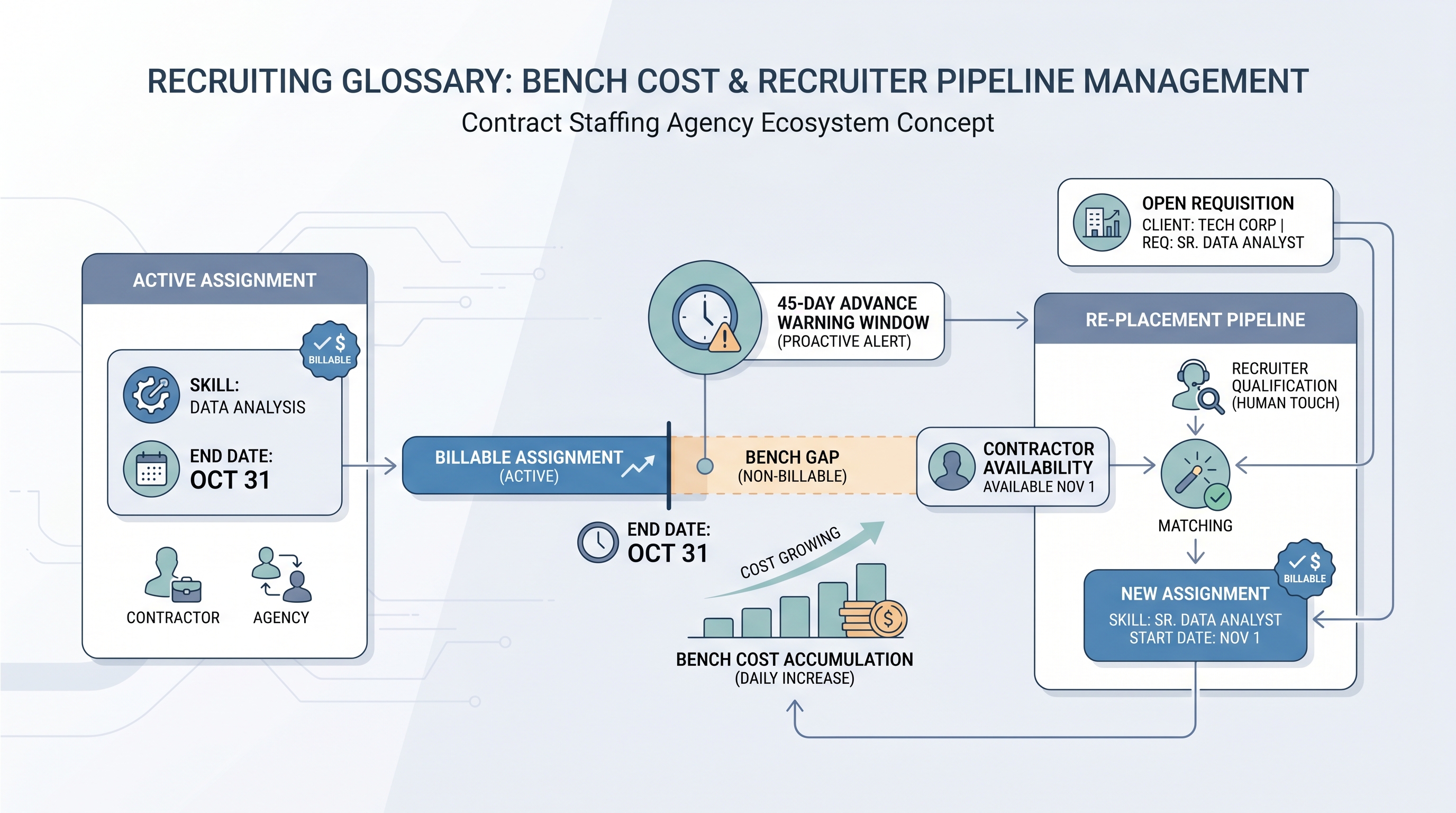
Bench cost is the expense a contract staffing agency absorbs when a contractor finishes one client engagement and has not yet started the next one. Under employment arrangements where the agency pays the contractor a salary or guaranteed hours regardless of active client billing, every unbilled day generates a net negative: the contractor is on payroll but no invoice is going to a client.
The term "bench" comes from the sports analogy of a player who is on the team roster but not in the game. In staffing, a contractor on the bench is ready to work, under a contractual relationship with the agency, but temporarily without a placement.
Recruiter pipeline management is the operational discipline that keeps the bench short. It means tracking assignment end dates weeks in advance, maintaining a live backlog of open client requisitions, and running proactive re-placement conversations before a contractor actually finishes a role. Agencies that treat these as separate functions, one financial and one recruiting, tend to discover bench cost problems after they have already accumulated. Agencies that connect the two treat bench cost as a real-time metric that pipeline management either controls or fails to control.
In practice
- A contract staffing agency managing 40 active contractors runs a weekly operations review that includes an end-date report: every contractor whose assignment ends in the next 60 days appears on the list with their skill category, rate, and current client. The operations manager uses the list to assign re-placement calls to account managers two weeks before each assignment ends. Average bench time drops from 18 days to 7 days over two quarters.
- An agency places a DevOps contractor on a 6-month engagement with an enterprise client. At month 4, the account manager opens an extension conversation with the client instead of waiting for the contract to expire. The client extends for 3 months. The contractor never hits the bench. The agency avoids roughly 9,000 in bench cost at the contractor's rate.
- A small contract recruiter tracking utilization manually in a spreadsheet discovers that three contractors in the same skill category all have end dates within a 10-day window. She contacts her two most active clients with open requirements in that category before the assignments end. Two of the three contractors are placed immediately. One sits on bench for 5 days before the third placement closes.
Quick read, then how hiring teams use it
This page is for agency founders, operations managers, and contract recruitment leads who want to understand bench cost as a financial metric and pipeline management as the primary control lever. Skim the first section for the definition. Use the second when you are building a bench tracking workflow or briefing account managers on utilization targets.
Plain-language summary
- What it means for you: Every unplaced day for an employed contractor is a direct cost to the agency. Bench cost is not a background noise item: on a book of 30 contractors at average daily rates, a two-week gap across even four of them can erase a month of margin.
- How you would use it: Track each contractor's assignment end date from day one of the engagement. Build a 60-day rolling forward view of which contractors are coming off assignment and which open reqs are available to absorb them.
- How to get started: Pull your current active contractor list and add an end-date column. Sort by end date ascending. Any end date within 45 days with no active re-placement conversation is a bench risk. Count those contractors and multiply daily bench cost by expected gap length to size the exposure.
- When it is a good time: When your gross margin is running below plan without an obvious pricing cause, when you are onboarding a new account manager and setting productivity expectations, or when a client calls to extend and you want to decide quickly whether to accept a lower rate versus risking bench time.
When you are running live reqs and tools
- What it means for you: Bench cost is a pipeline metric, not just a finance metric. If account managers are not flagging end dates 45 to 60 days out, the first time finance sees the exposure is on the payroll run after the gap opens.
- When it is a good time: At your weekly ops review, and the day any contractor's assignment is confirmed as ending rather than extending.
- How to use it: Connect end-date alerts to your ATS or CRM so they surface automatically. Use workflow automation to trigger a re-placement task for the account manager as soon as an end date enters the 45-day window. Cross-reference available contractors against open reqs by skill category using a language model to draft a candidate-to-req matching shortlist. Keep the qualification conversation with the recruiter.
- How to get started: Define your bench cost calculation for each employment category in your contractor pool: daily pay plus employer burden divided by working days. Build a simple tracker that multiplies average bench days by that daily cost across the contractor population. Review it weekly alongside your utilization rate.
- What to watch for: End-date clustering, where multiple contractors in the same skill category all finish assignments within a two-week window. That cluster creates a sudden bench spike that can overwhelm an account manager's re-placement capacity. Flag clusters 90 days out and begin staggering extension conversations or new placement timelines if possible. See agency recruiter utilization for how to manage recruiter capacity alongside contractor capacity.
Where we talk about this
On AI with Michal live sessions, bench cost and utilization topics come up in the AI in recruiting track when agency founders and contract recruitment leads ask how to systematize the business side of running a staffing operation alongside sourcing and screening work. The Sourcing Lab cohort covers agency economics, placement fee structures, and pipeline management so TA leaders and agency principals can build shared vocabulary before they negotiate agreements or evaluate vendors.
Around the web (opinions and rabbit holes)
Third-party creators cover bench cost, contractor utilization, and pipeline management from operations, finance, and staffing industry perspectives. These are starting points, not endorsements. Verify any rate calculations or employment cost estimates with your finance team or employment counsel before applying them to your contracts.
YouTube
- How staffing agencies manage contractor bench time covers the operational approaches agencies use to track utilization and reduce the gap between placements.
- Contract staffing agency profitability and margins walks through how bench cost, markup, and billing rates interact to determine agency gross margin.
- Recruiter pipeline management for contract roles covers how recruiters structure their open-role backlog and contractor availability tracking to reduce reactive placement scrambles.
- Bench cost and utilization in r/RecruitmentAgencies covers real situations where agency owners have dealt with bench time spikes and the process changes they made in response.
- Contract staffing margins and pricing in r/staffing surfaces practitioner discussions on how bench cost affects pricing decisions and client negotiation.
- Pipeline management for agency recruiters in r/recruiting covers how agency recruiters structure their weekly activity to maintain placement continuity across a contractor portfolio.
Quora
- How do staffing agencies handle contractor bench time between assignments? collects practitioner accounts of how agencies structure employment agreements, track utilization, and manage re-placement timelines to minimize bench cost.
Bench cost scenarios: key variables
| Variable | Low bench risk | High bench risk |
|---|---|---|
| End-date visibility | 45 to 60 days in advance | Discovered on final day |
| Open req backlog | Active matching reqs in same skill category | No warm reqs; starting from scratch |
| Extension culture | Proactive extension conversations at month 4 of 6 | Waiting for client to initiate |
| Skill category demand | High-demand skills with multiple active clients | Niche skills with one or two active buyers |
| Employment structure | 1099 or limited company (bench risk on contractor) | W-2 or employed (bench risk on agency) |
Related on this site
- Glossary: Markup and margin on contract staffing, Agency recruiter utilization, Agency invoice payment terms
- Glossary: Backfill periods and replacement guarantees, Business development for recruiting agencies, Recruitment agency software
- Glossary: Workflow automation, Human-in-the-loop, Hiring funnel conversion rates
- Glossary: Agency recruiter utilization, Weekly hiring funnel report
- Workshops: Sourcing Lab
- Course: Starting with AI: the foundations in recruiting
- Membership: Become a member