Client pass-through compliance for agency vendors
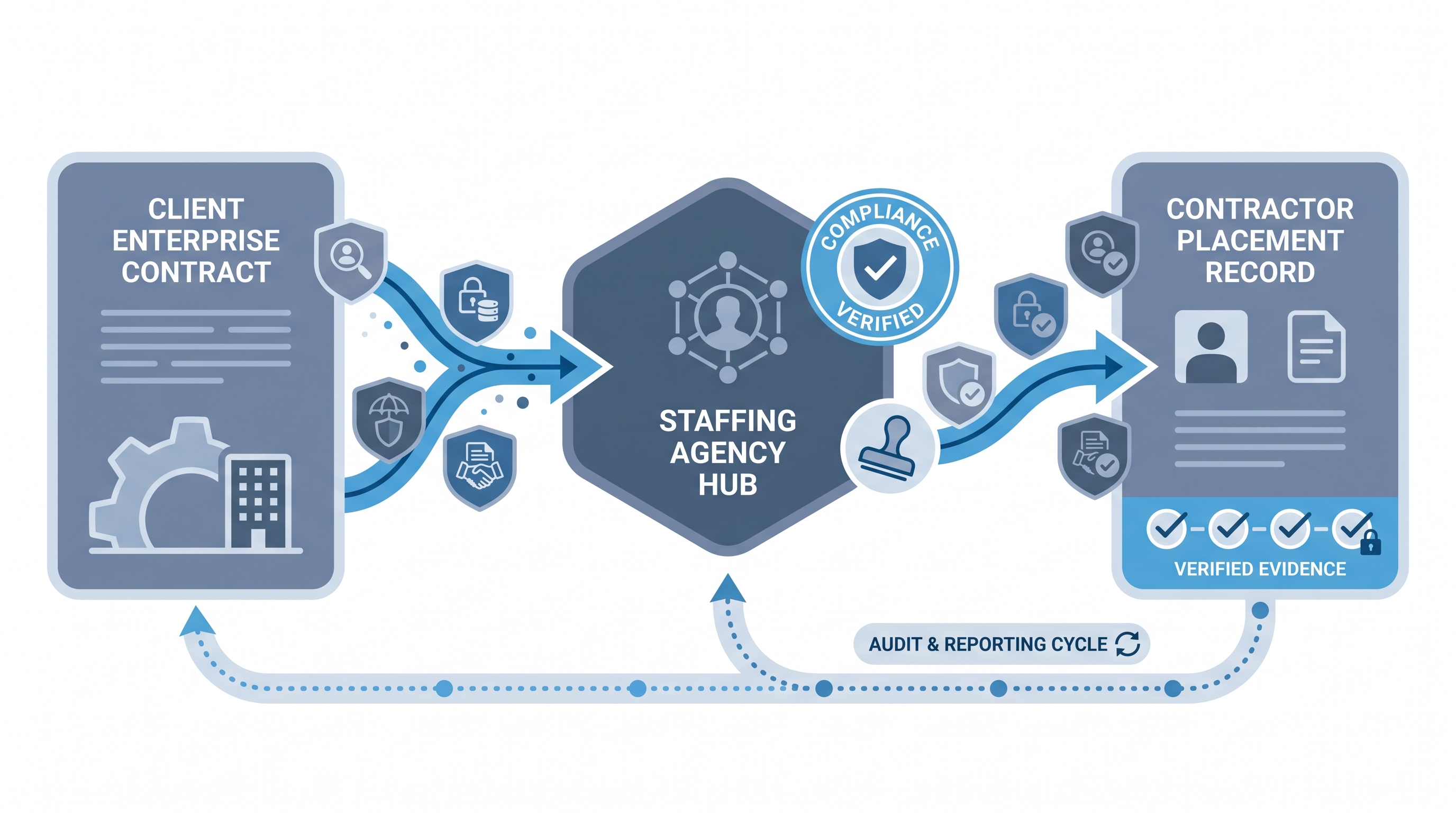
Client pass-through compliance is the requirement that a recruitment or staffing agency adopts and enforces the end client's policies, security standards, background check rules, and contractual obligations for any contractor or permanent hire it places, flowing those requirements downstream through the agency's own agreements.
Michal Juhas · Last reviewed May 7, 2026
What is client pass-through compliance for agency vendors?
Client pass-through compliance is the mechanism by which a hiring organisation transfers its own regulatory, contractual, and policy obligations to the staffing or recruitment agency it uses. The agency must apply those rules when placing candidates or contractors, and mirror them in its own downstream agreements.
The concept matters most in contract staffing and managed service programmes, where a contractor may be working on-site at the client's facilities for months or years. The client cannot directly govern the agency's internal practices, so it uses the supplier agreement to impose equivalent standards. Common obligations include background check level and frequency, minimum insurance coverages, data security standards, drug and alcohol policies, and conduct codes derived from the client's own employee handbook.
For permanent hire agencies the compliance burden is lighter because the obligation typically ends at placement. For contract staffing agencies managing a bench of active contractors, pass-through compliance is an ongoing operational cost that must be priced into the billing rate or absorbed as a cost of holding a preferred supplier position.
In practice
- An enterprise technology company adds a data security addendum to its PSA requiring all staffing vendors to pass an annual vendor security assessment and ensure contractors complete a data handling training module within five days of starting an engagement. The agency builds this into its onboarding checklist for every contractor placed at that client, adding roughly half a day of admin per placement.
- A financial services firm passes through a requirement for enhanced background checks, including a credit history screen, on all contractors with access to trading systems. The staffing agency updates its contractor agreements to include explicit consent for credit screening and flags the added cost to clients who ask why its bill rate is higher than a competitor's.
- A global professional services company migrates its supplier programme to a managed service provider. As part of the transition, the MSP issues a new pass-through compliance schedule that replaces the previous bilateral agreements. Agencies on the panel must recertify their compliance posture by a set date or lose their supplier status. Smaller agencies without a dedicated compliance function miss the deadline and are suspended pending review.
Quick read, then how hiring teams use it
This page is for agency principals, operations managers, and in-house TA leaders who manage or negotiate supplier agreements. Skim the first section for the definition. Use the second when you are reviewing a new client MSA, renewing a PSA, or deciding how to price compliance cost into your billing model.
Plain-language summary
- What it means for you: When you sign a client's supplier agreement, you are agreeing to run your business to their standards for the scope of that relationship. That includes how you screen contractors, store data, carry insurance, and conduct yourself on their behalf.
- How you would use it: Before signing, extract every obligation in the agreement's schedules and annexes. Assign an owner and a renewal date to each one. Price the operational cost into your rate card before the agreement is final, not after.
- How to get started: Pull the last PSA you signed and list every compliance obligation. Check which ones you actively monitor and which ones you signed and forgot. That gap is your risk register for the next client audit.
- When it is a good time: At the point of contract review, before signature. Adding pass-through terms retrospectively is hard and often triggers renegotiation. Front-loading the compliance review protects both sides.
When you are running live reqs and tools
- What it means for you: Pass-through compliance creates a direct link between a client policy change and your internal operating procedures. When the client updates their data handling standard or adds a new background check requirement, your obligation updates automatically if the agreement says so. Most do.
- When it is a good time: Audit your pass-through obligations at each agreement renewal and whenever the client notifies you of a policy change. Do not wait for a client audit to discover a gap.
- How to use it: Build a compliance matrix per client: obligation, internal owner, last reviewed date, next review date, evidence of compliance. Store it where your operations lead can update it without needing to open the full agreement. Cross-reference against your contractor agreements to confirm the downstream clauses are current.
- How to get started: Start with your highest-revenue client. Map the MSA or PSA obligations in one hour. You will almost certainly find at least one expired certificate or one process that was never formally implemented. Fix those before the client asks. See agency invoice and payment terms for how compliance status affects your ability to invoice without dispute.
- What to watch for: Blanket pass-through language such as "the agency shall comply with all client policies in force from time to time" with no notification requirement. This clause can bind you to policy changes you were never told about. Push back to require written notice of material changes and a grace period to implement them.
Where we talk about this
On AI with Michal live sessions, agency contract structure including MSAs, PSA terms, and pass-through compliance schedules comes up in the AI in recruiting track when agency owners discuss how to run compliant, scalable operations. The Sourcing Lab cohort covers the business and legal side of agency agreements so both in-house TA leaders and agency principals understand what they are signing and why each clause exists.
Around the web (opinions and rabbit holes)
Third-party content on pass-through compliance in staffing spans procurement forums, employment law commentary, and agency owner communities. These are starting points, not endorsements. Verify any clause language with employment counsel before including it in a live agreement.
YouTube
- Staffing agency compliance and client contracts covers how compliance obligations flow through supplier agreements in contingent staffing.
- Master service agreement basics for staffing firms walks through common MSA sections including vendor obligations and indemnification.
- How to negotiate a staffing agency PSA discusses how agencies push back on onerous pass-through schedules without losing the client relationship.
- PSA and compliance requirements in r/RecruitmentAgencies includes agency owner accounts of audits, compliance gaps, and how to structure operations when managing multiple enterprise PSAs.
- Background check requirements for staffing vendors in r/recruiting surfaces recruiter and TA views on how pass-through vetting standards vary across industries.
- Contractor compliance and client obligations in r/humanresources covers the HR leader side of managing vendor compliance in contingent workforce programmes.
Quora
- What compliance requirements do staffing agencies need to meet for enterprise clients? collects practitioner perspectives on the most common and most onerous pass-through obligations agencies face.
Pass-through compliance by engagement type
| Engagement type | Typical pass-through scope | Duration of obligation | Main compliance cost |
|---|---|---|---|
| Contract staffing (PSA) | Background checks, insurance, data handling, conduct | Throughout contractor tenure | Ongoing admin, recertification cycles |
| Retained executive search | Data handling, conflict of interest, confidentiality | Duration of search engagement | Low admin, high contractual risk if breached |
| Contingency permanent hire | Background check level, reference standards | Ends at placement | Per-placement cost |
| MSP-managed programme | Full vendor code of conduct, security assessment, reporting | Annual recertification | Highest admin overhead |
Related on this site
- Glossary: Agency indemnification clauses, Agency markup in contract staffing
- Glossary: Agency invoice and payment terms, Agency escrow retainer
- Glossary: Candidate right to represent, Client concentration risk for recruitment agencies
- Glossary: Backfill periods and replacement guarantees, GDPR and first-touch outreach
- Glossary: Standard operating procedures for AI recruiting
- Workshops: Sourcing Lab
- Course: Starting with AI: the foundations in recruiting
- Membership: Become a member