Client concentration risk for recruitment agencies
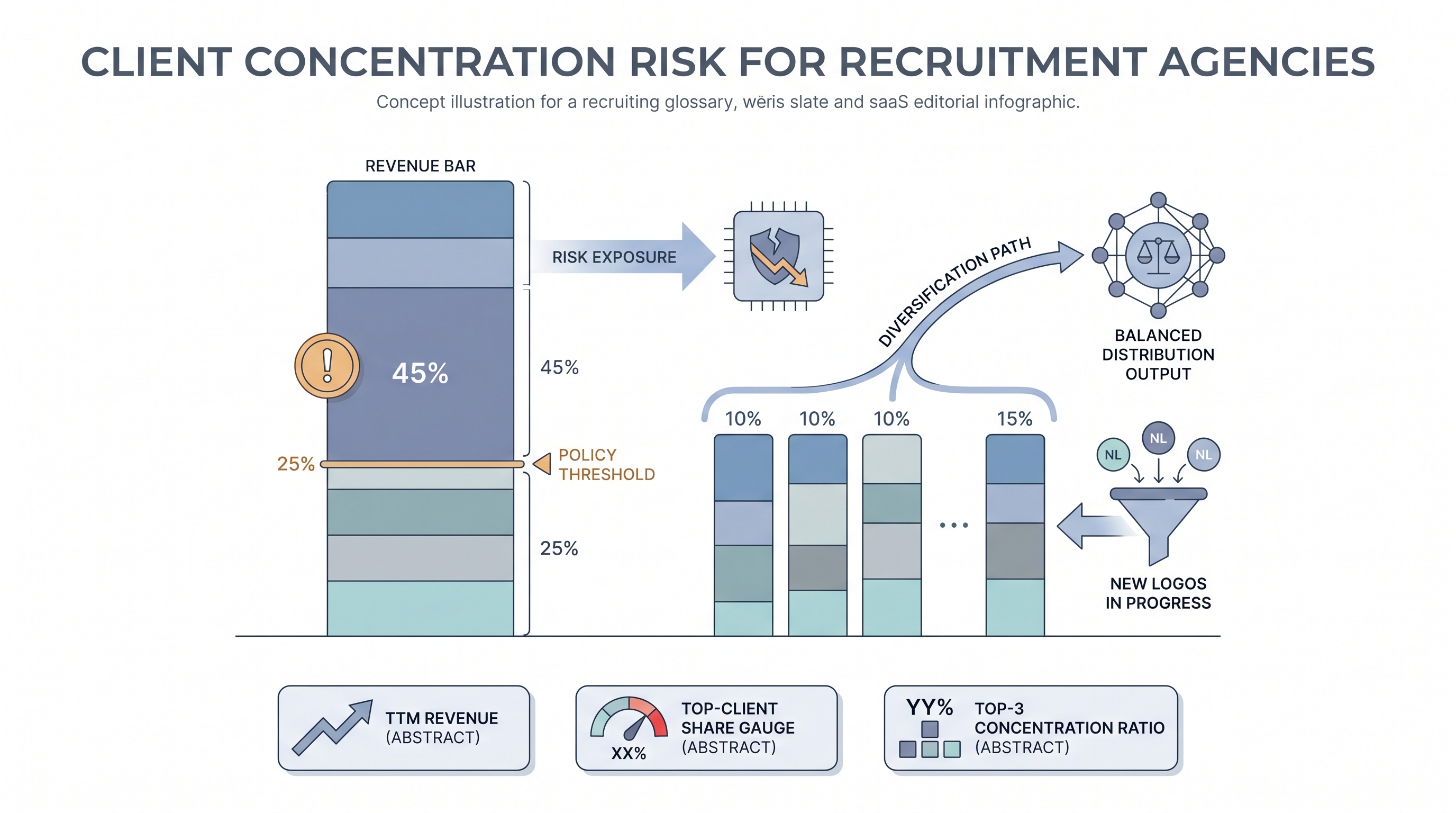
Client concentration risk is the financial exposure a recruitment agency carries when a large share of its revenue depends on one or a few client accounts, making the business vulnerable if a top client pauses hiring, changes preferred supplier lists, or moves work in-house.
Michal Juhas · Last reviewed May 7, 2026
What is client concentration risk for recruitment agencies?
Client concentration risk is the exposure a recruitment agency takes on when a disproportionate share of its revenue comes from one or a few client relationships. When the top client decides to pause hiring, consolidate suppliers, or move work in-house, the agency faces a revenue shortfall its existing pipeline cannot quickly fill.
The problem compounds because of timing: a client's decision to reduce spend usually happens internally before any communication reaches the agency. Meanwhile the agency's fixed costs, recruiter salaries, office space, tools, and benefits, run regardless of billing volume.
Most agency principals are aware of the risk in general terms but do not measure it formally until a large account gives notice. By that point the gap is visible but months away from being closed by new business development.
In practice
- A 15-person perm agency runs 60 percent of its billings through a single enterprise technology client. When that client hires an in-house TA team and reduces agency usage by 70 percent over six months, the agency loses more than half its revenue before a replacement client pipeline is in place. The principal later describes it as "the number we should have been watching every month but never did."
- An agency that runs a quarterly business review using nothing but candidate and vacancy data misses a concentration warning: one client that used to represent 18 percent of revenue has grown to 34 percent over 18 months. The account manager had been celebrating the growth. The ops team had never seen it framed as risk.
- During a sale process, a mid-market PE firm discounts an agency's valuation by 15 percent because a single blue-chip client represents 28 percent of trailing revenue. The agency founder argues the account is stable; the buyer argues the risk premium is non-negotiable.
Quick read, then how hiring teams use it
This page is for agency founders, operations managers, and finance leads who want to understand client concentration as a financial health metric and business development as the primary control lever. Skim the first section for the definition. Use the second when you are building a concentration tracking workflow or reporting to investors or principals.
Plain-language summary
- What it means for you: If your top client leaves, how long can the agency survive on remaining revenue? That question, answered with a number, is what concentration risk management means in practice.
- How you would use it: Track each client's share of total billings monthly. Flag any client above 20 percent of revenue and build a BD plan to diversify before that share grows further.
- How to get started: Pull your trailing 12-month billings by client. Calculate each client's percentage of total. Sort descending. If any one client exceeds 20 percent, start the business development conversation this week.
- When it is a good time: During annual planning, when a client relationship is growing unusually fast, when preparing for a sale process, or when a key account manager leaves and you realize they own the relationship.
When you are running live reqs and tools
- What it means for you: Concentration risk is a portfolio problem, not a single-client problem. The metric tells you whether your revenue base is robust enough to absorb the loss of any one account without triggering a cash crisis.
- When it is a good time: At your weekly or monthly ops review, and any time a single account grows to represent a larger share of active req volume than the prior period.
- How to use it: Build a concentration dashboard alongside your bench cost tracker and utilization metrics. Use workflow automation to pull CRM billing data into a weekly report and alert on threshold breaches. Keep the relationship and BD decisions with the principal or senior account manager.
- How to get started: Start with a simple spreadsheet: client name, trailing 12-month billings, percentage of total, change from prior period. Run it monthly. Share it with every account manager so concentration is visible, not just a finance concern. Add a BD pipeline column for any client above 20 percent so you can see whether diversification is moving.
- What to watch for: Concentration can grow silently during good trading periods. A client that grows from 15 to 30 percent of revenue over 18 months looks like a success story until the relationship ends. Flag clients not just for revenue share but for rate of change: any account growing faster than your overall revenue growth deserves a concentration review.
Where we talk about this
On AI with Michal live sessions, agency economics topics including revenue concentration, client risk, and business development come up in the AI in recruiting track when agency founders and principals ask about building sustainable agency businesses alongside AI tooling. The Sourcing Lab cohort covers agency economics, placement fee structures, and pipeline management so TA leaders and agency principals can build shared vocabulary before they negotiate agreements or evaluate vendors.
Around the web (opinions and rabbit holes)
Third-party creators cover client concentration risk, revenue diversification, and agency valuation from operations, finance, and M&A perspectives. These are starting points, not endorsements. Verify any financial metrics or thresholds with your finance team or M&A adviser before applying them to your agency.
YouTube
- How to value a recruitment agency covers the key metrics buyers examine, including client concentration and revenue dependency, when evaluating agency acquisitions.
- Recruitment agency business development strategies walks through approaches agencies use to diversify their client base and reduce dependency on a small number of key accounts.
- Staffing agency KPIs and financial metrics covers the operational and financial KPIs agency operators use to track business health, including revenue concentration and utilization.
- Client concentration risk in r/RecruitmentAgencies surfaces real discussions from agency owners about managing dependency on large accounts and the impact of losing a major client.
- Recruitment agency valuation in r/recruiting covers how concentration risk affects agency sale prices and investor interest in the industry.
- How to diversify recruitment agency revenue in r/staffing collects practitioner perspectives on the strategies and timelines involved in reducing revenue dependency on a small client base.
Quora
- How do recruitment agencies manage client concentration risk? collects practitioner accounts of how agency principals have approached revenue diversification and the challenges of growing new accounts while managing existing relationships.
Concentration risk by agency type
| Factor | Perm placement agency | Contract staffing agency |
|---|---|---|
| Revenue pattern | One-time placement fee per hire | Recurring bill-rate margin per contractor week |
| Concentration impact | Immediate if client freezes headcount | Gradual unless client terminates all contracts |
| Recovery speed | Faster if BD pipeline is active | Slower: contractor re-placement needed |
| Safe threshold (single client) | Below 20 percent of annual billings | Below 25 percent; contract revenue has more inertia |
| Warning sign | Client share growing without new BD wins | Active contractor headcount clustering in one account |
Related on this site
- Glossary: Business development for recruiting agencies, Agency data room and due diligence, Bench cost and recruiter pipeline management
- Glossary: Agency recruiter utilization, Agency invoice payment terms, Markup and margin on contract staffing
- Glossary: Backfill periods and replacement guarantees, Workflow automation, Hiring funnel conversion rates
- Workshops: Sourcing Lab
- Course: Starting with AI: the foundations in recruiting
- Membership: Become a member