Diversity recruiting tools
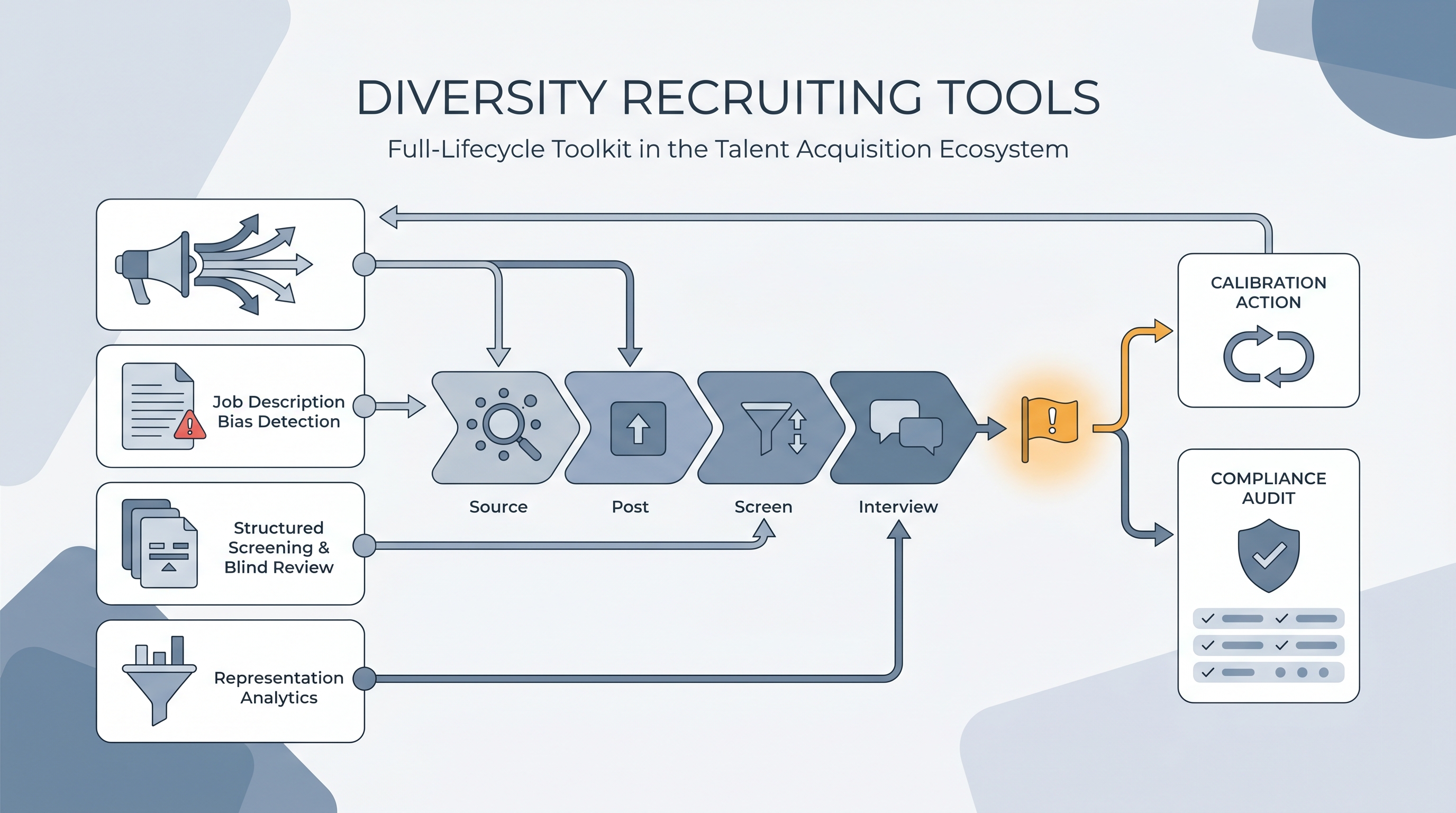
Software platforms and features that help TA teams build more representative pipelines across the full recruiting lifecycle, from job description analysis and diverse sourcing through structured screening, funnel representation tracking, and GDPR-compliant audit documentation.
Michal Juhas · Last reviewed May 10, 2026
What are diversity recruiting tools?
Diversity recruiting tools are software platforms and features TA teams use to build more representative pipelines. The term covers the full toolkit: job description analyzers that flag exclusionary language before a role posts, sourcing tools that reach communities outside default professional networks, structured screening features that reduce evaluator bias, and analytics layers that track group representation at every funnel stage.
The distinction from a standard ATS matters. An ATS tells you how many candidates moved through each stage; diversity recruiting tools tell you which groups moved through, at what rates, and where representation dropped. That diagnostic layer is what turns a DEI program from a year-end headcount audit into an operational feedback loop.
In practice
- A TA ops lead at a mid-size tech company integrates a job description analyzer that flags terms statistically associated with lower application rates from underrepresented groups. The team revises the language before three open roles post, and early-funnel representation from those groups increases meaningfully over the prior quarter.
- A sourcer running university campus recruiting adds historically Black colleges and universities and Hispanic-serving institutions to the outreach list, connects the sourcing channels to ATS attribution fields, and tracks whether early-funnel representation improves over the semester rather than only measuring hire outcomes.
- An HRBP conducting a DEI audit uses stage-level representation data to show leadership that the gap is not at sourcing (representation is strong at application) but at the hiring manager interview stage, where one group passes at 60 percent the rate of the highest-passing group. The finding triggers structured scorecard criteria and panel calibration rather than a new sourcing campaign.
Quick read, then how hiring teams use it
This is for recruiters, sourcers, TA, and HR partners who need shared vocabulary in vendor evaluations, team planning, and compliance reviews. Skim the first section for a fast shared picture. Use the second when you are deciding how to configure these tools in your ATS, sourcing workflow, or compliance documentation.
Plain-language summary
- What it means for you: A toolkit of software features that address bias at each point in the recruiting process, from writing the job description to reporting on who was hired.
- How you would use it: Connect job description analysis to your drafting workflow, add diverse sourcing channels to your channel mix, enable blind review options for first-screen shortlisting, and run stage-level representation reports monthly alongside pipeline health metrics.
- How to get started: Export one quarter of stage-decision data with EEO indicators, build a simple pivot table by group, and identify the two stages with the biggest representation drop. Fix those before buying new software.
- When it is a good time: After you have consistent EEO data collection with candidate consent, stable sourcing channels to compare, and at least one named person who owns the metric review cadence.
When you are running live reqs and tools
- What it means for you: Diversity recruiting tools give you stage-level visibility into which groups pass each gate and why, so your calibration response matches where the gap actually is.
- When it is a good time: After your sourcing channels are stable enough to compare, your EEO consent language is documented and approved by legal, and a monthly review cadence has a named owner.
- How to use it: Run stage-conversion reports by group each month. Flag stages where one group passes at less than four-fifths the rate of the highest-passing group. Investigate whether the selection tool or evaluator at that stage has documented validity. Cross-check with adverse impact methodology and AI bias audit cadence.
- How to get started: Map ATS stage fields to EEO indicators, confirm consent language with legal, and build the first report before evaluating dedicated software. Most early-stage programs run on ATS exports and a structured spreadsheet.
- What to watch for: Self-identification gaps leaving sample sizes too small for statistically meaningful conclusions; AI recommendation features embedding historical bias; GDPR documentation lagging data collection. Log which tool version produced each report and store the audit trail with your DPIA.
Where we talk about this
On AI with Michal live sessions, diversity recruiting tools appear in both the AI in recruiting track (structured evaluation, bias audit practices) and the sourcing automation track (building diverse sourcing channels without automating bias at scale). If you want a full-room conversation with peers running similar programs, start at Sourcing Lab and bring your ATS stage schema and one real quarter of data.
Around the web (opinions and rabbit holes)
Third-party creators move fast. Treat these as starting points, not endorsements. Do not copy untested sourcing automation scripts that move candidate data to new platforms without reviewing the privacy implications first.
YouTube
- Search "diversity recruiting funnel analysis" on the AIHR YouTube channel for practitioner walkthroughs of how to read stage-level representation data and present gap findings to leadership.
- Search "DEI recruiting tools" on LinkedIn Talent Solutions YouTube for how sourcing channel strategy affects early-funnel representation across different team sizes and industries.
- Search "inclusive job descriptions" on YouTube for practical walkthroughs of language testing and bias-detection tools applied to real job postings.
- Diversity recruiting tools discussion in r/humanresources surfaces which features practitioners actually use versus what vendors promise.
- DEI funnel metrics and ATS in r/TalentAcquisition covers how TA ops teams structure quarterly reporting and which metrics leadership acts on.
- Inclusive job descriptions tools in r/recruiting compares job description analyzers with practitioner perspectives on what actually changes application rates.
Quora
- What tools help recruiters hire more diversely? collects both DEI consultant and in-house TA perspectives on which toolkit layers matter most at different company stages (quality varies; read critically).
Diversity recruiting tools vs. diversity hiring tools
| Concept | Focus | Primary output |
|---|---|---|
| Diversity recruiting tools | Full toolkit across sourcing, screening, analytics | Fewer bias entry points across the lifecycle |
| Diversity hiring tools | ATS-connected stage analytics and EEO reporting | Stage-level representation gap data and audit exports |
| Diversity recruiting software | Software category connecting ATS data to representation analytics | Funnel-level analytics and compliance documentation |
| Diversity funnel metrics | Measurement framework for the funnel | Quantified representation at each hiring gate |
Related on this site
- Glossary: Diversity hiring tools, Diversity recruiting software, Diversity funnel metrics, Adverse impact, AI bias audit, Scorecard, Explainable AI in hiring, Human-in-the-loop (HITL), Talent acquisition metrics
- Blog: AI sourcing tools for recruiters
- Guides: Sourcers
- Live cohort: Sourcing Lab
- Course: Starting with AI: the foundations in recruiting
- Membership: Become a member