Diversity recruiting software
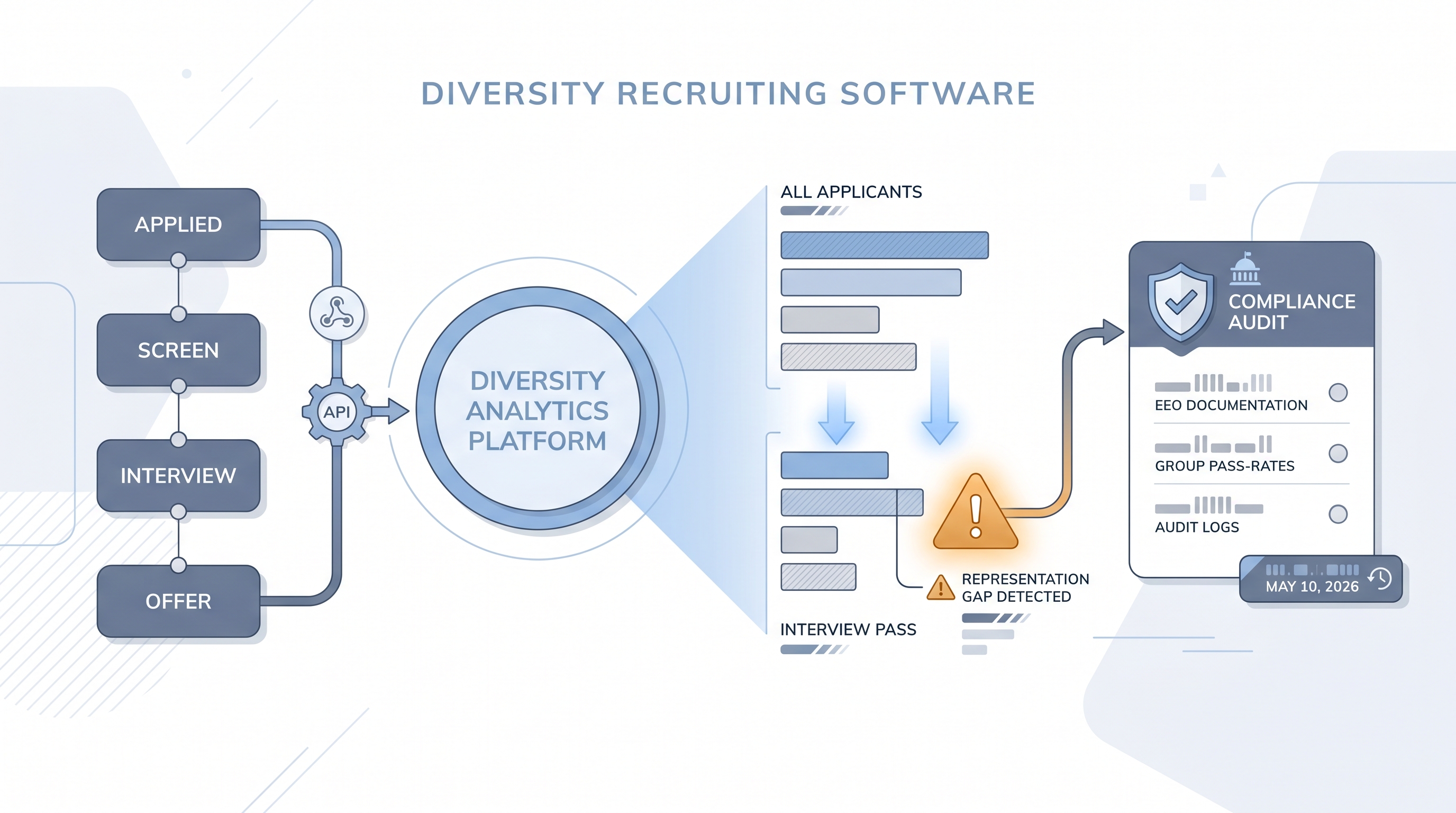
Dedicated platforms and ATS modules that connect to stage-move data in real time, track candidate representation at each hiring gate, and produce audit-ready reports for GDPR, EEO, and internal equity reviews.
Michal Juhas · Last reviewed May 10, 2026
What is diversity recruiting software?
Diversity recruiting software is the category of platforms that connect to your ATS stage data, collect voluntary EEO self-identification, and produce representation analytics at each hiring gate. The defining characteristic is stage-level measurement: these tools show where diverse candidates drop off during sourcing, screening, or panel interviews rather than only reporting on who was eventually hired.
The distinction between native ATS modules and standalone platforms matters in practice. Native modules are faster to configure but constrain your analytics to what the ATS vendor has prioritised. Standalone platforms give richer cross-ATS comparisons and often include sourcing channel attribution, but require a separate integration, a data processor agreement, and ongoing field mapping maintenance.
In practice
- A TA ops lead at a 500-person company connects a standalone DEI analytics platform to the ATS API, maps EEO self-identification fields to stage records, and begins pulling a monthly representation report that shows the hiring manager interview as the stage where underrepresented candidates drop at the highest rate. The finding triggers a calibration session before the next req opens.
- A talent leader at a global firm uses the native diversity dashboard inside their enterprise ATS to filter sourcing channel data by region, then reallocates sourcing spend toward channels that produce more diverse early-funnel candidates after seeing that three channels contribute 80 percent of volume but less than half of diverse applicants.
- An HRBP preparing for a compliance review exports stage-level EEO data with disposition codes from the diversity recruiting platform, reviews the four-fifths rule calculation at the phone screen stage, and confirms the audit trail has sufficient sample size before presenting findings to legal.
Quick read, then how hiring teams use it
This is for recruiters, sourcers, TA ops, and HR partners who need the same vocabulary in vendor evaluations, ATS configuration discussions, and compliance reviews. Skim the first section for a fast shared picture. Use the second when you are deciding how these platforms connect to your ATS, how to manage consent flows, and what to watch for in production.
Plain-language summary
- What it means for you: Software that connects to your ATS and shows where your pipeline loses diverse candidates at each stage, not just whether your final hires match a target.
- How you would use it: Configure EEO self-identification fields in your ATS, connect the platform via API or scheduled export, and run a monthly representation review alongside pipeline health metrics.
- How to get started: Export one quarter of stage-decision data with EEO indicators, build a simple funnel view by group, and identify the two stages with the biggest representation drop. Fix those before buying new software.
- When it is a good time: After you have a consistent EEO data collection process, documented consent language, and a named owner for the review cadence. A platform without an owner generates reports nobody acts on.
When you are running live reqs and tools
- What it means for you: Diversity recruiting software turns raw ATS data into real-time funnel analytics, sourcing channel attribution, and audit-ready exports. It makes representation gaps visible at the point where calibration still helps.
- When it is a good time: After your ATS stage fields are stable enough to map, your EEO consent language is documented with legal, and at least one person owns the metric review cadence.
- How to use it: Pull stage-conversion data by group monthly. Flag stages where one group passes at less than four-fifths the rate of the highest-passing group, then investigate whether the selection tool at that stage has documented validity. See adverse impact and AI bias audit for the full audit methodology.
- How to get started: Map your ATS stage fields to EEO indicators, confirm consent language with legal, and build the first report before evaluating dedicated software. Most early-stage programs run on ATS exports and a spreadsheet.
- What to watch for: Low EEO self-identification completion rates that make cohorts too small for statistical conclusions; AI scoring features trained on historical hire data embedding past bias; and GDPR documentation lagging the data collection. Log which platform version and export date produced each report and retain the audit trail with your DPIA.
Where we talk about this
On AI with Michal live sessions we cover diversity recruiting software in both directions: the AI in recruiting track shows how to configure representation analytics against real ATS schemas and how to present stage-level findings to hiring managers, while the sourcing automation track covers building diverse early-funnel pipelines before buying a dedicated analytics platform. If you want the full room conversation with peers working on the same configuration and compliance questions, start at Sourcing Lab and bring your ATS field map.
Around the web (opinions and rabbit holes)
Third-party creators move fast. Treat these as starting points, not endorsements, and double-check anything before you wire candidate data to a new platform.
YouTube
- Search "diversity recruiting analytics ATS" on the AIHR YouTube channel for practitioner walkthroughs of how to connect EEO data to stage-level conversion reports and present findings to leadership.
- Search "DEI hiring funnel software" on LinkedIn Talent Solutions YouTube for how sourcing and screening stages affect representation outcomes and which software categories address each gap.
- Search "adverse impact software recruiting" on YouTube for tutorials on computing group pass-rate checks from ATS exports and using software to automate the calculation.
- Diversity recruiting software discussion in r/humanresources shows which features practitioners value versus vendor marketing claims.
- DEI analytics ATS integration in r/TalentAcquisition covers how TA ops teams configure ATS integrations for diversity reporting and which field mapping issues appear most often.
- Recruiting software bias audit in r/recruiting connects software configuration decisions to the legal risk side, with examples from recruiters running AI tools at scale.
Quora
- What software do companies use to track diversity in hiring? collects practitioner and DEI consultant perspectives on which platforms hold up under real ATS integration (quality varies; read critically).
Native ATS module versus standalone platform
| Approach | Setup effort | Key trade-off |
|---|---|---|
| Native ATS diversity dashboard | Low: no separate integration | Analytics limited to what the ATS vendor prioritises |
| Standalone DEI analytics platform | Medium: API or export configuration required | Richer funnel and sourcing analytics; separate DPA |
| ATS data export to BI tool | Low tooling cost; high ops overhead | Full flexibility but no built-in compliance workflows |
| AI-powered sourcing with diversity filters | Requires bias audit before use | Widest early-funnel reach; highest risk of embedding historical bias |
Related on this site
- Glossary: Diversity hiring tools, Diversity funnel metrics, Adverse impact, AI bias audit, Explainable AI in hiring, Human-in-the-loop (HITL), Talent acquisition metrics, Scorecard
- Blog: AI sourcing tools for recruiters
- Guides: Sourcers
- Live cohort: Sourcing Lab
- Course: Starting with AI: the foundations in recruiting
- Membership: Become a member