Employer value proposition (EVP)
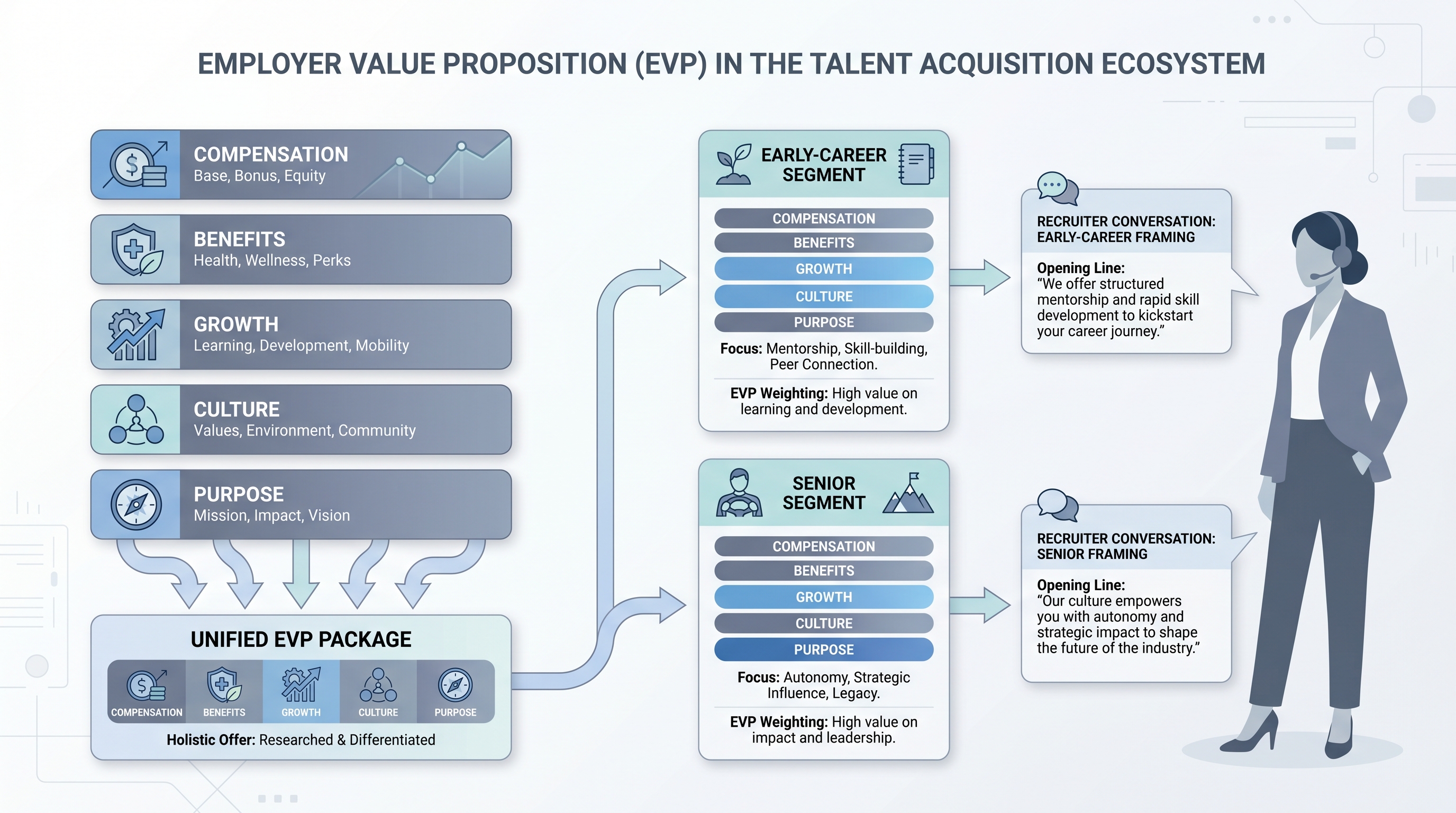
The package of compensation, benefits, career growth opportunities, culture, and purpose that a company offers employees in exchange for their skills and commitment, forming the foundation of employer branding, offer negotiations, and retention programs.
Michal Juhas · Last reviewed May 26, 2026
What is an employer value proposition (EVP)?
An employer value proposition is the full package a company offers people in exchange for their time, skills, and commitment. It includes compensation and benefits, career growth opportunities, culture and ways of working, and the sense of purpose the role and organization provide.
The EVP is the substance behind the employer brand. Where the brand is the story told externally, the EVP is whether that story holds up when employees live it daily. A strong EVP is not built by the communications team alone; it is discovered through honest research with current and former employees, then communicated with specificity rather than aspiration.
In practice
- When a recruiter loses a final-round candidate to a competitor offering more base salary, the debrief often reveals the recruiter never surfaced the equity refresh schedule, the learning budget, or the promotion velocity data that would have reframed the comparison.
- A TA director who notices that the same role keeps losing offers at the same career stage often finds, after reviewing exit data, that the EVP message delivered to candidates does not match what the role actually offers at that level.
- An HRBP running a retention risk analysis after a leadership change will use EVP components, specifically growth opportunity and culture stability, as the first diagnostic levers before recommending any compensation adjustments.
Quick read, then how hiring teams use it
This is for recruiters, TA leaders, HR business partners, and total rewards teams who own or contribute to the employee value proposition. Skim the first section for vocabulary that applies in offer conversations and sourcing messaging. Use the second when you are diagnosing offer decline trends, refreshing a stale EVP, or training recruiters to sell beyond base salary.
Plain-language summary
- What it means for you: The EVP is what you are actually selling in every offer conversation. If you do not know it specifically by role family and level, you are having the wrong conversation with every final-round candidate.
- How you would use it: Map the EVP components for your two or three highest-volume roles. Write specific, verifiable statements for each component. Give recruiters those statements to use in offer conversations.
- How to get started: Pull exit interview data from the last 12 months. Identify the three most common reasons for leaving. Then check whether your current EVP messaging addresses those gaps honestly.
- When it is a good time: Before your next offer cycle, when offer decline rates are rising, or when a competitor is actively recruiting from your team.
When you are running live reqs and tools
- What it means for you: EVP differentiation in sourcing outreach improves cold response rates for passive candidates. A message that describes a specific learning program or a concrete equity structure outperforms a generic we are a great place to work message in every test.
- When it is a good time: Any time you are writing sourcing outreach for senior or in-demand profiles who receive high message volume. EVP specificity is what separates your message from the other 12 they got this week.
- How to use it: Give your AI drafting tools specific EVP claims to incorporate: salary range transparency, learning budget, remote policy, and equity details where legally appropriate. Generic inputs produce generic output; specific inputs produce messages candidates actually respond to.
- How to get started: Write one EVP fact sheet per role family, covering compensation range, key benefits, growth path examples, and one or two specific culture markers. Give it to every recruiter before their next offer conversation and every sourcer before their next outreach campaign.
- What to watch for: EVP claims that are not verifiable by candidates talking to the team during the hiring process, compensation benchmarks that have not been updated in two years, and role-level growth stories that apply to two people in the entire company rather than a realistic path.
Where we talk about this
On AI with Michal live sessions, EVP comes up most often in the offer-stage conversation, when participants realize they are losing final-round candidates not because of compensation gaps but because the value story was never communicated clearly enough to compare against a competing offer. The fix is usually a combination of specific EVP fact-building and AI outreach drafting that incorporates those specifics into sourcing and follow-up messaging. Start at Sourcing Lab or bring EVP questions to membership office hours.
Around the web (opinions and rabbit holes)
Third-party creators move fast. Treat these as starting points, not endorsements, and double-check anything before you wire candidate data to a new tool.
YouTube
- How to Build an EVP That Works (search) surfaces practitioner frameworks for EVP research, validation, and communication across candidate segments.
- EVP and Offer Negotiation (search) shows how recruiters translate EVP components into specific talking points in competitive offer situations.
- Measuring EVP Effectiveness (search) covers the metrics that connect EVP investment to business outcomes like offer acceptance rate and 12-month retention.
- How do you communicate EVP to candidates? in r/recruiting is a candid thread on what actually lands with candidates versus what HR communications teams prefer.
- EVP and compensation benchmarking in r/humanresources covers how total rewards teams connect EVP components to market data.
- Losing offers to competitors: EVP vs salary in r/recruiting surfaces real recruiter experiences of offer competition and what EVP framing changed outcomes.
Quora
- What is an employer value proposition and how do companies build one? collects answers from HR leaders and talent acquisition specialists on research methods, content, and measurement.
EVP components by employee segment
| Component | Early-career engineers | Senior individual contributors | Managers and leaders |
|---|---|---|---|
| Most weighted | Growth and learning | Autonomy and challenge | Impact and team quality |
| Second priority | Compensation trajectory | Equity upside | Culture and values alignment |
| Key risk to address | Unclear promotion criteria | Equity cliff or refresh terms | Change in strategic direction |
Related on this site
- Glossary: Employer branding, Talent acquisition metrics, Large language model, AI outreach drafting
- Blog: AI sourcing tools for recruiters
- Guides: Sourcers
- Live cohort: Sourcing Lab
- Commercial: AI workshops for teams
- Membership: Become a member