Employer branding
The reputation and narrative a company builds around what it is like to work there, used to attract and retain talent by shaping candidate perceptions through careers pages, social content, employee stories, and the lived experience of people inside the organization.
Michal Juhas · Last reviewed May 26, 2026
What is employer branding?
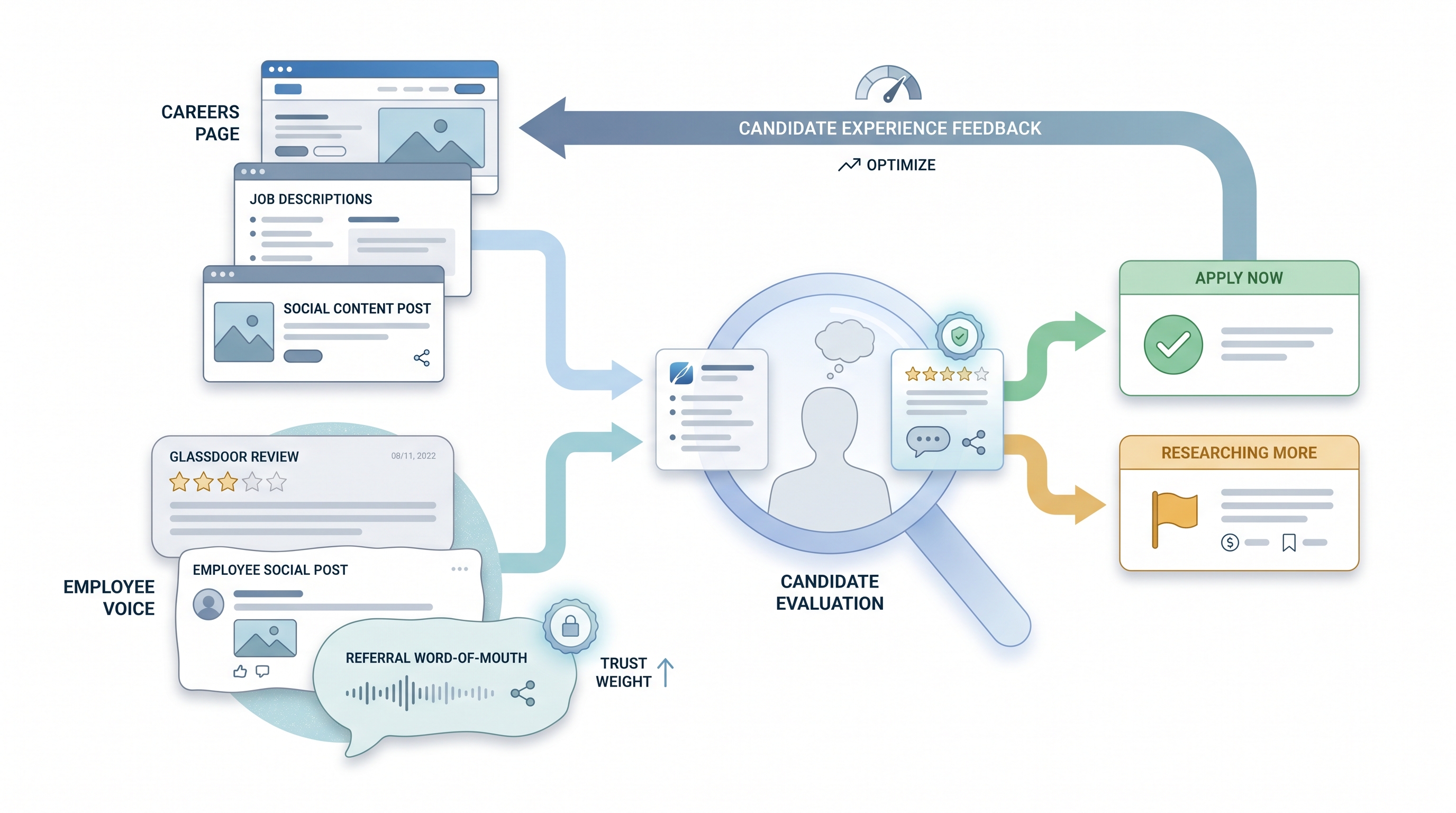
Employer branding is the reputation and narrative a company builds around what it is like to work there. It shapes how candidates perceive the organization before they apply, during the hiring process, and when they are deciding whether to accept an offer. It also influences whether current employees recommend the company to people in their networks.
The honest version of employer branding is not about polishing a public image. It is about understanding what people actually experience working there, communicating the real picture clearly, and closing the gap where experience and promise diverge.
In practice
- When a strong candidate says "I have heard good things about your team" before the first call, that is employer brand working. When a recruiter spends the first 20 minutes of a screen defending the company against a Glassdoor review, that is employer brand failing.
- A sourcer at a 200-person scale-up who finds that inbound applications dropped after a round of public layoffs is watching employer brand affect sourcing volume in real time, even if the pipeline report only shows fill rates.
- An HRBP reviewing exit interview data and finding that the stated reason for leaving is growth opportunity should ask whether the careers page claim about learning investment matches what employees actually experienced.
Quick read, then how hiring teams use it
This is for recruiters, TA leads, HR partners, and people ops teams who manage or contribute to how the company presents itself to candidates and current employees. Skim the first section for vocabulary that transfers to vendor calls and strategy sessions. Use the second when you are diagnosing offer acceptance drops, planning a careers site refresh, or briefing a content strategy.
Plain-language summary
- What it means for you: Every interaction a candidate has with your company, from the job description to the interview debrief note, contributes to employer brand. The careers page is one input; Glassdoor is another, and candidates weight them very differently.
- How you would use it: Audit the top three places candidates research your company before applying. Check whether the message they find is consistent, specific, and believable by someone who already has a job.
- How to get started: Pull your last 10 offer declines. Ask each candidate (or your recruiter's debrief notes) where in the process the employer brand story broke down. That is your starting prioritization.
- When it is a good time: Before any significant sourcing investment. Paying to drive candidates to a weak brand costs more per hire than fixing the brand first.
When you are running live reqs and tools
- What it means for you: Employer brand affects every stage conversion rate. Low application-to-screen rates on job postings can reflect a messaging problem as much as a targeting problem. High interview-to-offer rejection rates can reflect a brand promise that did not survive the hiring process.
- When it is a good time: When offer acceptance rate drops below target, when a specific role type is consistently hard to fill despite adequate candidate volume, or when exit data shows a gap between stated culture and lived experience.
- How to use it: Connect brand health metrics to hiring funnel data. When offer acceptance drops, segment by source to isolate whether the issue is specific to candidates who found you via a platform with negative reviews. Use AI outreach drafting to audit whether your outreach messaging is specific enough to stand out from generic competitor approaches.
- How to get started: Run a three-question Glassdoor audit for your company: What is the overall rating? What do the most recent reviews say about growth and management? How does the CEO approval score trend? These three data points tell you where the brand credibility gap is widest.
- What to watch for: AI-generated employer brand content that sounds polished but reads as generic, careers pages updated once every three years while Glassdoor data updates daily, and employee stories that were sourced only from the happiest employees in the most photogenic roles.
Where we talk about this
On AI with Michal live sessions, employer branding comes up when participants analyze why their sourcing budget is not converting into applicants. The conversation usually reveals a brand credibility gap that paid channels amplify rather than solve. The practical fix often starts with auditing what candidates find when they search the company name before investing more in distribution. If you want the room conversation with TA practitioners working on the same problem, start at Sourcing Lab and bring your careers analytics.
Around the web (opinions and rabbit holes)
Third-party creators move fast. Treat these as starting points, not endorsements, and double-check anything before you wire candidate data to a new tool.
YouTube
- How to Build an Employer Brand That Attracts Top Talent (search) surfaces practitioner walkthroughs of employer brand audits, employee story formats, and careers page design.
- Glassdoor Strategy for Recruiters (search) covers how companies manage review responses and use platform data to diagnose brand gaps.
- Employer Branding for Small Companies (search) is useful for TA teams who cannot rely on brand recognition and must build from employee stories and niche community presence.
- What actually works for employer branding? in r/recruiting is a candid discussion from practitioners about what moves candidates versus what feels good to marketing.
- AI-generated job descriptions and employer brand in r/humanresources covers the growing candidate awareness of synthetic careers content.
- Employer brand and DEI in r/recruiting surfaces real examples of where visible culture content affected diversity hiring pipeline volume.
Quora
- How do companies build a strong employer brand? collects answers from HR leaders, recruiters, and talent marketers on what actually moves candidates from passive awareness to active interest.
Related on this site
- Glossary: Employer value proposition, Diversity sourcing, Talent acquisition metrics, Recruitment marketing, AI slop
- Blog: AI sourcing tools for recruiters
- Guides: Sourcers
- Live cohort: Sourcing Lab
- Commercial: AI workshops for teams
- Membership: Become a member