Funnel velocity in recruiting
A recruiting metric that measures how quickly candidates move through each stage of the hiring pipeline, combining stage-by-stage conversion rates with elapsed time to show where the process is accelerating or stalling.
Michal Juhas · Last reviewed May 9, 2026
What is funnel velocity in recruiting?
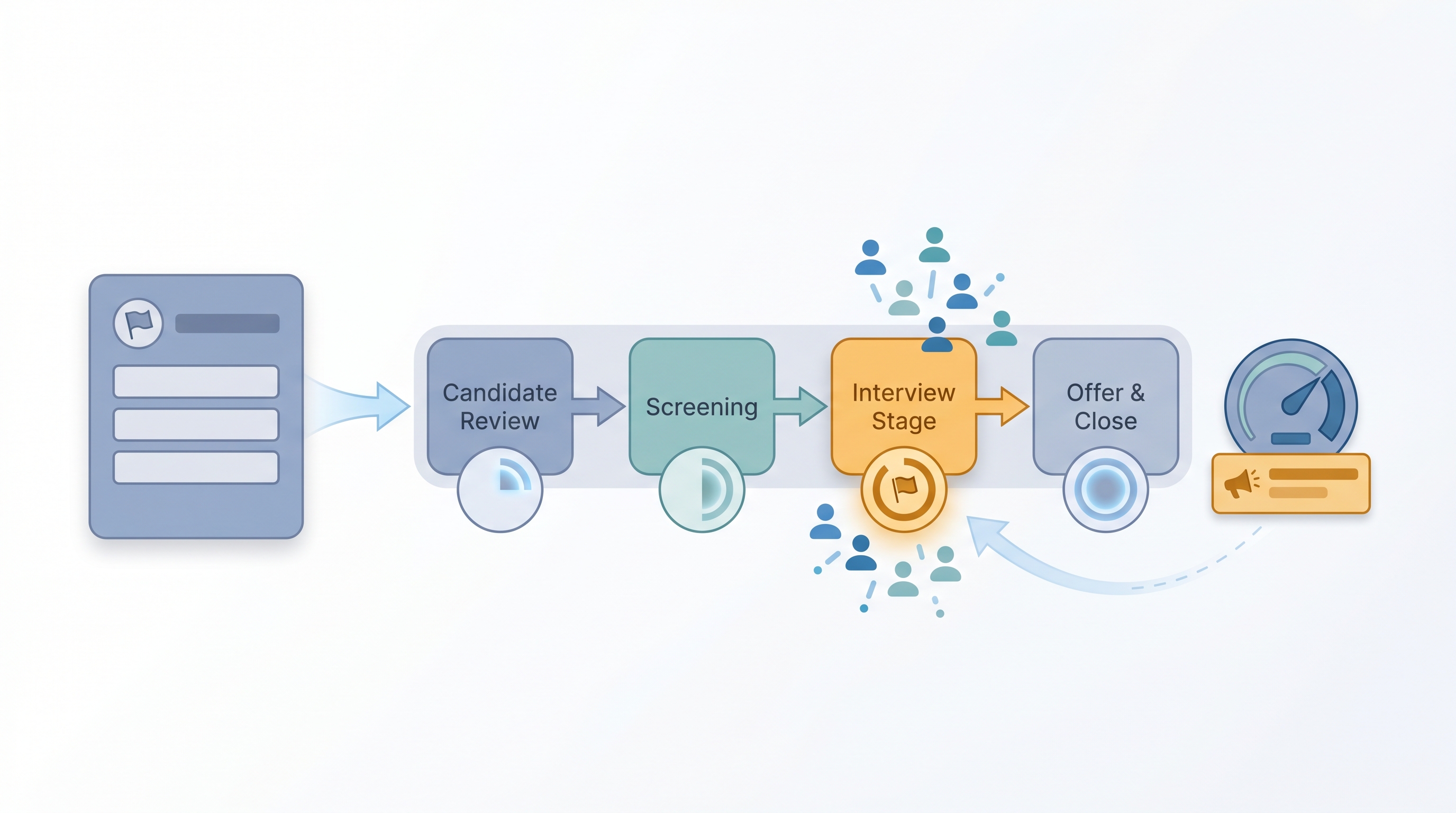
Funnel velocity measures how fast candidates move through each stage of the hiring pipeline, from first sourced or applied through to offer accepted. It differs from tracking volume or conversion alone by combining two dimensions: how many candidates advance and how many days it takes them to do so.
A recruiter might be advancing 50 percent of screened candidates to final interviews, which looks healthy in a conversion report. But if those candidates are sitting 14 days in each stage while the market closes other opportunities, conversion rate is misleading. Funnel velocity catches that mismatch.
The practical question it answers is not "are we converting?" but "are we converting fast enough that the right candidates are still available when we want to move?"
In practice
- A TA lead pulls weekly ATS data and finds the phone screen stage converts 45 percent of applications but the median cycle time has grown from four days to nine days over six weeks. That shift is the signal: screening capacity is not keeping up with application volume. No criteria change needed, just recruiter bandwidth.
- After a candidate declines an offer citing another company's faster process, the recruiting ops team maps the end-to-end funnel and discovers the debrief-to-decision stage averaged 11 business days last quarter. They set a 48-hour feedback-filing SLA for panel interviewers and velocity improves measurably within a month.
- During a AI Sourcing Lab session, a team models their funnel in a shared spreadsheet and spots that 60 percent of sourced candidates spend more than a week in "sourced but not contacted" before outreach fires. That lag, invisible until mapped, was the biggest contributor to their time-to-fill.
Quick read, then how hiring teams use it
This is for recruiters, TA leads, TA ops, and HR partners who need shared vocabulary in pipeline reviews, operations debriefs, and vendor evaluations. Skim the first section for a fast shared picture. Use the second when configuring dashboards or setting stage-level SLAs.
Plain-language summary
- What it means for you: Funnel velocity answers "how fast are we moving candidates?" at each stage, so you can catch a slow stage before it causes a dropout rather than after the candidate accepts another offer.
- How you would use it: Pick your most critical stages (usually sourced-to-screened and interview-to-decision) and track median days week over week. When a stage grows by more than 50 percent, investigate before moving on.
- How to get started: Pull last month of ATS data and calculate median days per stage for all active reqs. If your ATS does not expose this, flag it as a reporting gap and proxy with a weekly manual count.
- When it is a good time: Before increasing AI-assisted outreach volume, and after any hiring team capacity change, so you have a baseline to compare against.
When you are running live reqs and tools
- What it means for you: Funnel velocity tells you whether your ATS, scheduling, and screening tooling is compressing cycle time or hiding it. A stage that used to take three days but now takes eight after adopting a new tool is a tooling failure, not a sourcing failure.
- When it is a good time: Weekly during pipeline reviews; immediately after any process or tooling change; and at the 30-day mark of any new req to catch early stall patterns.
- How to use it: Configure your applicant tracking software to surface median days per stage alongside volume. Set amber and red thresholds per stage type and assign ownership of each threshold breach.
- How to get started: Start with two stages that matter most for your current mix of reqs. Add stages as your team builds the habit of reviewing the data. Avoid building a full dashboard before anyone is using a partial one.
- What to watch for: Cycle time improving while conversion drops, which means candidates are moving faster but fewer are qualifying. Both dimensions need to hold or you are trading one problem for another.
Where we talk about this
On AI with Michal live sessions, funnel velocity comes up in AI in recruiting blocks as the operational metric beneath time-to-fill that makes bottleneck conversations specific rather than general. Sourcing automation tracks use velocity data to calibrate how AI tools change pipeline flow in practice, not just in demos. Full room conversation at Sourcing Lab.
Around the web (opinions and rabbit holes)
Third-party creators move fast. Treat these as starting points, not endorsements, and double-check anything before you wire candidate data.
YouTube
- Recruiting Metrics and KPIs You Need to Track (AIHR) covers stage-level pipeline reporting and which speed metrics TA leaders surface to business partners.
- How to Analyze Your Hiring Funnel (Greenhouse) walks through cycle time reporting and how to identify which interview stage contributes most to overall time-to-fill.
- Talent Acquisition Metrics That Drive Decisions (SHRM) explains how velocity trends inside your own data outperform industry benchmarks for diagnosing where process is breaking down.
- What recruiting metrics do you report to leadership? in r/recruiting has candid practitioner responses about which funnel numbers drive decisions versus which stay in dashboards nobody reads.
- How do you track candidates through the pipeline? in r/recruiting discusses stage-by-stage tracking approaches from teams at different scales and ATS configurations.
- What contributes to long time to hire? in r/TalentAcquisition includes discussion on which cycle time stages are hardest to compress and what process changes helped.
Quora
- How do you measure the efficiency of a hiring process? collects practitioner views on funnel timing and which stage metrics TA leaders track to diagnose where process breaks down (read critically for context).
Funnel velocity versus related hiring metrics
| Metric | What it measures | When it warns you |
|---|---|---|
| Time to fill | Total days req open to offer accepted | Process is too slow overall |
| Funnel velocity | Cycle time per stage, not just total | Which specific stage is the drag |
| Stage conversion rate | Percentage of candidates advancing | Too many dropping, not about speed |
| Pipeline coverage | Candidate volume per stage vs. target | Not enough pipeline to sustain offers |
Related on this site
- Glossary: Time to fill, Hiring funnel conversion rates, Time in stage reporting, Weekly hiring funnel report, Pipeline coverage reporting, Sourcing funnel metrics, Funnel drop-off analysis, Stage conversion hiring funnel
- Tools: Applicant tracking software
- Course: Starting with AI: the foundations in recruiting
- Live cohort: Sourcing Lab
- Membership: Become a member